
Why Use a Steel Flat Flange Instead of Other Flange Types
2025-12-23
In the complex world of piping and fluid systems, selecting the right flange is critical for safety, performance, and cost-efficiency. Among the various options available, the Steel Flat Flange stands out for specific, crucial applications. At Wenzhou Longan, with decades of expertise in manufacturing high-quality pipeline components, we understand the nuanced advantages this type of flange offers. This article explores the key reasons to choose a flat face flange over alternatives like raised face (RF) or ring-type joint (RTJ) flanges.
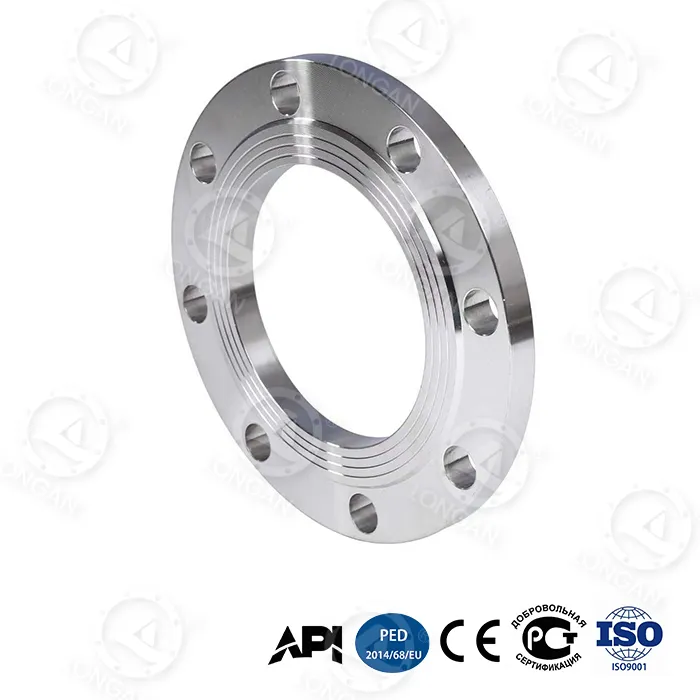
The primary advantage of a Steel Flat Flange is its full-face contact design. The flat, smooth surface mates perfectly with another flat face or a flat gasket. This design is inherently safer and more effective in specific scenarios:
-
For Low-Pressure Applications: Ideal for low-pressure systems where a simple, reliable seal is sufficient.
-
With Non-Metallic Gaskets: The flat surface provides excellent, even compression for materials like rubber, Teflon, or compressed non-asbestos fiber (CNAF) gaskets.
-
Preventing Over-Pressure: In connections involving cast iron, ductile iron, or plastic components, a flat face prevents the concentrated stress that a raised face could cause, thereby protecting brittle materials from cracking.
Flat Flange vs. Raised Face Flange: A Quick Comparison
| Feature | Steel Flat Flange (FF) | Raised Face Flange (RF) |
|---|---|---|
| Face Surface | Flat, level across the entire face. | Has a raised ring around the bore. |
| Gasket Type | Full-face gasket. | Ring-type gasket that sits inside the raised area. |
| Ideal Pressure | Low to moderate pressure. | Moderate to high pressure. |
| Material Compatibility | Excellent with cast iron, plastic, and softer materials. | Standard for carbon and stainless steel systems. |
Steel Flat Flange FAQ
Q: Can a Steel Flat Flange be bolted to a Raised Face Flange?
A: It is strongly discouraged. Mating a flat face with a raised face creates an improper seal. The contact will only occur on the raised ring’s outer edge, leading to excessive stress on the gasket and a very high probability of leakage and joint failure.
Q: Are Steel Flat Flanges suitable for high-temperature services?
A: Their suitability depends on the gasket material. While the Steel Flat Flange itself (e.g., ASTM A105) handles heat well, the full-face non-metallic gaskets often used with them have lower temperature limits. For high-temperature service, specialized flat metal gaskets are required, and the design must be carefully evaluated by an engineer.
Q: How do I ensure a leak-proof connection with a Flat Face Flange?
A: Achieving a leak-proof seal requires three key steps: First, use a full-face gasket that matches the bolt hole pattern. Second, ensure both flange faces are clean, smooth, and undamaged. Third, follow a proper bolting sequence (criss-cross pattern) and torque the bolts evenly and gradually to the specified value to compress the gasket uniformly across the entire face.
Understanding the correct application of a Steel Flat Flange is key to building a safe and durable piping system. Its design offers simplicity, safety for brittle materials, and effective sealing where full-face gaskets are preferred. For projects requiring reliable, specification-compliant flanges, choosing a trusted manufacturer is paramount.
At Wenzhou Longan, we specialize in producing precision-engineered Steel Flat Flanges that meet international standards. Our commitment to quality ensures your connections are secure and long-lasting. Contact us today with your project specifications or to request a quote for your next piping requirement. Let our expertise be the foundation of your system's integrity.