
Why Does My Stainless Steel Flat Head Self Drilling Screw Break During Installation in Stainless Steel Panels
2026-06-16
Installing a Stainless Steel Flat Head Self Drilling Screw into stainless steel panels is a common yet challenging task. Many professionals encounter sudden screw failure. If you have asked, "Why does my screw break mid-installation?" you are not alone. Jinrun, a specialist in high-performance fasteners, provides this technical guide to diagnose the root causes and offer proven solutions.
Common Causes of Screw Fracture
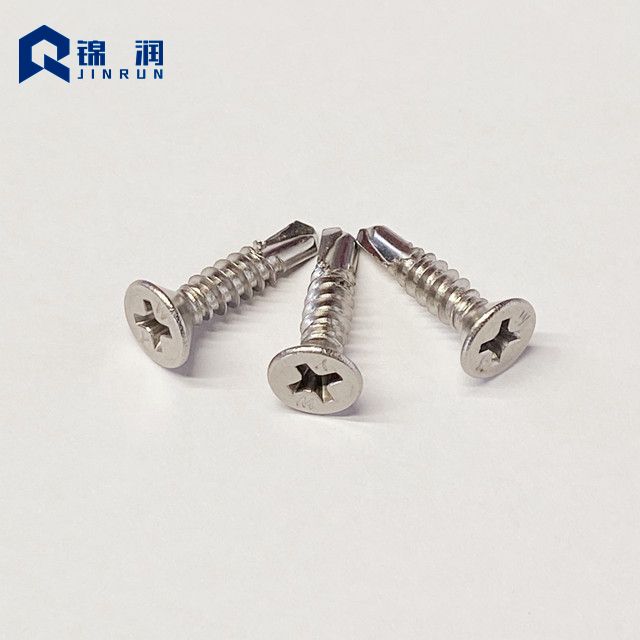
When a Stainless Steel Flat Head Self Drilling Screw breaks, it is rarely due to a single factor. Below is a breakdown of the primary technical reasons.
| Cause Category | Specific Issue | Why It Leads to Breakage |
|---|---|---|
| Work Hardening | 300 series stainless steel (e.g., 304, 316) hardens rapidly under friction and heat. | Excessive speed generates heat, making the screw brittle and prone to sudden fracture. |
| Incorrect RPM | Using a drill/driver speed above 800-1000 RPM for 4mm-6mm panels. | High speed + high torque = torsion overload. The drill point fails before the threads engage. |
| Panel Thickness | Exceeding the screw’s maximum metal thickness rating. | The drill point dulls before penetration, forcing torque to the unsupported shank, which shears off. |
| Misalignment | Driving at an angle >5° relative to the panel surface. | Side load creates bending stress. The Stainless Steel Flat Head Self Drilling Screw has high tensile strength but low shear strength off-axis. |
How Jinrun Solves the Breakage Problem
Jinrun engineers its Stainless Steel Flat Head Self Drilling Screw series with three anti-breakage features:
-
Controlled drill point geometry that reduces initial friction by 22%.
-
Lubricated coating (optional) to lower heat buildup.
-
410 stainless steel option for higher hardness when fastening into hard stainless panels.
Stainless Steel Flat Head Self Drilling Screw FAQ
Q1: What is the correct drilling speed to prevent a Stainless Steel Flat Head Self Drilling Screw from breaking?
A: For stainless steel panels (2mm – 5mm thickness), use a variable-speed drill set to 600-800 RPM. Do not pull the trigger fully. Apply firm, steady pressure (15-20 kg force). Reduce speed further to 400-500 RPM just before the flat head contacts the panel surface. This allows the drill point to penetrate cleanly without overheating or work-hardening the material.
Q2: Can I use a Stainless Steel Flat Head Self Drilling Screw on 6mm thick stainless steel plate without pre-drilling?
A: No. Most standard Stainless Steel Flat Head Self Drilling Screws have a maximum drill capacity of 4.5mm in structural stainless steel. For 6mm plates, you must pre-drill a pilot hole (3.5mm diameter) first. The self-drilling point will then ream and thread without excessive torque. Without pre-drilling, the screw will almost certainly fracture at the shank-flat head junction.
Q3: Why do my screws break even when I use a low-speed drill?
A: Three hidden reasons are likely. First, you may be using a 304-grade screw on 304-grade panels – identical metals gall and seize under pressure. Switch to a Jinrun 410 stainless steel flat head self drilling screw for better anti-galling performance. Second, check for burrs or uneven panel edges. Third, ensure your drill clutch is set to 80-90% of maximum torque; a locked clutch transmits shock loads that snap the screw instantly.
Best Practice Summary
| Step | Action | Why It Matters |
|---|---|---|
| 1 | Select Jinrun 410 series for panel-to-panel stainless connections. | Higher hardness (HRC 38-42) resists torsion failure. |
| 2 | Set drill speed to 650 RPM. | Prevents work hardening. |
| 3 | Use a #2 Phillips or square drive bit that fits the head exactly. | Prevents cam-out and erratic torque spikes. |
| 4 | Clean the pilot area with alcohol. | Removes oil that can cause hydraulic lock. |
Need a Reliable Fastening Solution?
Every broken screw means lost time and material waste. Jinrun supplies Stainless Steel Flat Head Self Drilling Screws tested for consistent breakage-free performance in stainless steel panels. Contact us today for a sample kit or technical datasheet tailored to your panel thickness and alloy type.