
Why Do Standard Punches with Coatings Improve Stamping Performance?
2026-09-30
In modern stamping and die manufacturing, punch performance directly affects dimensional accuracy, production consistency, tool life, and maintenance frequency. As production volumes increase and manufacturers process harder or more demanding materials, conventional uncoated punches may face accelerated wear, friction, adhesion, and surface damage. Standard Punches with Coatings provide a practical solution by combining standardized punch dimensions with an engineered surface treatment designed to improve working performance. For manufacturers looking for reliable die components, Dongguan Luckyear Precision Mold Parts Co., Ltd. provides coated standard punch solutions for different tooling requirements and industrial applications.
What Are Standard Punches with Coatings?
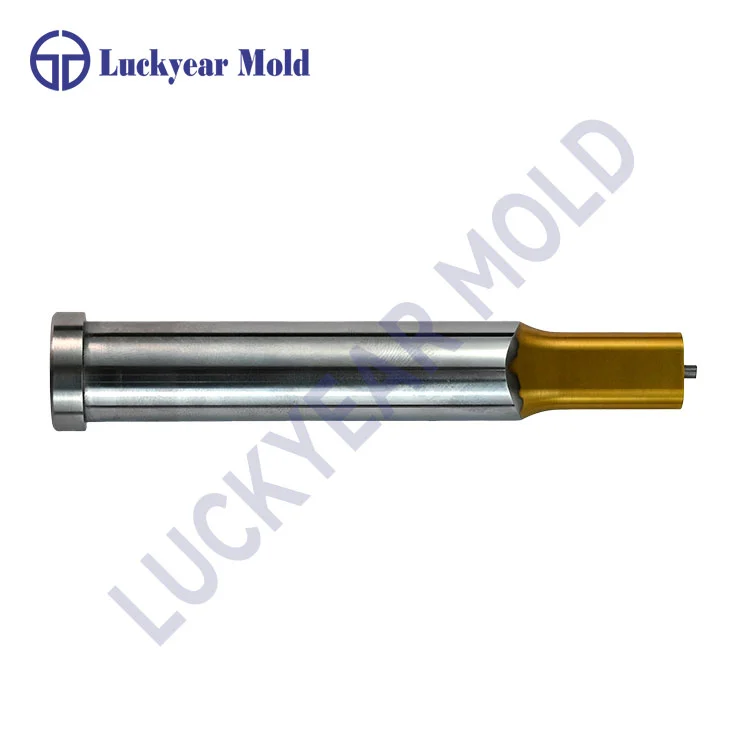
Standard Punches with Coatings are precision punch components manufactured according to commonly used tooling standards and enhanced with a functional surface coating. The basic punch provides the required geometry, dimensions, hardness, and dimensional accuracy, while the coating modifies the working surface to improve resistance against wear and friction.
Depending on the application, coating options can include TiN, TiCN, TiAlN, CrN, AlCrN, Altin, DLC, and other surface treatments. The appropriate choice depends on factors such as workpiece material, stamping speed, operating temperature, lubrication conditions, and required service life.
The combination of standardized dimensions and specialized surface treatment makes coated punches particularly useful when manufacturers need dependable tooling without developing a completely customized component for every application.
Why Is Coating Important for Punch Performance?
During stamping, the punch repeatedly enters and exits the die while applying substantial mechanical force to the workpiece. Continuous contact creates friction and can gradually cause wear on the punch tip and working surface.
A suitable coating can provide several important functions:
-
Reduce surface friction: A low-friction surface can help reduce resistance during repeated punching operations.
-
Improve wear resistance: Coated surfaces can provide additional protection against abrasive and adhesive wear.
-
Support dimensional stability: Reduced wear helps the punch maintain its designed geometry for longer periods.
-
Improve production consistency: A more stable punch condition can contribute to consistent hole dimensions and part quality.
-
Extend maintenance intervals: Slower surface deterioration can reduce the frequency of punch replacement or servicing.
-
Support demanding applications: Certain coatings are designed for applications involving high-speed operation, harder materials, or elevated working temperatures.
These benefits are especially valuable for manufacturers operating continuous production lines where unexpected tooling wear can increase downtime and affect delivery schedules.
Standard Punches vs. Standard Punches with Coatings
| Feature | Standard Punches | Standard Punches with Coatings |
|---|---|---|
| Basic tooling function | Precision punching | Precision punching |
| Surface protection | Depends mainly on base material | Enhanced through surface treatment |
| Friction control | Standard | Improved depending on coating |
| Wear resistance | Material-dependent | Enhanced surface resistance |
| Service requirements | Regular inspection | Potentially longer service intervals |
| Suitable applications | General stamping | General and more demanding stamping |
The choice should not simply be based on whether a punch is coated. Instead, manufacturers should consider the complete working environment and select a coating that matches the application.
What Effects Can Coated Punches Deliver?
The practical value of Standard Punches with Coatings can be seen throughout the production process. When the coating is correctly matched to the application, the punch surface can better withstand repeated contact and mechanical stress.
For high-volume stamping, this can help maintain stable punching performance over extended production cycles. For precision tooling, maintaining the punch's working geometry is particularly important because even relatively small amounts of wear can influence hole size, edge quality, burr formation, and overall dimensional consistency.
Coated punches can also support more efficient tooling management. Instead of focusing only on the initial purchase price, manufacturers can evaluate the complete operating cost, including replacement frequency, maintenance labor, machine downtime, and rejected parts.
Where Are Standard Punches with Coatings Used?
Coated standard punches can be applied across a wide range of manufacturing environments, including:
-
Metal stamping – Used for punching and forming sheet-metal components.
-
Automotive components – Suitable for tooling used in high-volume component production.
-
Electronics manufacturing – Useful where precise and repeatable holes or shapes are required.
-
Hardware production – Supports repetitive punching operations for various metal parts.
-
Precision die manufacturing – Helps tooling manufacturers achieve stable performance from standardized components.
-
High-volume production – Particularly useful where tool wear and replacement frequency influence production efficiency.
The actual coating and punch material should be selected according to the specific application rather than applying the same treatment to every production environment.
How Does Luckyear Support Coated Punch Requirements?
Dongguan Luckyear Precision Mold Parts Co., Ltd. specializes in precision die and mold components and has developed experience in producing standard and customized tooling parts. The company works with international standards and systems including MISUMI, DAYTON, LANE, FIBRO, MDL, DME, HASCO and other commonly used specifications. Its manufacturing capabilities include precision grinding, CNC machining, wire cutting, EDM, and inspection equipment for dimensional and quality control.
For coated punch applications, material and surface treatment can be selected according to customer requirements. Luckyear lists coating options such as TiN, TiCN, TiAlN, CrN, AlCrN, Altin and DLC, while its standard punch product range includes different punch configurations for press die applications.
The company also supports customized or special mold parts based on customer drawings or samples, allowing buyers to address applications that cannot be solved by standard dimensions alone.
How Should Buyers Select the Right Coated Punch?
Before purchasing Standard Punches with Coatings, buyers should confirm several technical factors:
-
Punch standard and dimensions
-
Base material and required hardness
-
Workpiece material
-
Punching speed and production volume
-
Required tolerance and surface finish
-
Operating temperature
-
Lubrication conditions
-
Suitable coating type
-
Expected service life
-
Replacement and delivery requirements
A professional supplier can help match the punch specification and coating to the actual production environment rather than recommending a one-size-fits-all solution.
Conclusion
Standard Punches with Coatings combine the convenience of standardized tooling with the performance advantages of engineered surface treatments. By helping control friction, resist surface wear, maintain dimensional stability, and support consistent production, coated punches can become an important component in modern stamping and die manufacturing.
For manufacturers seeking precision die components, Dongguan Luckyear Precision Mold Parts Co., Ltd. offers standard punches, coated punches, precision mold components, and customized tooling solutions designed around different production requirements. With experienced manufacturing capabilities and support for international tooling standards, Luckyear can provide practical solutions for both routine and demanding applications.
If you are looking for reliable Standard Punches with Coatings for your stamping or die manufacturing project, contact us to discuss your required dimensions, material, coating, tolerance, and application requirements.