
Which Facing Type Works Best with a 304 Neck Butt Welding Flange in High-Pressure Pipelines
2026-06-29
Selecting the correct facing type for a 304 Neck Butt Welding Flange is not a trivial decision—it directly impacts seal integrity, bolt load distribution, and long-term service life in high-pressure systems. For engineers and procurement specialists working with critical pipelines, the wrong facing choice can lead to costly leaks, unplanned shutdowns, or even catastrophic failures. At Longan, we have supplied thousands of 304 Neck Butt Welding Flange units across oil, gas, chemical, and power generation projects, and we consistently observe that facing selection ranks among the most misunderstood technical parameters. This blog post breaks down the performance of each facing type under high-pressure conditions, provides data-driven comparisons, and offers clear guidance to help you specify the right solution for your application.
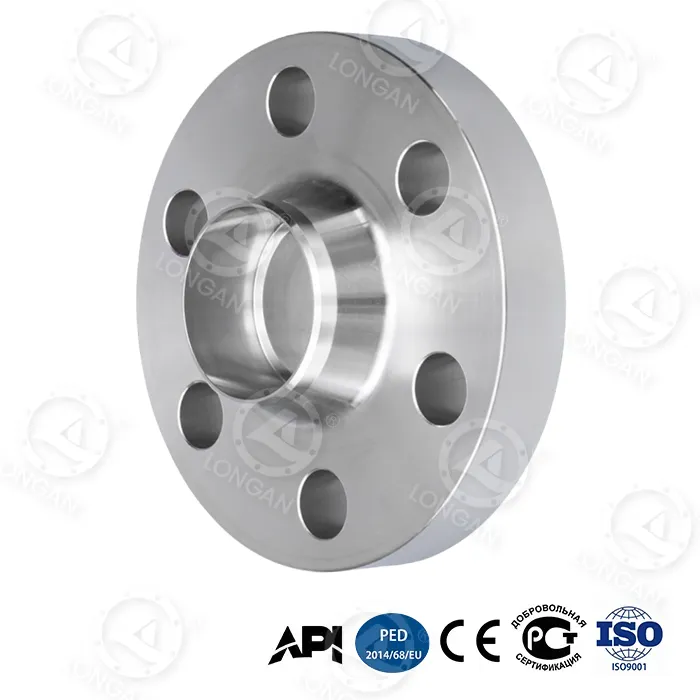
Common Facing Types for Weld Neck Flanges
The raised face (RF), flat face (FF), and ring-type joint (RTJ) are the three primary facing styles available for a 304 Neck Butt Welding Flange. Each design serves a distinct sealing mechanism and operates within different pressure-temperature envelopes. Below is a functional comparison:
| Facing Type | Seal Mechanism | Typical Pressure Range | Gasket Compatibility | Reusability |
|---|---|---|---|---|
| Raised Face (RF) | Compressed soft/steel gasket | Up to Class 900 | Spiral wound, sheet, or kammprofile | Moderate |
| Flat Face (FF) | Full-face gasket compression | Up to Class 150 | Full-face soft gaskets | Low |
| Ring-Type Joint (RTJ) | Metal-to-metal interference fit | Class 900 to Class 2500+ | Oval/octagonal metal rings | High (with ring replacement) |
Why RTJ Dominates High-Pressure Service
For high-pressure pipelines—typically defined as systems operating above 10 MPa (1,500 psi)—the RTJ facing consistently outperforms both RF and FF designs. The RTJ configuration employs a machined groove that accepts a deformable metal ring. When bolted, the ring compresses against the groove walls, creating a leak-tight seal that relies on material hardness rather than gasket crush resistance. This makes the 304 Neck Butt Welding Flange with RTJ facing exceptionally reliable in fluctuating thermal cycles and vibration-prone environments.
Longan recommends RTJ for any 304 Neck Butt Welding Flange specified in sour service, hydrogen, or superheated steam lines where gasket degradation is a known failure mode. In contrast, the raised face design, while simpler and more cost-effective, depends heavily on gasket quality and bolt torque precision—factors that introduce variability in high-stress startups.
Pressure–Temperature Limitations
The following table illustrates the recommended maximum working pressures for a 304 Neck Butt Welding Flange with each facing type at 200°C (based on ASME B16.5 Group 2.2 materials):
| Facing Type | Class 150 (psi) | Class 300 (psi) | Class 600 (psi) | Class 900 (psi) | Class 1500 (psi) |
|---|---|---|---|---|---|
| RF | 275 | 720 | 1,440 | 2,160 | 3,600 |
| FF | 275 | Not recommended | Not recommended | Not recommended | Not recommended |
| RTJ | 275 | 720 | 1,440 | 2,160 | 3,600 (up to 6,000 with special rings) |
While RF and RTJ share identical pressure ratings by class, the RTJ maintains higher leak-tightness integrity during rapid depressurization events—a critical advantage that Longan engineers emphasize during project consultations.
Bolt Load and Gasket Selection Trade-offs
RF facings require higher bolt preload to compress the gasket, which increases flange rotation risk in thin sections. RTJ facings, by contrast, achieve sealing through radial interference with lower overall bolt stress, preserving flange alignment. For a 304 Neck Butt Welding Flange, the 304 material’s moderate yield strength (≈205 MPa) means that excessive bolt loading on an RF face can cause yielding at the hub-to-ring junction. Longan advises using RTJ for any design pressure exceeding Class 600 unless your gasket supplier provides validated spiral-wound data for the specific service fluid.
Frequently Asked Questions About the 304 Neck Butt Welding Flange
Q1: Can a raised face 304 Neck Butt Welding Flange be used with an RTJ gasket in an emergency?
A1: No—this is a dangerous mismatch. An RTJ gasket requires a machined groove with specific angle and depth tolerances (typically 23° for octagonal rings). Placing an RTJ ring on a raised face will create point loading, insufficient groove engagement, and immediate leakage upon pressurization. If your existing 304 Neck Butt Welding Flange has an RF facing and you need RTJ performance, you must replace the flange with a proper RTJ-faced component. Longan offers direct RTJ replacements with identical bore and hub dimensions to minimize pipe rework.
Q2: What is the most cost-effective facing type for a 304 Neck Butt Welding Flange in a 5,000 psi natural gas pipeline?
A2: The RTJ facing is the only economically viable choice. Although RTJ flanges cost 15–25% more than RF equivalents upfront, they eliminate the need for expensive specialty gaskets (e.g., graphite-filled kammprofile) that would require replacement at every maintenance cycle. Over a 10-year lifecycle, Longan’s project data shows RTJ reduces total sealing cost by approximately 40% in high-pressure gas service due to longer ring life and fewer torque re-tightening events.
Q3: Does the facing type affect the NDT (non-destructive testing) requirements for a 304 Neck Butt Welding Flange?
A3: Yes, indirectly. RTJ grooves require additional dimensional inspection—specifically, profilometer readings of the groove surface finish (≤ 63 µin Ra) and a go/no-go ring gauge test. RF facings only require visual and dye-penetrant checks on the gasket sealing area. For critical high-pressure systems, Longan performs full volumetric ultrasonic testing on all RTJ-faced 304 Neck Butt Welding Flange units to verify groove integrity after machining, as any subsurface porosity in the groove area can propagate under cyclic pressure loading.
Final Recommendation for Specification Engineers
For any high-pressure pipeline exceeding Class 600 or operating above 200°C with cyclic startup/shutdown, the RTJ facing is the definitive best match for a 304 Neck Butt Welding Flange. The raised face remains acceptable for moderate pressures (Class 300 and below) where gasket replacement is routine and cost-sensitive. The flat face should be avoided entirely in high-pressure systems due to its reliance on low-stiffness full-face gaskets that extrude under high bolt loads.
Longan maintains an extensive inventory of 304 Neck Butt Welding Flange products in RF, FF, and RTJ configurations, all certified to ASME B16.5 and NACE MR0175 for sour service. Our in-house metallurgical lab verifies each batch's chemical composition and grain size to ensure consistent performance across all facing types.
Contact Us
Choosing the correct facing type for your 304 Neck Butt Welding Flange is just the first step—proper material certification, hub dimension verification, and torque procedure documentation are equally critical. At Longan, we provide end-to-end technical support, from flange selection through installation monitoring. If you are currently specifying a 304 Neck Butt Welding Flange for a high-pressure project, request our free facing selection worksheet and pressure-temperature rating chart. Contact Longan today through our website or email our engineering team directly—we respond to all technical inquiries within 4 business hours with detailed, project-specific recommendations. Let us help you seal your pipeline with confidence.