
What Standards and Certifications Should a 180 Degree Stainless Steel Elbow For Industrial System Meet
2026-07-06
When sourcing critical piping components for heavy-duty operations, procurement engineers and project managers often ask one fundamental question: What guarantees that this fitting will perform safely under extreme conditions? For a 180 Degree Stainless Steel Elbow For Industrial System, the answer lies in a complex web of international standards, material certifications, and rigorous testing protocols. At HengDi, we understand that compliance is not merely a bureaucratic checkbox—it is the backbone of system reliability, worker safety, and long-term operational cost control. This guide breaks down the mandatory certifications, material grades, and quality benchmarks that every buyer must verify before installation.
Why Standards Matter for a 180 Degree Stainless Steel Elbow For Industrial System
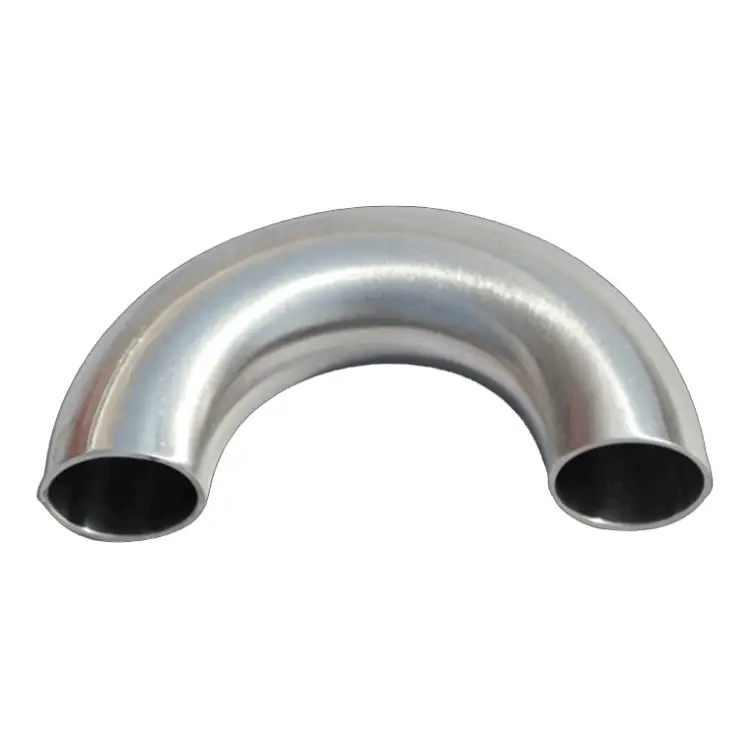
A 180 Degree Stainless Steel Elbow For Industrial System reverses flow direction completely, subjecting the material to extreme stress from pressure surges, thermal expansion, and corrosive media. Without unified standards, dimensional mismatches cause leaks, while substandard alloys fail under fatigue. Recognized standards ensure interchangeability, predictable mechanical properties, and auditable traceability from melt shop to project site. For global supply chains, certifications also simplify customs clearance and insurance approvals.
Core Standards Governing Dimensions & Tolerances
The geometric integrity of a 180 Degree Stainless Steel Elbow For Industrial System is defined by two primary families of standards:
| Standard | Scope | Key Requirement |
|---|---|---|
| ASME B16.9 | Factory-made wrought butt-welding fittings | Center-to-center radius, wall thickness, bevel end dimensions |
| EN 10253 | European series of butt-welding pipe fittings | Type A (equal) and Type B (reduced) dimensional rules |
| ISO 3419 | Non-alloy and alloy steel fittings | Pressure-temperature ratings and tolerance classes |
HengDi produces all 180 Degree Stainless Steel Elbow For Industrial System units strictly to ASME B16.9 Class 3000 and 6000, with optional EN 10253-4 compliance for EU projects.
Material Certifications – Traceability from Coil to Finished Part
Beyond dimensions, the chemical composition and mechanical strength must be proven. Reputable manufacturers provide these mandatory documents:
| Certification Type | What It Proves | Applicable Standard |
|---|---|---|
| 3.1 Mill Test Certificate (EN 10204) | Chemical analysis & tensile results from the producing mill | EN 10204 Type 3.1 |
| 3.2 Inspection Certificate | Independent third-party verification | EN 10204 Type 3.2 (required for pressure equipment) |
| NACE MR0175 / ISO 15156 | Suitability for sour service (H₂S environments) | NACE International |
| PED 2014/68/EU | Conformity with European Pressure Equipment Directive | EU Regulation |
For critical offshore or chemical projects, HengDi offers full 3.2 certification with witnessed testing by DNV or BV, ensuring your 180 Degree Stainless Steel Elbow For Industrial System meets the most stringent sour-service conditions.
Hydrostatic & Nondestructive Testing (NDT) Requirements
A certified 180 Degree Stainless Steel Elbow For Industrial System must survive proof tests that simulate decades of service. Mandatory examinations include:
-
Hydrostatic Test: Each unit is pressurized to 1.5× the design pressure for a minimum hold time, with zero visible leakage.
-
Radiographic (RT) or Ultrasonic (UT) Examination: 100% volumetric inspection for laminations, porosity, or inclusions—particularly at the intrados (inner bend), where thinning is most severe.
-
Dye Penetrant (PT) / Magnetic Particle (MT): Surface crack detection on all welded seams and end bevels.
HengDi integrates automated UT arrays into our production line, delivering real-time wall-thickness mapping for every 180 Degree Stainless Steel Elbow For Industrial System—far exceeding the minimum spot-check requirements of ASME B31.3.
Grade Selection – 304/L vs. 316/L vs. Duplex
The standard itself does not dictate material grade—that decision depends on your fluid chemistry. However, the certification must clearly state the UNS designation:
| Grade (UNS) | Best For | Certification Marking |
|---|---|---|
| 304/304L (S30400/S30403) | General-purpose, non-saline, moderate temperatures | ASTM A403 WP304L |
| 316/316L (S31600/S31603) | Chloride-bearing media, marine, pharmaceutical | ASTM A403 WP316L |
| 2205 Duplex (S32205) | High-chloride, high-stress, sour gas | ASTM A815 UNS S32205 |
HengDi stocks all three grades with full traceability, and our technical team can guide you toward the optimal metallurgy for your specific pH and temperature window.
FAQ – Common Questions About 180 Degree Stainless Steel Elbow For Industrial System
Q1: Is a hydrostatic test mandatory for every 180 Degree Stainless Steel Elbow For Industrial System, or can it be waived for small sizes?
A1: Under ASME B31.3 and most international pressure piping codes, hydrostatic testing is not optional for new fabrication—regardless of size. However, for fittings NPS 2 and below, some manufacturers may substitute a pneumatic test at lower pressure, but this requires explicit customer approval and risk assessment. HengDi performs hydrostatic testing on 100% of our 180 Degree Stainless Steel Elbow For Industrial System units up to NPS 24, with digital records retained for 10 years. Waivers are only accepted for non-pressure utility lines where the client provides a formal deviation in writing.
Q2: How can I verify that the 180 Degree Stainless Steel Elbow For Industrial System I receive matches the certified material grade?
A2: Two independent checks are recommended. First, inspect the permanent stencil markings on the fitting body—they must include the manufacturer’s name (or trademark), material grade (e.g., WP316L), schedule number, and heat number. Second, cross-reference the heat number on the physical part with the accompanying 3.1 or 3.2 mill certificate; the chemical analysis (C, Mn, P, S, Si, Cr, Ni, Mo) must fall within ASTM specified ranges. For high-stakes projects, HengDi recommends performing a positive material identification (PMI) test using an XRF gun upon receipt—we can even arrange third-party PMI at our warehouse prior to dispatch.
Q3: Does a 180 Degree Stainless Steel Elbow For Industrial System require re-certification after field welding or modification?
A3: Yes—and this is frequently overlooked. The base fitting carries a factory certification for the as-supplied condition (solution-annealed and pickled). Once you weld the elbow into your piping spool, the heat-affected zone (HAZ) undergoes metallurgical changes. Post-weld, you must perform: (a) a final hydrostatic test on the assembled spool, (b) hardness testing (max HRC 22 for sour service per NACE), and (c) if the fitting was solution-annealed, ensure your welding procedure maintains the minimum required corrosion resistance. HengDi provides weld procedure qualification records (PQR) upon request to help you plan your post-weld heat treatment (PWHT) strategy.
Final Checklist Before Purchase
Before issuing your purchase order, confirm that your supplier provides:
-
ASME/EN/ISO dimensional compliance report
-
EN 10204 Type 3.1 or 3.2 mill certificate (with heat-to-heat traceability)
-
NDT records (RT/UT/PT) with film or digital storage
-
Hydrostatic test pressure and hold-time documentation
-
Material grade stenciling per MSS SP-25
-
NACE MR0175 certification if applicable
Why Partner with HengDi for Your Critical Piping Needs
For over 15 years, HengDi has supplied certified 180 Degree Stainless Steel Elbow For Industrial System solutions to oil refineries, chemical plants, power stations, and shipbuilding yards across 40+ countries. Our in-house metallurgical lab, DNV-approved NDT technicians, and real-time digital traceability platform ensure that every fitting leaves our factory with complete, auditable paperwork—no gaps, no guesswork.
We do not outsource testing or certification; we control every step from billet inspection to final packaging. This vertical integration allows HengDi to offer lead times as short as 14 days for standard schedules, with full compliance packages delivered electronically 48 hours before shipment.
Contact Us Today
Specifying the correct 180 Degree Stainless Steel Elbow For Industrial System is only half the battle—ensuring it arrives with genuine, verifiable certifications is the other half. Do not leave system integrity to chance. Contact HengDi now to request a compliance dossier, request a sample PMI report, or discuss your project’s unique pressure-temperature requirements. Our engineering team responds within 4 business hours with grade recommendations, certification samples, and firm delivery dates.