
What Size Phillips Countersunk Flat Head Chipboard Screw Should I Use for 18mm Plywood
2026-06-26
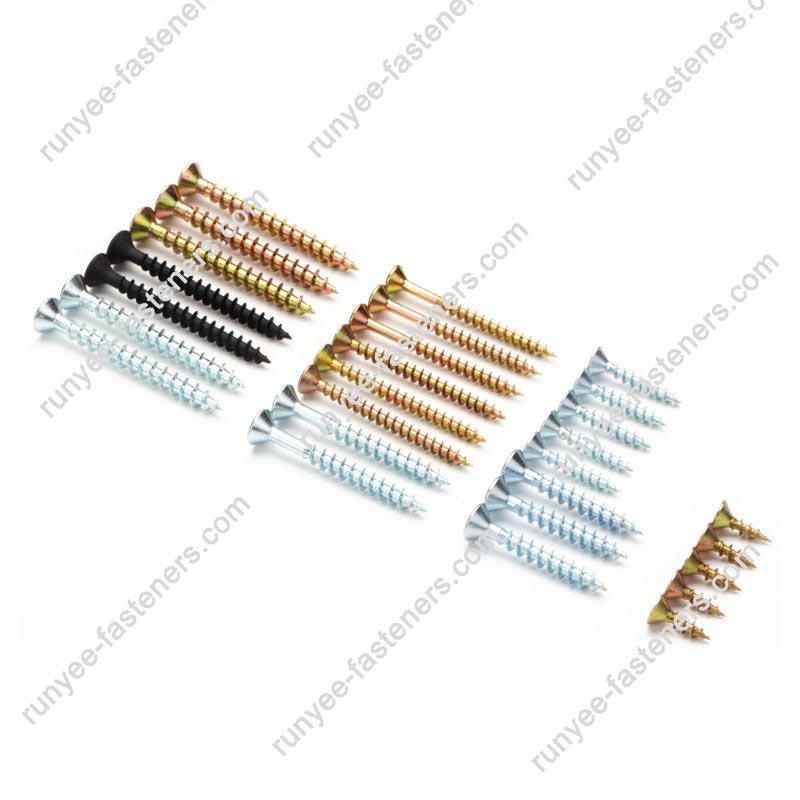
Selecting the correct fastener for 18mm plywood is not a guessing game. The wrong choice leads to split wood, stripped heads, or joints that fail under load. For professional cabinetmakers, furniture builders, and DIY enthusiasts, the Phillips Countersunk Flat Head Chipboard Screw remains a top choice due to its self-centering drive and flush-finish head. However, size selection depends on material thickness, pilot hole strategy, and application stress. This guide provides data-driven answers, and we at Runyee have engineered our fasteners to meet these exact specifications.
The Golden Rule for Screw Length in 18mm Plywood
For 18mm (approximately 23/32 inch) plywood, the screw must penetrate the second sheet by at least 1.5 times its thickness to achieve full holding power.
-
Minimum length: 18mm (top sheet) + 27mm (penetration) = 45mm total
-
Recommended length: 50mm (2 inches) – this allows for 32mm of bite into the lower panel, accommodating for slight material compression.
-
Maximum length before risk: 55mm – anything longer may poke through the back face unless you verify the exact combined thickness.
Diameter Selection: Gauge Matters
For 18mm plywood, the optimal shank diameter balances pull-out resistance against splitting risk. Use this table as your quick reference:
| Application Type | Recommended Gauge | Shank Diameter | Pilot Hole Size (Hardwood) | Pilot Hole Size (Softwood) |
|---|---|---|---|---|
| Light-duty shelving, backing panels | #8 | 4.0mm | 3.0mm | 2.5mm |
| General cabinetry, drawer boxes | #10 (Most Common) | 4.8mm | 3.5mm | 3.0mm |
| Heavy-duty racks, load-bearing frames | #12 | 5.5mm | 4.0mm | 3.5mm |
Pro Tip from Runyee: Our Phillips Countersunk Flat Head Chipboard Screw in #10 x 50mm is the best-selling size for 18mm plywood joinery because the countersunk head sits perfectly flush while the deep Phillips drive eliminates cam-out during high-torque driving.
The Countersink Depth Calculation
The flat head must seat below or flush with the surface to allow for wood filler or a smooth finish. For 18mm plywood:
-
Head diameter (for a #10 screw) ≈ 9.4mm
-
Countersink depth required ≈ 2.5mm to 3.0mm (measured from the plywood surface)
Practical rule: If you are not using a pre-countersink bit, the Phillips Countersunk Flat Head Chipboard Screw is designed to self-countersink into plywood’s top veneer. However, for Baltic birch or phenolic film-faced plywood, pre-countersinking with a 90° bit is mandatory to prevent top-layer splintering.
Three Critical Factors Beyond Length
-
Plywood Core Type: Birch or maple hardwood cores require a 0.5mm larger pilot hole than softwood (pine/fir) cores to reduce friction and heat.
-
Thread Design: Full-thread screws (threads running to the head) are preferred for 18mm plywood because they compress the plies together. Partial-thread screws are for thicker solid timber.
-
Coating: Zinc-plated is sufficient for indoor furniture. For outdoor or humid environments (e.g., kitchen cabinets near sinks), choose Runyee’s stainless steel or yellow-zinc passivated Phillips Countersunk Flat Head Chipboard Screw to resist galvanic corrosion with the wood’s natural acids.
Step-by-Step Selection Workflow for 18mm Plywood
-
Measure total material thickness – two layers of 18mm = 36mm.
-
Add 1.5x penetration – 36mm + 27mm = 63mm? No – remember the screw only penetrates one sheet. The combined thickness is 36mm; the screw must exit the top sheet and go 27mm into the bottom sheet, so total screw length = 18 + 27 = 45mm minimum.
-
Select gauge based on load – #10 for general use; #12 for high-stress joints.
-
Test pilot hole – drill into a scrap piece. The screw should drive with steady resistance but not require excessive torque that strips the Phillips recess.
-
Verify flush seating – after driving, run your fingernail across the head. It should be perfectly level with the plywood surface.
Phillips Countersunk Flat Head Chipboard Screw – FAQ Common Questions
Q1: Can I use a 40mm Phillips Countersunk Flat Head Chipboard Screw for 18mm plywood instead of 50mm?
A1: Technically yes, but only for non-structural edge joints or temporary fixtures. A 40mm screw gives only 22mm of bite into the bottom sheet (18mm + 22mm = 40mm). This is less than the recommended 1.5x (27mm) penetration. The withdrawal resistance drops by approximately 35% according to wood engineering standards. For cabinet carcasses that hold heavy stone tops, 40mm is risky. Runyee strongly advises using 50mm for permanent assemblies. If you must use 40mm, increase the number of screws per joint by 50% and apply wood glue to compensate.
Q2: Should I choose a coarse thread or fine thread Phillips Countersunk Flat Head Chipboard Screw for 18mm birch plywood?
A2: Always choose coarse thread (wider pitch, deeper flutes) for all plywood types. Plywood is a cross-laminated engineered wood with alternating grain directions. Coarse threads cut through the resin-glued layers more aggressively and grip the individual veneers without delaminating them. Fine threads are designed for hard metals or plastics – they generate excessive heat in plywood, which melts the glue binder and reduces holding strength over time. Every Runyee Phillips Countersunk Flat Head Chipboard Screw in the #8–#12 range features a coarse thread geometry optimized specifically for engineered wood panels.
Q3: How do I prevent the Phillips drive from stripping when driving into 18mm plywood with an impact driver?
A3: Three preventive steps are non-negotiable. First, use a genuine Phillips #2 bit (not a worn or universal bit) – replace it every 500 drives. Second, set your impact driver to speed setting "1" or "low" – high-speed impacts generate vibrational cam-out that chews the cross recess. Third, apply axial pressure (push straight down) equal to about 5kg of force while driving; this keeps the bit seated fully in the recess. Most importantly, drill an accurate pilot hole as specified in the table above – an undersized pilot hole forces the driver to over-torque, which is the #1 cause of stripping. For production runs, Runyee offers a hardened-steel Phillips bit with our screw boxes to match the recess tolerance precisely.
Final Verdict for 18mm Plywood
For edge-to-face joinery (e.g., attaching a side panel to a base), choose #10 x 50mm. For face-to-face lamination (stacking two sheets flat), choose #8 x 45mm to avoid bottom blowout. Always pair with a 3.5mm pilot hole for hardwoods or 3.0mm for softwoods. And never reuse a Phillips Countersunk Flat Head Chipboard Screw – the threads deform after the first drive, reducing pull-out strength by up to 20%.
Need Professional-Grade Fasteners for Your Next Plywood Project?
At Runyee, we manufacture Phillips Countersunk Flat Head Chipboard Screws with precision-ground threads, 60° sharp points for instant bite, and a four-wing Phillips recess that grips bits 40% tighter than standard DIN tolerances. Whether you need bulk packaging for workshop production or sample kits for testing, our engineering team provides free sizing consultations based on your exact plywood density and climate conditions.
Contact us today – email our fastener specialists at [email protected] or submit your project specs through our website form. We will reply within 4 hours with a custom size chart, pilot hole calculator, and a free physical sample pack shipped to your door. Let Runyee be the threaded backbone of your woodworking success.