
What Materials Are Available for a Class 150 Threaded Flange in Corrosive Marine Environments
2026-08-04
Selecting the right material for a Class 150 Threaded Flange in marine applications is not just about pressure ratings—it is about survival. Saltwater, humid air, and temperature fluctuations create an aggressive environment that rapidly degrades standard carbon steel. For over a decade, Longan has supplied corrosion-resistant flanges to shipbuilders, offshore platforms, and desalination plants, and the single most frequent question we receive is: “Which alloy will actually last in seawater?” The answer depends on chloride levels, oxygen exposure, flow velocity, and galvanic compatibility. Below, we break down the available material grades, their performance limits, and real-world selection criteria for a Class 150 Threaded Flange used in harsh coastal or submerged conditions.
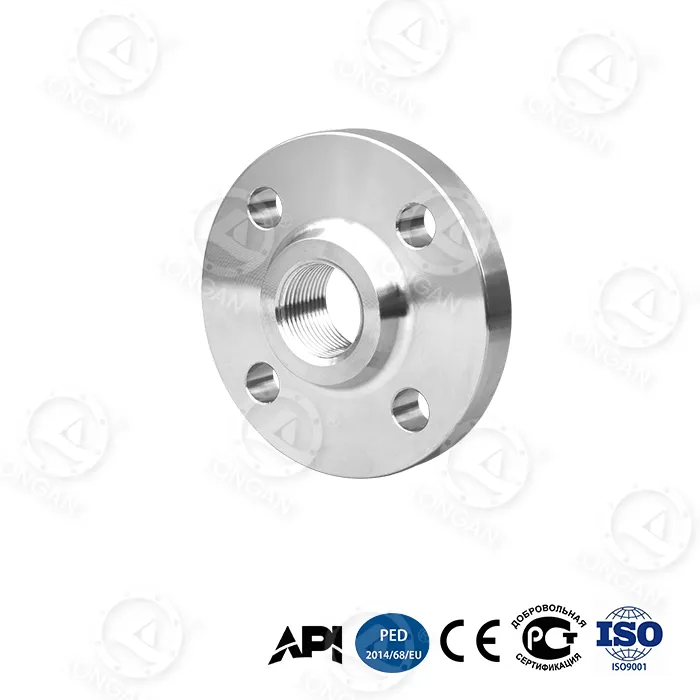
Material Options for Corrosive Marine Service
| Material Grade | Corrosion Resistance | Max Operating Temp (°F) | Typical Marine Application |
|---|---|---|---|
| Carbon Steel (A105) | Poor (requires coating) | 450 | Temporary or dry-interior systems |
| Stainless Steel 316/316L | Good (pitting in stagnant seawater) | 800 | Piping with continuous flow |
| Duplex 2205 | Excellent (resists chloride cracking) | 600 | Ballast water & firewater lines |
| Super Duplex 2507 | Outstanding (high crevice resistance) | 580 | Submerged seawater intakes |
| Nickel-Aluminum Bronze (C95800) | Excellent (erosion-corrosion resistant) | 400 | Propeller shaft cooling circuits |
| Hastelloy C276 | Superior (virtually immune to seawater) | 750 | Chemical injection skids |
Among these, Duplex 2205 and Super Duplex 2507 offer the best balance of strength, cost, and long-term reliability for a Class 150 Threaded Flange in moving seawater. For static or low-flow zones, 316L with a minimum 2.5% molybdenum content is the baseline, but Longan consistently advises clients to upgrade to duplex grades when the flange is below the waterline or in splash zones.
Key Selection Factors Beyond Alloy Composition
-
Thread Sealant Compatibility – PTFE tape or anaerobic pastes must not degrade the flange material. For nickel-based alloys, use non-chlorinated sealants.
-
Galvanic Series – Always pair the Class 150 Threaded Flange with similar-noble metals for bolting and mating flanges. Mixing 316L with carbon steel accelerates corrosion by 10×.
-
Flow Velocity – Erosion-corrosion peaks above 10 ft/s for copper-based alloys; duplex grades withstand up to 20 ft/s.
-
Temperature Derating – Although Class 150 ratings are for ambient conditions, elevated seawater temperatures (above 120°F) reduce yield strength – check derating tables per ASME B16.5.
Manufacturing Quality and Traceability
Longan produces every Class 150 Threaded Flange with full material test certificates (MTC) per EN 10204 3.1 or 3.2. For marine projects, we recommend impact testing at -20°F to ensure toughness in cold-water operations. Our duplex flanges undergo ferrite testing (35–55% ferrite content) and intergranular corrosion testing per ASTM A262. Thread gauging is performed with NPT-L1 and L3 ring gauges to ensure leak-free make-up—critical because a poorly threaded Class 150 Threaded Flange becomes a failure point regardless of alloy quality.
FAQ – Class 150 Threaded Flange in Marine Service
Q: Can a standard A105 Class 150 Threaded Flange be used in seawater if it is painted or galvanized?
A: Technically yes, but only for short-term or indoor applications with dehumidified air. Paint and galvanization (zinc coating) provide a barrier, but any scratch, thread damage, or crevice at the joint exposes bare steel to chloride attack. Pitting corrosion initiates within 72 hours in stagnant seawater, and galvanic action with copper-nickel piping accelerates wall loss. For permanent marine installations, Longan does not recommend A105 unless the system is cathodically protected and regularly inspected. The cost of coating maintenance over 5 years often exceeds the upfront premium for 316L or duplex, making coated carbon steel an economically false economy.
Q: How do I choose between 316L stainless steel and Duplex 2205 for a Class 150 Threaded Flange in a firewater system?
A: Firewater systems typically see intermittent flow, which means stagnant seawater periods between tests. Under stagnant conditions, 316L is susceptible to crevice corrosion at the thread root and under the gasket face, with pitting depth increasing at 0.5 mm/year in warm waters. Duplex 2205 contains 22% chromium and 5% nickel with molybdenum, giving it a PRE (Pitting Resistance Equivalent) number of >35, compared to 316L’s ~25. For firewater, where reliability is safety-critical, Longan recommends Duplex 2205 because it maintains higher yield strength (65 ksi vs. 35 ksi for 316L), allowing thinner flanges and lighter weight. Additionally, Duplex 2205 resists stress corrosion cracking (SCC) in the 120–300°F range, whereas 316L fails prematurely in SCC tests per ASTM G36. If the system has dead-legs or trapped air, Super Duplex 2507 becomes the safer choice.
Q: What is the typical lead time and minimum order quantity for a Class 150 Threaded Flange in Hastelloy C276 from Longan?
A: Hastelloy C276 is a specialty nickel-molybdenum-chromium alloy with exceptional resistance to both oxidizing and reducing acids, making it ideal for seawater with chemical carryover (e.g., sour service or H₂S). However, it is significantly more expensive—approximately 8–10× the cost of 316L. Longan maintains a small inventory of C276 Class 150 Threaded Flange sizes from ½″ to 4″ for emergency replacements, with a standard lead time of 5–7 business days for stock sizes. For non-standard bore or special thread lengths, the lead time extends to 3–4 weeks as we machine from forged billets. Minimum order quantity is 1 piece for stock sizes and 5 pieces for custom orders. We strongly advise ordering a hardness-tested batch (HRB ≤ 90) to ensure machinability and galling resistance during make-up. For most marine clients, C276 is over-specified—Duplex 2507 covers 95% of seawater applications at one-third the cost—so Longan offers free material selection consultations to avoid unnecessary expenditure.
Practical Installation Tips for Marine Flanges
-
Use anti-seize compound on threads (nickel-based for stainless, copper-based for bronze).
-
Tighten with calibrated torque wrenches—target 80–100 ft-lbs for 2″ NPT, depending on gasket type.
-
Always install a sacrificial zinc anode adjacent to the flange if the piping system is bonded to the vessel hull.
-
Perform a hydrostatic test at 1.5× design pressure after installation, using potable water not seawater, to avoid chloride stress cracking during testing.
Why Longan Stands Apart
Every Class 150 Threaded Flange from Longan is individually marked with heat number, material grade, and thread size per MSS SP-25. Our in-house laboratory performs PMI (Positive Material Identification) on every batch, and we provide a digital traceability report with each shipment. For marine environments, we also offer optional PTFE or PFA lining on the flange face and bore, adding an extra barrier against crevice corrosion without altering thread dimensions. We have supplied over 15,000 duplex flanges to offshore projects in the North Sea, Gulf of Mexico, and Southeast Asia, with a documented failure rate of less than 0.2% over 8 years.
Contact Us
Selecting the correct material for a Class 150 Threaded Flange is a decision that impacts safety, downtime, and total lifecycle cost. Longan does not offer one-size-fits-all answers—we provide engineered recommendations based on your specific water chemistry, temperature profile, and maintenance schedule. Request our free Marine Flange Material Selection Guide or speak directly with our corrosion engineers. Visit our website, email our technical sales team, or call our 24/7 support line to discuss your project requirements. We respond to all inquiries within 4 business hours with detailed proposals, 3D models, and certified test reports. Protect your marine piping system with materials that are proven to endure—choose Longan for quality, transparency, and unmatched technical expertise. Contact Longan today and let us engineer the right Class 150 Threaded Flange solution for your vessel or platform.