
What Material Grades Are Available for Fine Tooth Hexagon Socket Head Cap Screws in High-Temperature Settings
2026-07-07
When engineers specify fasteners for high-temperature environments, the material grade becomes as critical as the thread design. Fine Tooth Hexagon Socket Head Cap Screws are widely used in automotive, aerospace, and industrial machinery because their finer pitch allows precise clamping and better vibration resistance. However, at elevated temperatures—above 300°C—standard carbon steel grades lose tensile strength and creep resistance. This is where Dongshao steps in with a clear material-grade framework tailored for thermal stability. Choosing the wrong alloy can lead to premature failure, galling, or loss of preload, so understanding the available grades is not optional—it is essential.
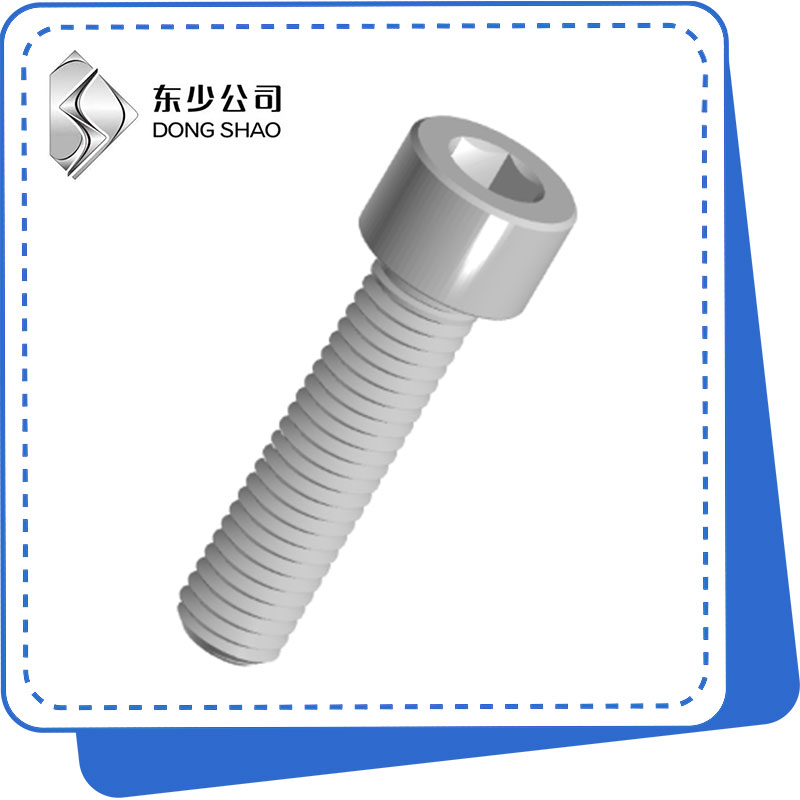
Standard Material Grades for High-Temperature Fasteners
The following table summarizes the most common material grades for Fine Tooth Hexagon Socket Head Cap Screws used in hot environments, along with their maximum continuous operating temperatures and key characteristics.
| Material Grade | Standard / Specification | Max Service Temp (°C) | Tensile Strength (MPa) | Key High-Temp Property |
|---|---|---|---|---|
| A2-70 (304 Stainless) | ISO 3506 | 400–450 | 700 | Good oxidation resistance, moderate creep |
| A4-80 (316 Stainless) | ISO 3506 | 450–500 | 800 | Superior pitting resistance, stable up to 500°C |
| Grade 8 (Medium Carbon Alloy) | SAE J429 | 425 (with surface coating) | 1,200 | High strength but requires anti-seize over 300°C |
| Inconel 718 | ASTM B637 | 650–700 | 1,350 | Excellent creep-rupture strength at 650°C |
| A286 (Iron-Based Superalloy) | ASTM A453 (Grade 660) | 600–650 | 950 | Low thermal expansion, good relaxation resistance |
| Hastelloy C-276 | ASTM B574 | 550–600 | 790 | Outstanding against reducing and oxidizing atmospheres |
For most industrial applications up to 500°C, Dongshao recommends A4-80 or A286 as cost-effective workhorses. For turbine housings or exhaust manifolds exceeding 600°C, Inconel 718 becomes the industry default despite its higher cost.
How Temperature Affects Mechanical Performance
Heat degrades fasteners through three primary mechanisms: loss of hardness, accelerated oxidation, and stress relaxation. A Fine Tooth Hexagon Socket Head Cap Screw made from quenched and tempered alloy steel (e.g., Grade 12.9) can lose up to 40% of its proof load at 400°C within 1,000 hours. By contrast, precipitation-hardened superalloys like Inconel 718 retain over 90% of room-temperature yield strength even at 650°C. This is why Dongshao always advises matching the material’s continuous-use curve to the equipment’s thermal duty cycle—not just peak temperature.
Selection Criteria Beyond Temperature
Temperature alone does not dictate the final choice. Engineers must also evaluate:
-
Oxidation resistance – Scales form faster on uncoated alloy steels above 350°C.
-
Thermal expansion coefficient – Mismatch with the joint material can induce additional bending stress.
-
Galling tendency – Austenitic stainless grades require anti-seize lubricants during assembly.
-
Cost vs. lifecycle – A cheaper screw that fails every 6 months often costs more than a superalloy screw lasting 5 years.
Dongshao provides application engineering support to help customers balance these factors. Their inventory includes both standard off-the-shelf Fine Tooth Hexagon Socket Head Cap Screws and custom-length versions for specialized furnace and boiler applications.
Frequently Asked Questions (FAQ)
Q1: Can I use standard Grade 12.9 alloy steel Fine Tooth Hexagon Socket Head Cap Screws at 450°C continuously?
A1: No. Grade 12.9 is a quenched and tempered low-alloy steel with a maximum recommended continuous service temperature of approximately 300°C–350°C. Above this threshold, the material undergoes tempering degradation—its martensitic structure begins to soften, reducing hardness from ~39 HRC to below 30 HRC within 200 hours. Tensile strength can drop from 1,220 MPa to under 850 MPa, which substantially increases creep relaxation and loosening risk. For 450°C, Dongshao recommends switching to A4-80 (316 stainless) or A286 superalloy, both of which maintain structural integrity at that temperature. If you must use alloy steel, apply a zinc-nickel or ceramic coating and limit torque to 75% of standard values, but even then, expect a shorter service life than with a true high-temperature grade.
Q2: How does the fine tooth pitch affect high-temperature performance compared to coarse thread?
A2: The fine tooth pitch (e.g., M10 x 1.0 instead of M10 x 1.5) offers higher core cross-sectional area and better stress distribution, which improves fatigue resistance—a key benefit in thermal cycling. However, the finer thread also increases the risk of thread galling at high temperatures, especially with stainless or nickel-based alloys, because the smaller flank angles generate higher localized friction during tightening. This is why Dongshao advises using a nickel-based anti-seize compound on every Fine Tooth Hexagon Socket Head Cap Screw installed above 350°C. Additionally, fine threads require more precise torque control; over-torque can induce micro-welding at the thread roots. When properly lubricated and torqued, fine thread fasteners actually outperform coarse threads in hot environments because they provide greater clamp force retention over thousands of thermal cycles.
Q3: What coating or surface treatment works best for Fine Tooth Hexagon Socket Head Cap Screws in high-temperature oxidizing atmospheres?
A3: For alloy steel grades (Grade 8 or 12.9), the most effective coating is zinc-nickel alloy with a trivalent chromate passivation, which resists oxidation up to 425°C. For stainless steel and superalloys, coatings are often unnecessary because they form their own protective oxide layer (e.g., chromium oxide on A4-80). However, when the environment contains sulfur or chlorine (e.g., incinerators or petrochemical furnaces), Dongshao recommends PTFE-impregnated aluminum oxide or molybdenum disulfide (MoS₂) dry film to prevent chemical attack and reduce friction. Avoid cadmium or pure zinc coatings above 250°C, as they volatilize and can contaminate nearby components. For the longest life in cyclic oxidation (e.g., 500°C–600°C), many customers choose uncoated Inconel 718 with a proprietary passivation finish, which Dongshao offers as a standard option for custom orders.
Best Practices for Installation and Maintenance
Even the best material grade will underperform without proper installation. Dongshao recommends:
-
Use a calibrated torque wrench with a friction-factor correction (typically ±10% for dry threads, ±5% for lubricated).
-
Apply high-temperature anti-seize paste (copper- or ceramic-based) to every Fine Tooth Hexagon Socket Head Cap Screw that will see >350°C.
-
Re-torque after the first thermal cycle, as initial creep relaxation can reduce clamp load by 5–15%.
-
Perform periodic hardness spot-checks on retired screws to detect microstructural degradation.
Final Recommendations by Temperature Range
| Temperature Range | Recommended Grade from Dongshao | Coating | Typical Application |
|---|---|---|---|
| Up to 350°C | Grade 12.9 (alloy steel) | Zinc-nickel | Engine blocks, compressors |
| 350°C – 500°C | A4-80 (316) or A286 | None or MoS₂ | Turbocharger housings, exhaust flanges |
| 500°C – 650°C | Inconel 718 | Passivation | Gas turbine casings, afterburner sections |
| 650°C – 750°C | Inconel 718 + ceramic barrier | Ceramic topcoat | Industrial furnace rollers, nuclear ancillary |
Contact Us
Selecting the correct material grade for Fine Tooth Hexagon Socket Head Cap Screws in high-temperature settings is a mission-critical decision that directly impacts safety, uptime, and maintenance costs. Dongshao offers full material traceability, mechanical test reports, and fast custom manufacturing for any of the grades discussed above—from A4-80 to Inconel 718. Our engineering team provides free thermal simulation support to match your exact duty cycle. Contact Dongshao today through our website or email [email protected] to request a material selection checklist and a no-obligation quote for your next high-heat fastening project. Let us help you fasten with confidence—even at the edge of your thermal limit.