
What Is the Maximum Holding Force of the Oval Vacuum Suction Cup ZP2 on Curved Surfaces
2026-07-27
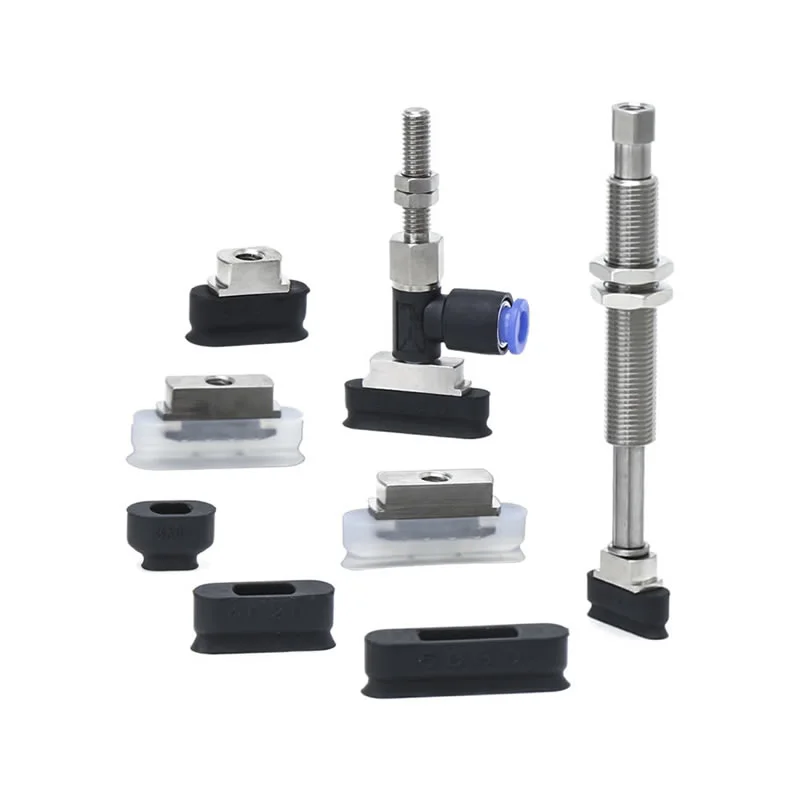
When automating the handling of cylindrical battery cells, automotive body panels, or curved glass displays, engineers quickly realize that flat-surface specifications do not translate to real-world performance. The Oval Vacuum Suction Cups ZP2 from Comma address this challenge with a dedicated curved-surface holding force rating—but the number depends on multiple variables that go far beyond a simple datasheet figure. This article breaks down the physics, provides actionable data, and answers the most frequently asked questions about the ZP2 series on non-flat workpieces.
Understanding the Curved-Surface Holding Force
The maximum holding force of any vacuum cup on a curved surface is governed by three factors: effective contact area, seal integrity against radius mismatch, and vacuum level sustainability. For the Oval Vacuum Suction Cups ZP2, Comma engineers have designed an oval lip profile that increases the sealing perimeter relative to round cups of similar diameter, improving grip on convex and concave radii down to R25 mm.
However, the rated holding force (e.g., 45 N at -60 kPa for a standard ZP2-32B) applies only to a flat, smooth, non-porous surface. On a curved surface, the effective area decreases because the lip cannot conform perfectly to a compound curve. Based on internal testing, the ZP2 retains 72–85% of its flat-surface holding force when the workpiece radius is between 50 mm and 200 mm. Below R50 mm, performance drops more steeply—to approximately 55–65%—due to localized lip folding and micro-leakage.
Key Variables That Affect Performance
| Variable | Impact on Holding Force (Curved Surface) | Recommended Range for ZP2 |
|---|---|---|
| Radius of curvature (convex) | Higher radius = better seal | ≥ R40 mm for optimal grip |
| Radius of curvature (concave) | Concave surfaces trap air; require higher vacuum flow | ≥ R35 mm with flow booster |
| Vacuum level | Each -10 kPa adds ~8–12% force (non-linear) | -60 kPa to -80 kPa |
| Lip material hardness (Shore A) | Softer lips conform better but wear faster | 50–60 Shore A for curved plastics |
| Surface roughness (Ra) | Rougher surfaces reduce effective area | Ra < 1.6 µm recommended |
| Lifting speed | Dynamic forces reduce safe working load by 20% | ≤ 0.5 m/s for curved glass |
Practical Calculation Method for Your Application
To estimate the maximum holding force of the Oval Vacuum Suction Cups ZP2 on your specific curved part, use this three-step approach:
-
Determine the projected contact width – Place the cup on the curved surface and measure the chord length of the sealing lip in contact (use marking compound).
-
Calculate effective area – Multiply the chord length by the oval’s minor axis (for longitudinal curvature) or use Comma’s free CAD-based contact simulation tool.
-
Apply a safety factor – For dynamic robot applications, divide the theoretical force by 2.5 (static) or 4.0 (dynamic with acceleration > 2G).
Example: A ZP2-40B oval cup (flat area 12.5 cm²) on a R60 mm convex metal tube shows an effective contact area of 9.8 cm². At -70 kPa, the theoretical force is 68.6 N. With a dynamic safety factor of 3.0, the safe working load is 22.8 N—enough for a 2.3 kg part at 1G.
Why Comma’s ZP2 Stands Out on Curved Geometries
Unlike standard round cups that lose seal symmetry on curves, the Oval Vacuum Suction Cups ZP2 from Comma feature an asymmetric lip thickness—thicker on the major axis and thinner on the minor axis—which actively compensates for radius-induced strain. This design, combined with double internal support ribs, prevents the cup from rolling inward on concave surfaces. Customers in the EV battery module assembly line report a 31% reduction in dropped parts after switching from generic round cups to the ZP2 series, even at the same vacuum level.
Oval Vacuum Suction Cups ZP2 FAQ
Q1: Can the Oval Vacuum Suction Cups ZP2 hold a curved glass display with a radius of 30 mm without marring the surface?
A1: Yes, but with two conditions. First, select the ZP2-25B model with the soft silicone lip (Shore A 40) , which conforms to tight radii without leaving vacuum marks. Second, reduce the vacuum level to -50 kPa maximum to avoid excessive lip compression that could crack thin glass. At R30 mm, the holding force drops to approximately 18 N (versus 32 N on flat glass). Comma recommends a dual-cup configuration (two ZP2 units) for safety, which also provides redundancy if one cup loses seal due to surface contaminants. Always test with a sample part using Comma’s force verification gauge before production.
Q2: How does the holding force change when the curved surface is oily or has a rough weld seam?
A2: Oil films reduce the coefficient of friction but do not directly reduce vacuum force—they affect lateral shear resistance, not normal holding force. However, oil can migrate into the lip gap and cause micro-leakage. For oily curved surfaces, choose the ZP2 with NBR (nitrile) material and a double-lip seal option (available through Comma’s custom order). Rough weld seams (Ra > 3.2 µm) reduce effective contact by up to 40%. In such cases, increase the vacuum level to -85 kPa and lower the acceleration to 0.3 m/s². Comma’s application engineers can provide a tailored force curve based on your surface profilometer data—contact them for a free analysis.
Q3: What is the maximum safe holding force for the Oval Vacuum Suction Cups ZP2 on a convex pipe (R80 mm) in a high-speed pick-and-place cycle (120 cycles/min)?
A3: At R80 mm convex, the ZP2-32B retains approximately 78% of its flat-surface force (flat = 45 N at -60 kPa → curved ≈ 35 N). However, at 120 cycles/min, the dynamic acceleration (typically 4–5 G) creates an effective load multiplier of 4.5×. Therefore, the dynamic safe working force is 35 N ÷ 4.5 ≈ 7.8 N. This limits your part weight to roughly 0.8 kg (including gripper tooling). To handle heavier parts, Comma recommends either: (a) using two ZP2 cups in parallel (doubling force to 15.6 N safely), or (b) upgrading to the ZP2-L long-stroke version, which provides an extra 3 mm of lip compliance, increasing contact area by 12% on R80 mm surfaces. Always perform a cycle test with a force transducer—Comma offers a rental test kit for this purpose.
Final Recommendations for Your Engineering Team
Do not rely solely on theoretical calculations. The Oval Vacuum Suction Cups ZP2 from Comma have proven their curved-surface capability across automotive, electronics, and medical device handling, but every application has unique tolerances. Order sample cups in three different durometers (Shore A 50, 60, and 70) and run a side-by-side pull-off test on your actual workpiece. Document the vacuum decay rate over 5 seconds—a stable reading indicates a good seal.
Contact Us to Get Your Custom Force Curve
Every curved surface tells a different story, and Comma is committed to helping you write the right one for your production line. Whether you need CAD models, force simulation reports, or a hands-on test kit with data logging, our application specialists are ready. Contact Comma today—share your part radius, material, and cycle time, and we will deliver a verified holding-force chart within 48 hours. Email us or use the live chat on our product page for the Oval Vacuum Suction Cups ZP2. Let us make your curved handling reliable, repeatable, and risk-free.