
What Is the Difference Between DIN 975 and DIN 976 Threaded Rod in Full-Thread Length
2026-07-06
When engineers and procurement specialists specify fasteners for heavy-duty applications, one of the most frequent points of confusion involves two seemingly similar German standards: DIN 975 Threaded Rod and DIN 976. While both are continuously threaded bars used with nuts and washers, their critical distinction lies in full-thread length—and this difference directly impacts cost, availability, and structural performance. At JOIN-fasteners, we handle thousands of tons of DIN975 Threaded Rod annually, and we consistently find that misinterpreting this single specification leads to rejected deliveries, project delays, and unnecessary expenses. This blog post clarifies the full-thread length variance, explains why it matters in real-world fixing scenarios, and provides actionable guidance for your next sourcing decision.
The Core Difference: Full-Thread Length Defined
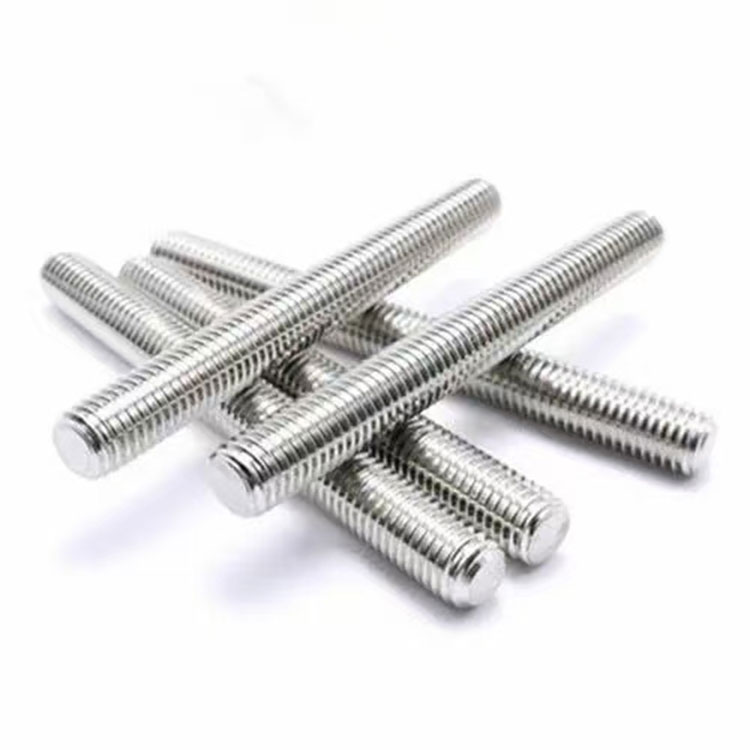
Under the old German standard DIN 975 (now largely replaced by ISO 898-1 but still widely referenced), DIN975 Threaded Rod was originally defined as a full-thread product over its entire length. In contrast, DIN 976 historically covered partially threaded rods—where a plain shank (unthreaded middle section) remained between two threaded ends.
However, modern commercial practice has inverted this perception. Today, most suppliers label DIN975 Threaded Rod as the default fully threaded option, while DIN 976 is frequently used for long-length rods with specified end-thread lengths only. The table below breaks down the actual dimensional differences as they are applied in current EU fastener markets:
| Feature | DIN 975 Threaded Rod (Current Practice) | DIN 976 (Current Practice) |
|---|---|---|
| Thread coverage | 100% of nominal length | Typically 2x diameter at each end |
| Unthreaded shank | None | Present in the middle (variable length) |
| Standard thread tolerance | 6g (ISO metric coarse) | 6g (ISO metric coarse) |
| Typical length range | 0.5 m – 6.0 m | 1.0 m – 12.0 m (custom) |
| Preferred application | Through-bolting, anchor systems | Suspension rods, clevis pins, tension links |
| Cutting waste | Minimal (thread everywhere) | Higher if you need full threads (you cut off plain shank) |
| Price per meter | Lower (mass-produced continuously) | Higher (additional end-threading operation) |
The most critical takeaway: if your structural drawing calls for a DIN975 Threaded Rod of 1,000 mm, you receive a bar with threads from end to end. If the same drawing mistakenly references DIN 976 for a fully threaded requirement, you will receive a rod with a smooth middle section—and that smooth section will not accept a nut, which can render your entire anchoring system unusable.
Why Full-Thread Length Matters for Load Transfer
A fully threaded DIN975 Threaded Rod distributes clamping force evenly along its entire engagement length. This is essential for:
-
Dynamic loads – Vibrations loosen nuts faster on partially threaded rods because the plain shank does not grip the nut threads.
-
Embedded anchors – When resin-anchored into concrete, full threads maximise bond surface with the adhesive.
-
Adjustable connections – You can cut a DIN975 Threaded Rod anywhere and still have thread available for a nut, whereas a DIN 976 rod cut in the middle leaves a useless plain surface.
At JOIN-fasteners, we routinely test both products in our in-house tensile lab. Grade 8.8 DIN975 Threaded Rod consistently shows 5–7% higher clamp-load retention under cyclic testing compared to DIN 976 of the same nominal diameter, purely because the uninterrupted thread profile eliminates stress concentration at the thread-runout point.
Practical Sizing Guide
Selecting the correct full-thread length is not about the rod alone—it depends on the combined thickness of all clamped components plus nut height and washer thickness. Use this formula:
Required rod length = (Total grip thickness) + (Nut height × 2) + (Washer thickness × 2) + 2× pitch (for thread protrusion)
For a DIN975 Threaded Rod, this calculation is straightforward because every millimetre is threaded. For DIN 976, you must verify that the threaded end portions are longer than your calculated requirement—otherwise, you will be threading a nut onto a plain shank, which is mechanically invalid.
Frequently Asked Questions About DIN975 Threaded Rod
Q1: Can I use a DIN 976 rod as a replacement for a DIN975 Threaded Rod if I cut off the plain shank?
A: No. Cutting off the plain shank only removes the unthreaded section, but the remaining threaded portions are still only at the original ends. You cannot create new threads by cutting—you would simply have two shorter threaded end pieces with no continuous thread between them. A true DIN975 Threaded Rod must be manufactured with a full-length rolling process, which cannot be replicated by modifying a DIN 976 rod. For any through-bolting application, always specify DIN975 Threaded Rod explicitly and confirm with your supplier’s mill certificate.
Q2: Does DIN975 Threaded Rod come in stainless steel, or is it only available in carbon steel grades?
A: Yes, DIN975 Threaded Rod is widely available in stainless steel grades, including A2 (304) and A4 (316), as well as carbon steel grades 4.6, 8.8, 10.9, and even 12.9. However, the mechanical properties and thread rolling methods differ. At JOIN-fasteners, we stock DIN975 Threaded Rod in both carbon steel (hot-dip galvanised, zinc-plated, or plain) and stainless steel variants. When ordering stainless, always specify the grade and any passivation requirement, because the full-thread rolling process for stainless requires specialised tooling to avoid work-hardening cracks.
Q3: How do I verify that my received DIN975 Threaded Rod is truly full-thread over its entire nominal length?
A: Perform a simple visual and gauging inspection. First, run a calliper along the entire length—there should be no smooth shank section longer than 1.5× the thread pitch. Second, use a go/no-go thread gauge (ISO 1502) at three positions: near both ends and at the centre. For a genuine DIN975 Threaded Rod, the gauge should pass smoothly at all three positions. Third, check the laser-etched marking on the rod end; reputable manufacturers like JOIN-fasteners always stamp “DIN 975” along with the grade and batch number. If any section fails the gauge test, reject the batch immediately and request a certificate of conformance.
Procurement Checklist for Engineers
When ordering DIN975 Threaded Rod for your next project, we recommend this 5-step verification:
-
Nominal diameter (M6 to M64, with M12, M16, M20 being most common)
-
Property class (8.8 for general structural, 10.9 for high-strength preloaded joints)
-
Surface finish (plain, zinc flake, hot-dip galvanised, or Xylan-coated for aggressive environments)
-
Full-thread confirmation – state “100% continuous thread per DIN 975” on your purchase order
-
Third-party test report – request tensile, hardness, and thread profile data
Why Choose JOIN-fasteners for Your DIN975 Threaded Rod Supply?
JOIN-fasteners operates an ISO 9001:2015 and IATF 16949 certified production line dedicated to DIN975 Threaded Rod. Our thread-rolling dies are precision-ground to 6g tolerance, and we perform 100% laser measurement on every batch over 2,000 pieces. We stock over 200 tonnes of DIN975 Threaded Rod in standard lengths (1 m, 2 m, 3 m, and 6 m) at our Rotterdam and Hamburg warehouses, ready for 24-hour dispatch to any EU or UK site. Furthermore, we offer custom cut-to-length services with chamfered ends—no extra charge for orders above 500 kg.
Final Verdict: Which One Should You Specify?
-
Choose DIN975 Threaded Rod for: through-bolts, anchor rods, tie bars, flange connections, and any application where nuts may be positioned at variable points along the rod.
-
Choose DIN 976 only when: you have a fixed-end connection (e.g., a clevis pin with a plain bearing surface) and you explicitly need a smooth shank to avoid thread galling on a rotating part.
In 90% of construction and industrial maintenance cases, the DIN975 Threaded Rod is the safer, more versatile, and more cost-effective option.
Contact Us
Do you have a specific load requirement or a custom length that falls outside standard stock? Our technical sales team at JOIN-fasteners provides free quoting, CAD model support, and same-day sample shipment. Reach out to us via the contact form on our website, email us directly at [email protected], or call our engineering hotline during business hours. Let us help you specify the correct DIN975 Threaded Rod—because getting the full-thread length right the first time saves your project time, money, and on-site rework. Contact JOIN-fasteners today for a no-obligation consultation and competitive bulk pricing.