
What is the difference between a flat face slip-on flange and a raised face flange
2026-06-08
When selecting a flat slip on flange for a piping system, engineers often compare it with the raised face version. Understanding this difference ensures leak-free performance. At Longan, we manufacture both designs to meet ASME B16.5 and EN 1092-1 standards.
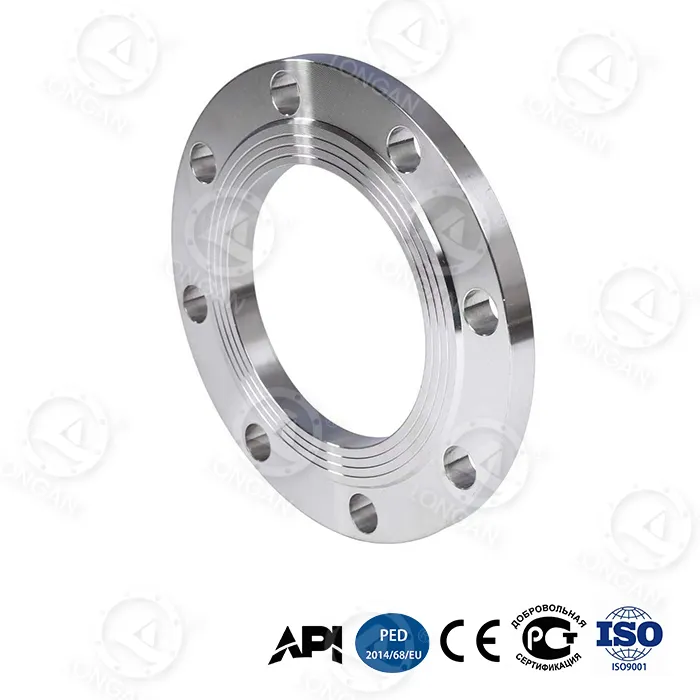
The primary distinction lies in the gasket contact surface. A flat face slip-on flange has a fully flat surface with no raised section. It mates only with another flat face flange. A raised face flange features a small raised ring (typically 1/16″ to 1/4″ high) that concentrates clamping force onto a narrow gasket area.
| Feature | Flat Face Slip‑On Flange | Raised Face Flange |
|---|---|---|
| Gasket contact area | Full flat surface | Narrow raised ring |
| Typical pressure rating | Class 150 or lower | Class 150 and above |
| Common mating flange | Flat face only | Flat or raised face |
| Bolt load requirement | Lower | Higher |
| Risk of flange bending | Higher (thin flat section) | Lower (reinforced profile) |
Why choose a flat face slip‑on flange? Low-pressure applications, cast iron equipment, and plastic-lined pipes often require a flat face design to prevent flange cracking from excessive bolt stress. Longan supplies both surface types with full material traceability.
Three essential FAQs about flat slip on flanges
Q1: Can a flat face slip-on flange be bolted to a raised face flange?
A: No, never. Bolting a flat slip on flange to a raised face flange will cause the raised ring to contact only the outer area of the flat surface, creating uneven gasket compression. This almost always leads to leakage. The raised face flange’s protruding ring can also bend the flat flange inward, causing permanent damage. Always match flat face to flat face.
Q2: What gasket works best with a flat face slip-on flange?
A: Use a full-face gasket that covers the entire flange face. Unlike raised face flanges which use ring-type gaskets, a flat slip on flange requires a gasket with bolt holes punched through its outer diameter. Common materials include compressed non-asbestos fiber, PTFE, or rubber. The full-face design distributes bolt load evenly and prevents the flange from bending at low bolt torques.
Q3: Are flat slip-on flanges weaker than raised face flanges?
A: For the same pressure class, a flat slip on flange has slightly lower resistance to external bending moments because the flat face lacks the mechanical reinforcement of a raised ring. However, within their rated pressure (typically Class 150 or PN10/PN16) and proper flat-to-flat assembly, they perform reliably. Exceeding design pressure or mating incorrectly are the real causes of failure, not the flat face itself.
Need flat slip on flanges with certified materials? Longan stocks sizes from 1/2″ to 48″ in carbon steel and stainless steel. All flanges come with mill test reports and full face machining. Contact us today for a quote or technical drawing support.