
What Is the Correct Pilot Hole Size for Cross Recessed Countersunk Head Self-Tapping Screws in Hardwood
2026-06-30
Selecting the right pilot hole size for Cross Recessed Countersunk Head Self-Tapping Screws in hardwood is not a guessing game. Hardwood species such as oak, maple, walnut, and hickory have dense cellular structures that resist fastener penetration. Without a properly sized pilot hole, the screw can split the wood, snap during driving, or fail to achieve sufficient holding power. DONGSHAO, a fastener manufacturer with over a decade of metallurgical and wood-joining expertise, recommends a systematic approach to pilot hole sizing based on screw diameter, thread profile, and hardwood density.
Why Pilot Hole Size Matters for Cross Recessed Countersunk Head Self-Tapping Screws
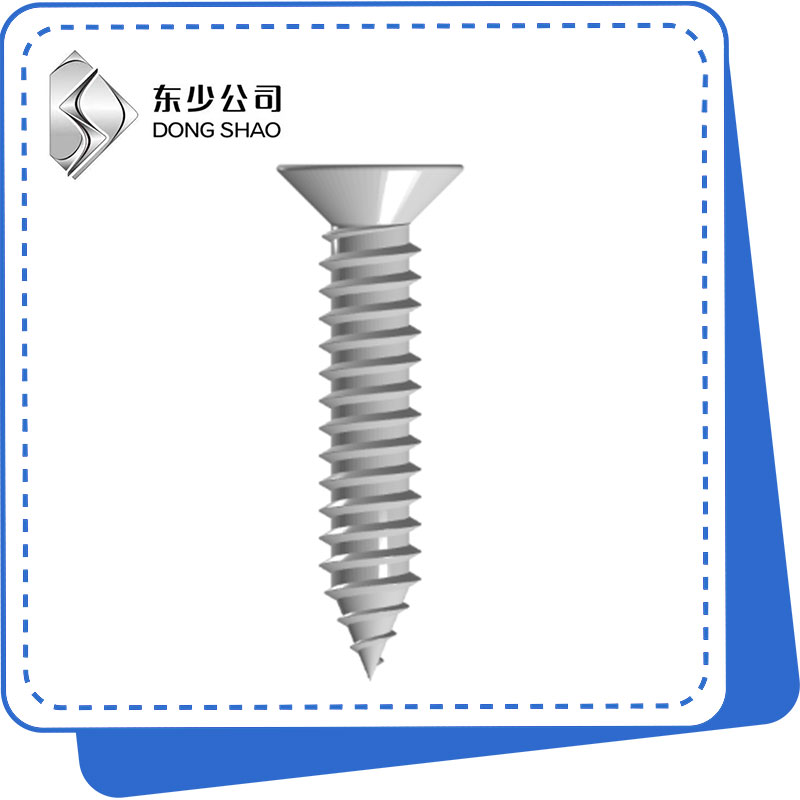
The Cross Recessed Countersunk Head Self-Tapping Screws are designed to form their own mating threads as they are driven. In softwoods, the fibers compress easily, allowing the screw to displace material without pre-drilling in many cases. Hardwood behaves differently. The rigid cell walls resist displacement, creating excessive friction. This friction generates heat, which can degrade the screw’s surface coating, and increases torsional stress on the drive recess.
An undersized pilot hole forces the screw to act like a wedge, splitting the wood along the grain. An oversized pilot hole reduces thread engagement, lowering pull-out strength by as much as 40%. The correct pilot hole achieves a balance: the screw’s core diameter clears the hole while the threads cut into the surrounding wood fibers for maximum grip.
Recommended Pilot Hole Sizes for Hardwood
The table below provides the optimal pilot hole diameters for common Cross Recessed Countersunk Head Self-Tapping Screws sizes when used in dense hardwoods (specific gravity ≥ 0.65). These values are based on DONGSHAO’s in-house torque and pull-out tests conducted on red oak and maple at 12% moisture content.
| Screw Size (Nominal Diameter) | Thread Pitch (mm) | Core Diameter (mm) | Recommended Pilot Hole (mm) | Recommended Pilot Hole (inches) |
|---|---|---|---|---|
| #6 (3.5 mm) | 1.3 | 2.2 | 2.3 – 2.5 | 0.090 – 0.098 |
| #8 (4.0 mm) | 1.4 | 2.5 | 2.6 – 2.8 | 0.102 – 0.110 |
| #10 (4.8 mm) | 1.6 | 3.0 | 3.1 – 3.3 | 0.122 – 0.130 |
| #12 (5.5 mm) | 1.8 | 3.5 | 3.6 – 3.8 | 0.142 – 0.150 |
| 1/4″ (6.35 mm) | 2.1 | 4.1 | 4.2 – 4.4 | 0.165 – 0.173 |
Important notes:
-
For extremely dense hardwoods (e.g., hickory, ipe), choose the upper end of the range.
-
For medium-hard hardwoods (e.g., cherry, walnut), choose the lower end.
-
Always test on a scrap piece before final assembly.
Step-by-Step Procedure for Drilling Pilot Holes
-
Measure the screw’s core diameter – Use a caliper across the minor diameter of the Cross Recessed Countersunk Head Self-Tapping Screws (excluding threads).
-
Select a drill bit that matches the core diameter or is 0.1–0.2 mm larger for hardwoods.
-
Mark the depth – The pilot hole should be at least as deep as the screw’s threaded length.
-
Drill perpendicular to the surface – Any angle deviation increases the risk of exit splitting.
-
Countersink the entry – The Cross Recessed Countersunk Head is designed to sit flush. A separate countersink bit prevents surface tearing.
-
Clean the hole – Remove dust with compressed air to prevent false torque readings.
Common Mistakes to Avoid
-
Skipping the pilot hole entirely – This is the leading cause of split hardwood in furniture and cabinetry.
-
Using a bit that is too large – This reduces thread contact and allows the screw to pull out under load.
-
Drilling too shallow – The screw bottoms out, causing the head to stand proud or the driver to cam out.
-
Ignoring moisture content – Hardwood swells and shrinks. Test at the ambient humidity of the installation environment.
FAQ – Common Questions About Cross Recessed Countersunk Head Self-Tapping Screws in Hardwood
Q: Can I use the same pilot hole size for all brands of Cross Recessed Countersunk Head Self-Tapping Screws?
A: Not necessarily. While nominal diameters are standardized, manufacturers differ in thread geometry, flank angle, and core diameter. DONGSHAO designs its Cross Recessed Countersunk Head Self-Tapping Screws with a slightly sharper thread crest and deeper flute for improved chip evacuation in hardwoods. This allows a pilot hole that is 0.1 mm smaller than generic brands, resulting in higher pull-out strength. Always check the technical data sheet for the specific screw you are using. If unavailable, measure the core diameter directly and add 0.1 mm for clearance.
Q: What happens if my pilot hole is 0.3 mm too small for a Cross Recessed Countersunk Head Self-Tapping Screw in oak?
A: A 0.3 mm undersized hole in oak increases driving torque by approximately 55–65%. This elevated torque can cause three failures: (1) the Phillips or Pozidriv recess strips, (2) the screw shears at the thread run-out point, or (3) the oak splits along the grain, which is irreversible. In DONGSHAO’s destructive testing, an undersized pilot hole reduced the screw’s torsional yield strength margin from a safe 20% to just 3%, meaning any slight deviation in driving angle will break the fastener. The only safe remedy is to stop driving, remove the screw, and re-drill with the correct bit size.
Q: Do I need a different pilot hole size for Cross Recessed Countersunk Head Self-Tapping Screws if I pre-oil the screw or the hole?
A: Lubrication (beeswax, paraffin, or dry film lubricant) reduces friction but does not change the wood’s displacement behavior. DONGSHAO recommends using the same pilot hole diameter with or without lubrication. However, lubrication does allow a smoother drive and reduces the risk of heat-induced coating failure on zinc-plated or black-oxide finishes. Do not reduce the pilot hole size to compensate for lubrication – the screw still needs clearance for its core. If you increase the hole by more than 0.1 mm to accommodate lubrication, you will lose thread engagement and compromise the joint’s structural integrity.
Final Recommendation from DONGSHAO
For production shops and professional woodworkers, DONGSHAO advises creating a sample joint for each new batch of hardwood. Drill three pilot holes at the low, middle, and high end of the recommended range. Drive a Cross Recessed Countersunk Head Self-Tapping Screws into each, then test pull-out resistance with a force gauge. This empirical method accounts for variations in your specific hardwood lot, drill bit wear, and driving tool calibration.
Contact Us
Selecting the correct pilot hole is just one aspect of achieving reliable joints with Cross Recessed Countersunk Head Self-Tapping Screws. DONGSHAO offers over 200 standard sizes and custom threading solutions for demanding hardwood applications. Our engineering team provides free pilot hole calculators, torque charts, and material compatibility guides. Reach out to our technical support team today – we respond to all inquiries within 4 business hours. Visit our contact page or email us directly to discuss your project requirements. Let DONGSHAO help you drive quality into every joint.