
What Bolt Torque Is Required for a Carbon Steel High Pressure Flange Connection
2026-07-03
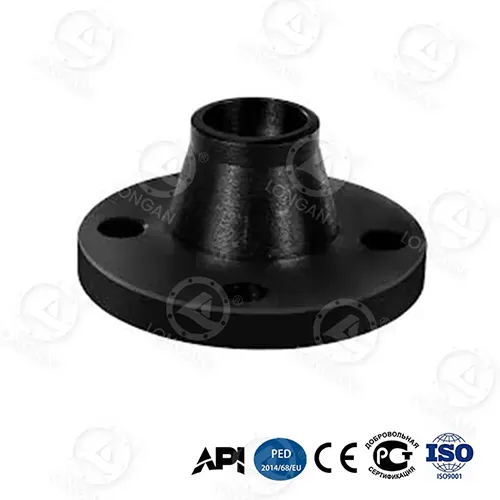
Proper bolt torque is not a number pulled from a chart—it is a calculated engineering decision. For any Carbon Steel High Pressure Flange, incorrect torque leads to gasket leakage, bolt fatigue, or flange face damage. This guide provides the torque calculation methodology, practical tables, and answers to the most asked questions about Carbon Steel High Pressure Flange bolting, with reference to industry practices trusted by Longan engineering team.
The Core Formula for Bolt Torque
The required torque (T) for a Carbon Steel High Pressure Flange is derived from:
T = K × D × F
Where:
-
T = Torque (ft-lb or N·m)
-
K = Nut factor (friction coefficient, typically 0.15–0.25 for lubricated steel)
-
D = Nominal bolt diameter (ft or m)
-
F = Desired bolt preload (lb or N)
Preload (F) is typically 50–70% of the bolt’s yield strength for ASME B16.5 Carbon Steel High Pressure Flange applications. For example, an ASTM A193 B7 bolt in a Class 900 flange requires preload around 60% of its proof stress.
Recommended Torque Range (Lubricated Bolts)
Below is a practical reference for stud bolts on a Carbon Steel High Pressure Flange (ASME B16.5, A193 B7 material, K=0.18):
| Bolt Diameter (inches) | Stud Size | Torque Range (ft-lb) | Torque Range (N·m) |
|---|---|---|---|
| ¾” | ¾-10 UNC | 150 – 190 | 203 – 258 |
| ⅞” | ⅞-9 UNC | 230 – 290 | 312 – 393 |
| 1” | 1-8 UNC | 340 – 420 | 461 – 569 |
| 1⅛” | 1⅛-8 UN | 480 – 590 | 651 – 800 |
| 1¼” | 1¼-8 UN | 660 – 810 | 895 – 1098 |
Values assume molybdenum disulfide lubrication and room temperature. Always verify with the gasket manufacturer and Longan flange documentation.
Factors That Change Torque Requirements
Torque for a Carbon Steel High Pressure Flange is not static. Three variables dominate:
-
Gasket type – Spiral wound or RTJ gaskets require higher preload than soft PTFE.
-
Flange rating – Class 600 vs. Class 2500 changes bolt circle and stud count.
-
Temperature – Above 200°C, creep relaxation reduces clamp force; torque must be increased by 10–15%.
Longan recommends using hydraulic tensioning instead of torque for Carbon Steel High Pressure Flange sizes above 12” in critical services, because friction scatter can exceed ±30% with manual wrenches.
Step-by-Step Torque Procedure for Field Use
-
Clean threads and nut bearing surfaces.
-
Apply calibrated lubricant (same batch for all studs).
-
Tighten to 30% of target torque in star pattern.
-
Increase to 60% – repeat star pattern.
-
Final pass to 100% – verify turn-of-nut method.
-
Mark each nut and recheck after 2 hours.
This procedure ensures the Carbon Steel High Pressure Flange joint achieves uniform gasket stress. Longan field data shows that skipping step 1 increases torque scatter by up to 40%.
Carbon Steel High Pressure Flange – FAQ
Q: What happens if I overtighten a Carbon Steel High Pressure Flange?
A: Overtightening crushes the gasket face, yields the stud threads, and can permanently deform the flange hub. For a Carbon Steel High Pressure Flange under ASME VIII, exceeding target torque by 20% reduces bolt fatigue life by 75%. The gasket may extrude into the bore, causing turbulent flow and erosion. Always use torque wrenches calibrated within ±3% and never exceed 75% of bolt yield strength. If you hear creaking during final pass, stop immediately—that indicates galling or thread seizure.
Q: Can I use the same torque value for a Carbon Steel High Pressure Flange in sub-zero service?
A: No. At temperatures below -20°C, carbon steel enters ductile-to-brittle transition zone. The required torque for a Carbon Steel High Pressure Flange must be reduced by 8–12% because bolt materials (e.g., A193 B7) lose toughness and become notch-sensitive. More importantly, the flange itself requires impact testing per ASTM A320. Longan advises using controlled yielding calculation based on actual Charpy values. Never apply room-temperature torque charts to cryogenic or Arctic installations without re-calculating preload based on reduced yield stress at the operating temperature.
Q: How often should I re-torque a Carbon Steel High Pressure Flange after initial assembly?
A: For a Carbon Steel High Pressure Flange in cyclic thermal service (e.g., steam or heat exchanger nozzles), re-torque is mandatory after the first heat cycle and then at every planned shutdown. Typically, re-torque at 24 hours after initial bolt-up, then again after 500 operating hours if temperature swings exceed 100°C. Longan maintenance protocols require re-torque verification using ultrasonic bolt elongation instead of torque wrench for critical Carbon Steel High Pressure Flange connections, because torque relaxation can be 15–20% within the first week due to embedment and gasket creep.
Why Engineering Judgment Beats Charts
Charts give a starting point. But every Carbon Steel High Pressure Flange joint is unique—flange finish, stud material, nut hardness, and even humidity affect the K factor. Longan engineers perform torque validation using strain-gauged studs on all new Carbon Steel High Pressure Flange assemblies for client projects. This real-time feedback adjusts torque values before pressurization, eliminating leak events during hydrotest.
Contact Us for Your Flange Bolting Specification
Every Carbon Steel High Pressure Flange application demands a tailored bolting plan. Longan provides full torque calculations, stud & nut kits, and on-site training for your maintenance crews. Send your flange class, size, gasket type, and design temperature to our engineering desk—we return a signed torque procedure within 24 hours.
Let us make your Carbon Steel High Pressure Flange connections safe, repeatable, and code-compliant from first bolt-up to final inspection.