
What Are the Welding Considerations for Duplex Steel Flanges
2025-12-24
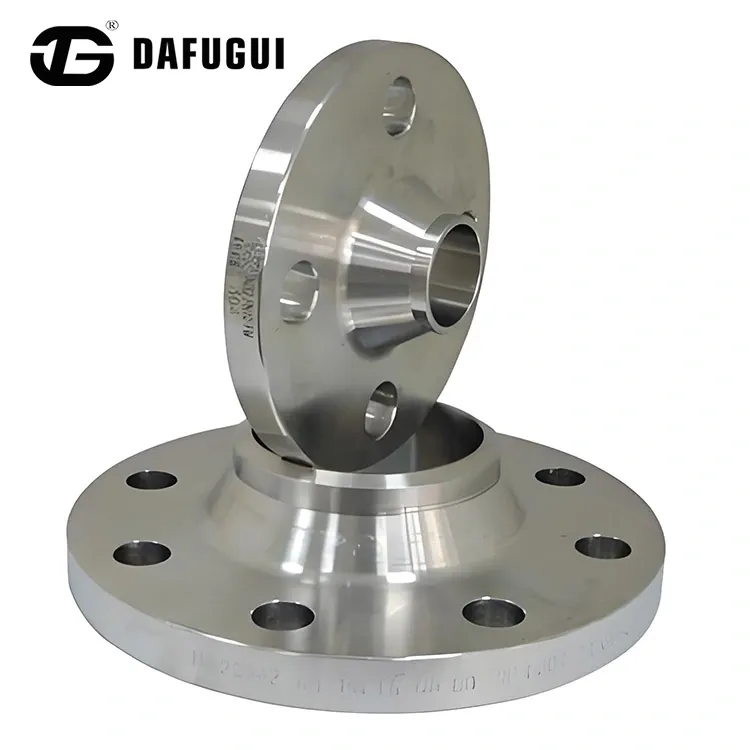
Welding Duplex Steel Flanges is a critical process that demands precise control to maintain their superior properties of high strength and excellent corrosion resistance. Incorrect procedures can degrade the microstructure, leading to premature failure. At Dafugui, we combine decades of metallurgical expertise with practical field knowledge to guide you through these essential considerations, ensuring your piping systems achieve maximum performance and longevity.
The primary goal is to preserve the balanced austenite-ferrite microstructure. Key factors include:
-
Heat Input Control: Strict limits are necessary. Excessive heat can lead to excessive ferrite formation and sigma phase precipitation, embrittling the weld.
-
Interpass Temperature: This must be kept low, typically below 100°C (212°F), to prevent negative microstructural changes.
-
Filler Material Selection: Using over-alloyed filler metals (e.g., ER2209 for duplex, ER2594 for super duplex) is standard to compensate for nitrogen loss and maintain corrosion resistance.
The following table outlines a basic procedure guideline:
| Process Step | Key Parameter | Dafugui Recommended Practice |
|---|---|---|
| Preparation | Joint Design & Cleaning | Bevel to ~70°, meticulously remove contaminants. |
| Filler Metal | Selection | Use over-alloyed AWS A5.9 ER2209/ER2594. |
| Welding | Heat Input & Interpass Temp. | Maintain 0.5-1.5 kJ/mm; Interpass ≤ 100°C. |
| Post-Weld | Cooling Rate | Allow rapid, undisturbed air cooling. |
Duplex Steel Flanges FAQ
Q: Can I weld duplex steel flanges to carbon steel pipe?
A: Technically yes, using a nickel-alloy filler metal like ER309L. However, this creates a dissimilar weld junction. The corrosion-resistant properties will not extend into the carbon steel section, requiring careful design to isolate the carbon steel from the corrosive environment.
Q: Is post-weld heat treatment (PWHT) required for duplex steel flanges?
A: No, PWHT is generally not required and is often detrimental for Duplex Steel Flanges. These alloys are designed to be used in the as-welded condition. Applying heat treatment can destroy the favorable phase balance, reducing both strength and corrosion resistance.
Q: How can I verify the quality of a welded duplex flange connection?
A: Beyond standard NDT (Radiography, Dye Penetrant), the weld quality should be verified by measuring the ferrite content using a Feritscope. For standard duplex, the weld metal should typically show a Ferrite Number (FN) between 35-65 to ensure the correct microstructure.
Successfully welding Duplex Steel Flanges hinges on disciplined procedure adherence. At Dafugui, we don't just supply premium flanges; we provide the critical technical partnership to ensure they are integrated flawlessly. Our experts are ready to support your project with detailed Welding Procedure Specifications (WPS) and material certification. Contact us today for a consultation to ensure the integrity of your most demanding applications.