
What Are the Main Advantages of Using Carbide Dies without Head in Progressive Die Sets
2026-06-16
In high-precision stamping operations, Carbide Dies without Head have become essential components for manufacturers seeking durability and accuracy. At Luckyear, we specialize in engineering these headless dies to meet the rigorous demands of progressive die sets, where uninterrupted performance and tight tolerances are non-negotiable.
Progressive dies operate continuously, often at high speeds, and any tooling failure can halt production. Carbide Dies without Head eliminate the structural weakness associated with headed designs, offering a seamless cylindrical form that simplifies mounting and improves concentricity. This design reduces runout, extends tool life, and ensures consistent part quality across millions of strokes.
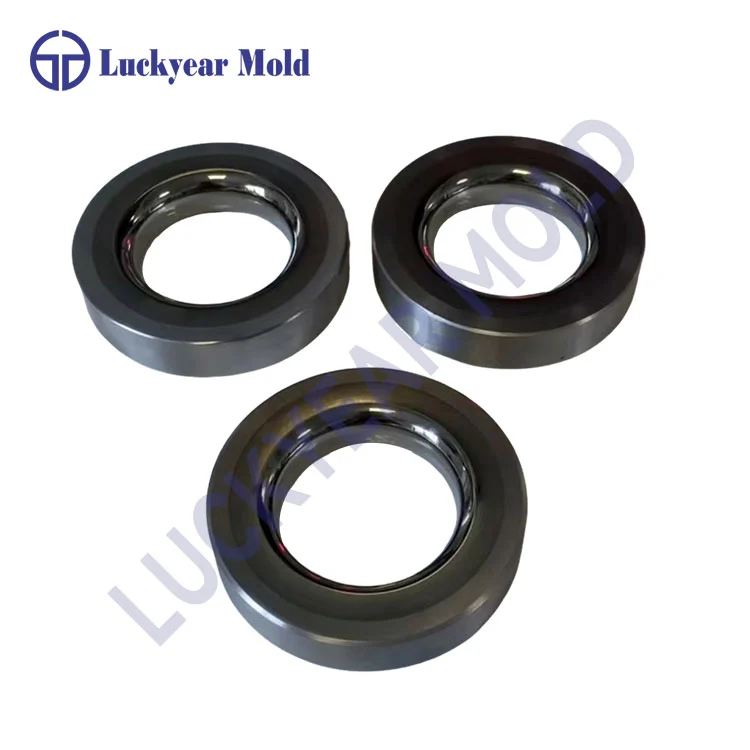
Key Advantages of Carbide Dies without Head in Progressive Die Sets
| Advantage | Description | Impact on Progressive Die Performance |
|---|---|---|
| Improved concentricity | No head means perfectly uniform outer diameter | Reduces misalignment and vibration |
| Easier mounting | Straight cylindrical body fits standard holders | Faster die changes and lower setup costs |
| Higher wear resistance | Solid carbide construction with no stress risers | Longer runtime between regrinds |
| Better heat dissipation | Uniform mass without abrupt geometry changes | Prevents localised thermal damage |
| Greater design flexibility | Headless form allows custom lengths and profiles | Adapts to complex progressive layouts |
Why Progressive Die Engineers Prefer Luckyear’s Headless Design
In progressive stamping, each station must register precisely with the next. A headed die introduces potential misalignment due to shoulder runout. Carbide Dies without Head eliminate that variable. The result is tighter strip positioning, reduced scrap, and longer intervals between maintenance. Luckyear manufactures these dies using submicron-grade carbide and precision EDM grinding, achieving tolerances within ±0.002 mm.
Carbide Dies without Head FAQ – Common Questions from Toolroom Professionals
Question 1: How do Carbide Dies without Head achieve better alignment in a progressive die set compared to headed dies?
Answer: Because Carbide Dies without Head have no shoulder, the entire outer surface is ground concentrically in a single setup. In headed dies, the head is often ground separately, introducing slight perpendicularity errors. When mounted in a precision holder, a headless die self-centers more accurately. This reduces punch-to-die clearance variation across progressive stations, directly improving part accuracy and reducing burr formation. Luckyear further guarantees alignment by laser-marking each die with actual diameter and runout data.
Question 2: Can Carbide Dies without Head be used in existing progressive die holders designed for headed dies?
Answer: Yes, but a simple adapter or spacer is typically required. Headed die holders have a counterbore for the head. By adding a precision ground back-up ring or sleeve, the same holder can accept Carbide Dies without Head. Many toolrooms prefer this conversion because it allows them to standardize on one die type. Luckyear offers custom length headless dies that match the overall height of the original headed assembly, eliminating the need for holder modification. This retrofit often reduces spare parts inventory by 40%.
Question 3: What is the typical failure mode of Carbide Dies without Head in high-speed progressive dies, and how can it be prevented?
Answer: The most common failure is not fracture but edge chipping at the die opening, caused by material galling or insufficient lubrication. Because Carbide Dies without Head lack a head, they cannot pull out of the holder, so pull-out failure is rare. To prevent chipping, Luckyear applies a polished or TiAlN-coated entry angle that reduces friction. Additionally, proper holder fit (H6 or G6 tolerance) and correct piloted strip lift-off timing are critical. Regular inspection with a borescope allows early detection of micro-chipping before it affects part quality.
Practical Applications in Progressive Die Sets
| Progressive Die Station | Typical Role of Carbide Dies without Head | Benefit from Luckyear’s Design |
|---|---|---|
| Piercing | Precision hole punching | Clean edges, zero slug pulling |
| Lancing | Partial cut forms | Consistent form height |
| Trimming | Edge profiling | Burr-free cuts over 10M strokes |
| Restriking | Final calibration | Repeatable dimensions |
For high-volume automotive or electronics stamping, switching to Carbide Dies without Head from Luckyear reduces tooling changeover time by up to 30% and doubles regrind intervals. The elimination of head-related runout also allows faster press speeds, often increasing SPM (strokes per minute) by 15–20% without sacrificing part quality.
Contact Us
Ready to upgrade your progressive die tooling? Luckyear provides standard and custom Carbide Dies without Head with full engineering support. Send your die holder drawing and stamping requirements to our tooling team today for a free fitment analysis and quote.