
What Are the Load Capacity and Tensile Strength Limits of DIN975 Threaded Rod
2026-06-15
When selecting fasteners for heavy-duty construction, infrastructure, or industrial assembly, understanding the mechanical limits of DIN975 Threaded Rod is critical. At Join, we frequently encounter engineers and procurement specialists who need reliable data on load capacity and tensile strength. This guide provides a professional breakdown based on ISO and EN standards, helping you make safe, compliant choices for your projects.
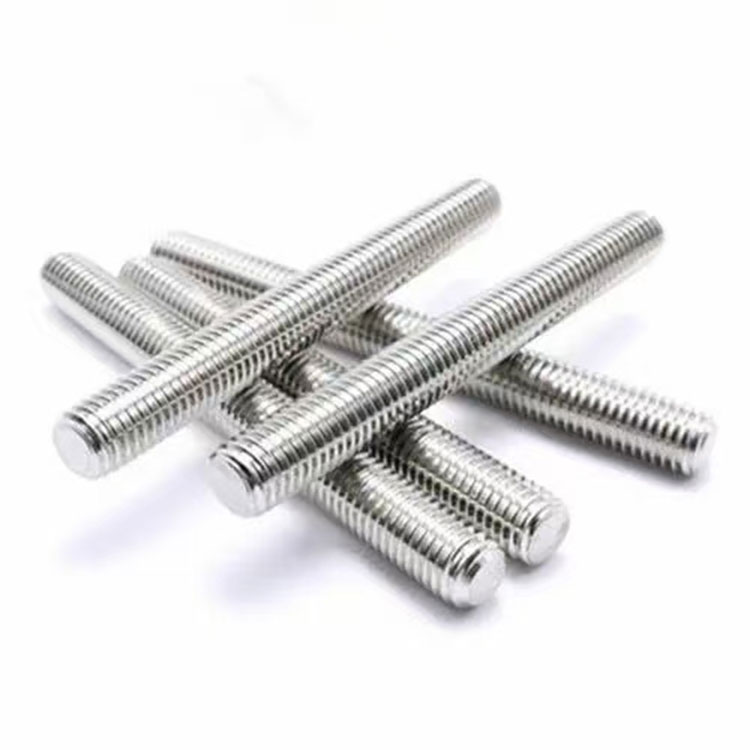
Tensile Strength & Load Capacity Overview
DIN975 Threaded Rod is manufactured in several property classes. The two most common are 4.6 (mild steel) and 8.8 (high-tensile). Below is a technical summary:
| Property Class | Nominal Tensile Strength (MPa) | Yield Strength (MPa) | Typical Application |
|---|---|---|---|
| 4.6 | 400 | 240 | Light fixtures, non-structural supports |
| 5.6 | 500 | 300 | General construction, HVAC hangers |
| 8.8 | 800 | 640 | Structural steel, heavy machinery anchoring |
| 10.9 | 1000 | 900 | High-stress bridges, seismic zones (less common) |
Load capacity formula (simplified for engineering use):
Max Load (kN) = (Tensile Stress Area, mm²) × (Yield Strength, MPa) / 1000
Example for M12 DIN975 Threaded Rod, class 8.8:
-
Tensile stress area ≈ 84.3 mm²
-
Yield strength = 640 MPa
-
Max load ≈ 84.3 × 640 / 1000 = 53.95 kN (approx. 5,500 kg)
Always apply a safety factor (typically 4:1 for static loads) in final designs.
Factors That Reduce Load Limits
| Factor | Impact on Strength |
|---|---|
| Thread corrosion | Reduces effective cross-section by 15–25% |
| Bending moment | Can halve the safe working load |
| Temperature >300°C | Strength drops by 30% for class 8.8 |
| Notch effect at thread roots | Stress concentration factor of 2.5–3.0 |
For outdoor or marine environments, Join recommends hot-dip galvanized DIN975 Threaded Rod to maintain load capacity over decades.
DIN975 Threaded Rod FAQ – Common Questions
Q1: Can I use standard DIN975 Threaded Rod for dynamic or vibrating loads?
A1: No. Standard DIN975 Threaded Rod in property classes 4.6 to 8.8 is designed primarily for static loads. Under dynamic or vibrating conditions (e.g., bridge expansion joints, rotating machinery), the threaded roots experience cyclic stress concentration, leading to fatigue failure over time. For dynamic applications, Join recommends using property class 10.9 with rolled threads (not cut) and performing a fatigue analysis per ISO 12107. If vibrations are moderate, apply thread-locking adhesives and use lock nuts. For high vibrations, switch to a stud bolt with controlled thread run-out.
Q2: How does the length of DIN975 Threaded Rod affect its load capacity?
A2: Length alone does not change tensile strength, but it significantly impacts buckling resistance under compression loads. For a 1-meter long, 10 mm diameter rod, the critical buckling load may be only 20% of its tensile capacity. As a rule of thumb: if the unsupported length exceeds 12× the rod diameter, you must calculate Euler buckling. For tension applications (e.g., hanging a pipe), length has no direct effect on capacity, but longer rods introduce more vibration and deflection. Always support long DIN975 Threaded Rod every 40–50 cm with intermediate nuts or brackets. Join provides custom cut lengths to eliminate unnecessary overhangs.
Q3: Does galvanizing or other coating reduce the strength of DIN975 Threaded Rod?
A3: The base metal strength remains unchanged, but hydrogen embrittlement is a real risk for high-strength rods (class 8.8 and above) when using electroplated or hot-dip galvanizing without proper post-treatment. Hydrogen atoms diffuse into the steel lattice during acid pickling or the coating process, making the rod brittle and prone to sudden fracture under load. For DIN975 Threaded Rod in class 8.8 or 10.9, Join only supplies mechanically galvanized or specially baked (hydrogen relief) products when corrosion protection is required. For class 4.6 or 5.6, hot-dip galvanizing is safe. Always request embrittlement testing per ASTM F1940 for safety-critical applications.
Why Trust Join for Your DIN975 Threaded Rod Needs?
Join supplies fully traceable DIN975 Threaded Rod with mill certificates confirming tensile strength, yield point, and elongation. Every batch is tested to EN ISO 898-1. Our inventory covers property classes 4.6, 5.6, 8.8, and select 10.9, with finishes ranging from plain black to zinc plating and hot-dip galvanizing. For custom lengths, we offer ±0.5 mm cutting tolerance – exceeding standard requirements.
Contact Us for Engineering Support
Selecting the correct load capacity for DIN975 Threaded Rod directly impacts structural safety. Contact Join today to request technical datasheets, obtain project-specific load calculations, or place an order with full certification. Our engineers are ready to assist.