
What Are the Key Dimensional Differences Between ASME B16.5 Socket Weld and Slip-On Flanges
2026-07-23
When selecting flanges for high-integrity piping systems, engineers frequently compare socket weld and slip-on designs under the ASME B16.5 standard. While both are common in low- to medium-pressure services, their dimensional characteristics dictate distinct applications. At Longan, we have witnessed how overlooking these differences leads to welding defects, misalignment, and premature joint failure. This guide dissects the critical measurements, tolerances, and design rationales that separate these two flange types.
1. Fundamental Bore and Hub Geometry
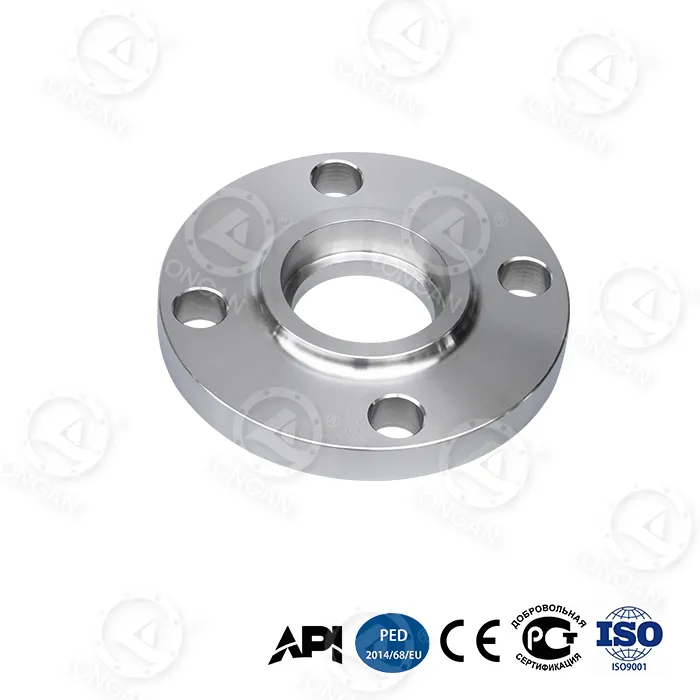
The most visible difference lies in the internal bore configuration. A ASME B16.5 socket weld flange features a counter-bored socket with a uniform shoulder at the bottom. The pipe inserts into this socket, leaving a controlled gap for thermal expansion. Conversely, a slip-on flange has a straight bore slightly larger than the pipe’s outside diameter, allowing the pipe to slide completely through the flange before welding.
| Feature | ASME B16.5 Socket Weld Flange | Slip-On Flange |
|---|---|---|
| Bore type | Counter-bored (stepped) | Straight-through |
| Pipe insertion | Stops at internal shoulder | Passes entirely through |
| Typical bore clearance | 0.5–1.5 mm (depending on NPS) | 1.5–3.0 mm (larger tolerance) |
| Hub taper | Short, heavy hub | Longer, gradual hub |
2. Face-to-Face Thickness and Hub Length
Under ASME B16.5, the minimum flange thickness (measured at the raised face) is identical for both types at the same pressure class. However, the overall hub length diverges significantly. A ASME B16.5 socket weld flange has a shorter hub because the socket depth accounts for pipe insertion, whereas slip-on flanges require extra hub material to accommodate the pipe passing through and the fillet weld on both sides.
For NPS 2, Class 150, the socket weld flange hub length is roughly 25 mm shorter than its slip-on counterpart – a critical constraint in tight piping layouts.
3. Weld Preparation and Gap Requirements
Dimensional specifications directly influence welding procedures. The ASME B16.5 socket weld flange mandates a 1.6 mm gap between the pipe end and the socket shoulder (per ASME B31.1) to prevent weld root cracking from thermal stress. Slip-on flanges do not require an internal gap, but they demand two fillet welds – one inside and one outside – which increases weld metal volume and distortion risk.
Key takeaway: The socket’s precise depth and shoulder position make the ASME B16.5 socket weld flange more forgiving for small-bore, high-vibration lines, while slip-on designs offer easier alignment but consume more longitudinal space.
4. Bolt Circle and Outside Diameter – Are They Different?
For the same NPS and pressure class, ASME B16.5 prescribes identical bolt circle diameters, number of bolts, and outside flange diameters for both socket weld and slip-on types. This means gaskets and bolting are interchangeable. The dimensional divergence is confined to the hub and bore – not the bolting pattern.
5. Practical Selection Matrix
| Criterion | ASME B16.5 Socket Weld Flange | Slip-On Flange |
|---|---|---|
| Pipe size range | NPS ½ to 24 (commonly ≤ NPS 2) | NPS ½ to 24 |
| Welding complexity | Single fillet + gap control | Double fillet, no gap |
| Fatigue resistance | Superior (smooth bore transition) | Inferior (stress concentration at fillets) |
| Inspection access | Limited (internal weld hidden) | Full access to both welds |
| Cost | Higher machining cost | Lower initial cost |
Longan recommends socket weld flanges for critical services (e.g., steam, hydrogen) where fatigue life governs, and slip-on for non-cyclic, low-pressure utility lines.
Frequently Asked Questions About ASME B16.5 Socket Weld Flange
Q1: Can a ASME B16.5 socket weld flange be directly substituted for a slip-on flange of the same rating without modifying the piping layout?
A: No. Substitution fails due to hub length and bore differences. The socket weld flange requires a shorter pipe stub and precise insertion depth. Replacing a slip-on with a ASME B16.5 socket weld flange without adjusting the pipe length will create a gap mismatch or shoulder interference. Always verify the available spool length and welding access before substitution.
Q2: What is the acceptable bore tolerance for a ASME B16.5 socket weld flange under the standard?
A: ASME B16.5 does not publish a separate bore tolerance for socket welds; it refers to ASME B36.10 for pipe OD and applies a standard clearance of 0.5 mm to 1.5 mm for NPS ≤ 2. The socket depth tolerance is ±1.5 mm, while the bore diameter tolerance is ±0.4 mm for most sizes. These tight tolerances ensure the 1.6 mm expansion gap remains consistent, which is critical to avoid root cracking during welding cooldown.
Q3: How does the pressure class affect the socket depth of a ASME B16.5 socket weld flange?
A: Socket depth increases slightly with higher pressure classes (e.g., Class 600 vs. Class 150) because wall thickness grows, requiring deeper sockets to maintain adequate engagement length. For a NPS 1 flange, Class 150 socket depth is approximately 10 mm, while Class 900 reaches 13 mm. Always refer to Table 12 of ASME B16.5 for class-specific socket dimensions, as using a Class 150 socket depth on a Class 900 flange will reduce weld shear area and compromise joint integrity.
Summary Table of Critical Dimension Checks
| Dimension | ASME B16.5 Socket Weld Flange | Slip-On Flange | Inspection Tool |
|---|---|---|---|
| Socket depth | Controlled (shoulder) | Not applicable | Depth micrometer |
| Pipe stop gap | Mandatory 1.6 mm | Not required | Feeler gauge |
| Hub taper angle | ~7° | ~10° | Angle gauge |
| Internal weld access | Restricted | Full | Visual borescope |
Why Trust Longan for Your Flange Specifications?
With over two decades of supplying ASME B16.5 socket weld flange solutions across oil, gas, and petrochemical sectors, Longan combines precision machining with third-party dimensional verification. Every flange is laser-measured for socket depth, bore concentricity, and hub geometry – ensuring your welding procedure qualifies on the first attempt.
We do not just sell flanges; we provide engineering support to interpret ASME codes, select suitable materials, and avoid common installation pitfalls. Our inventory includes all pressure classes (150 to 2500) and exotic alloys, ready for expedited shipment.
Contact Us
Selecting between a ASME B16.5 socket weld flange and a slip-on design requires more than a catalogue comparison – it demands a full understanding of your service conditions, welding capabilities, and inspection protocols. Longan’s technical team is available to review your piping class sheets, perform dimensional take-offs, and recommend the most reliable, cost-effective flange for your project. Reach out to our engineering desk today for a consultation, quote, or sample evaluation. Let us help you weld with confidence – contact Longan now.