
What Are the Corrosion Resistance Capabilities of Male Tee Stainless Steel Double Press Fittings in Harsh Environments
2026-03-24
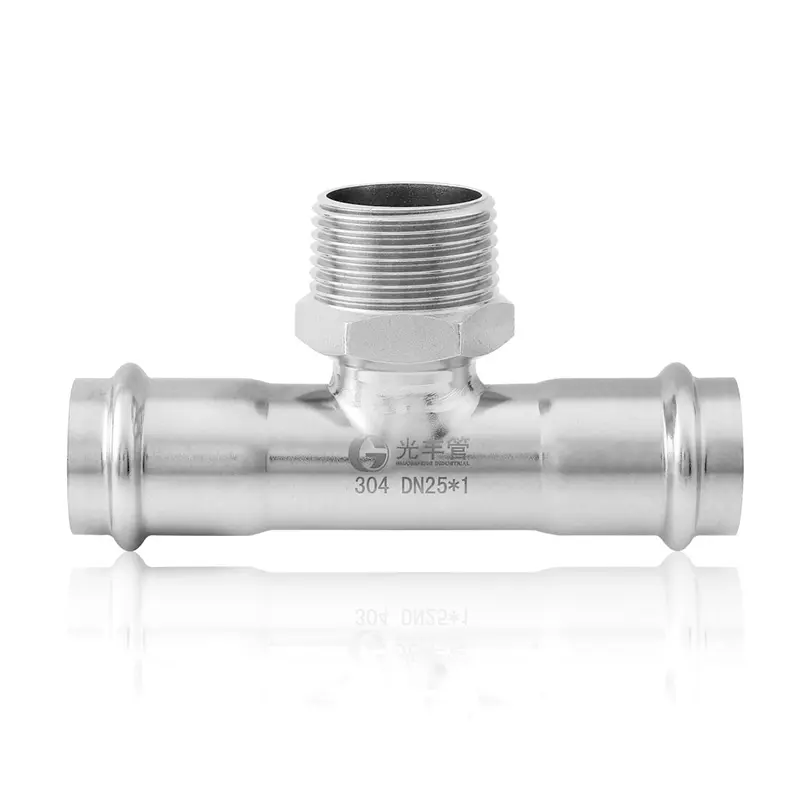
When selecting piping components for demanding industrial, commercial, or marine applications, Male Tee Stainless Steel Double Press Fittings stand out as a critical solution where corrosion resistance directly determines system longevity and safety. At Guangfeng, we engineer these fittings to withstand aggressive conditions that would rapidly degrade conventional materials, ensuring reliable performance in environments ranging from coastal installations to chemical processing facilities.
Understanding Corrosion Resistance in Stainless Steel Press Fittings
The corrosion resistance of Male Tee Stainless Steel Double Press Fittings derives primarily from the grade of stainless steel used and the integrity of the press connection itself. Most high-performance applications utilize 316/316L stainless steel, which contains molybdenum—an element that significantly enhances resistance to pitting and crevice corrosion in chloride-rich environments.
| Corrosion Type | Resistance Level | Key Protective Feature |
|---|---|---|
| Pitting Corrosion | Excellent | Molybdenum content in 316L steel prevents localized attack |
| Crevice Corrosion | High | Double press design eliminates exposed threads where moisture accumulates |
| Stress Corrosion Cracking | Superior | Austenitic structure with controlled carbon content resists cracking under tensile stress |
| Galvanic Corrosion | Optimized | Compatible material selection with EPDM sealing elements prevents dissimilar metal reactions |
| Atmospheric Corrosion | Outstanding | Passive chromium oxide layer self-repairs when surface is exposed to oxygen |
The Double Press Advantage in Harsh Environments
What distinguishes Male Tee Stainless Steel Double Press Fittings from traditional joining methods is the combination of material integrity and installation methodology. The double press mechanism creates two separate sealing points, significantly reducing the risk of leak paths that often become initiation sites for corrosion. Unlike threaded fittings, which create stress concentrations and expose vulnerable thread roots to corrosive agents, press fittings maintain a smooth, uninterrupted surface both internally and externally.
For environments characterized by salt spray, high humidity, acidic conditions, or chemical exposure, Guangfeng ensures that every Male Tee Stainless Steel Double Press Fitting undergoes rigorous passivation treatment. This process removes free iron from the surface and enhances the natural chromium oxide layer, elevating corrosion resistance to its maximum potential.
Key Factors That Influence Long-Term Performance
Several critical factors determine how Male Tee Stainless Steel Double Press Fittings perform in challenging conditions:
-
Material Certification: Full traceability to ASTM A276 or EN 10088 standards ensures consistent alloy composition
-
Seal Material Compatibility: EPDM seals resist ozone, UV radiation, and temperatures from -40°F to 300°F
-
Surface Finish: Electro-polished interiors minimize bacterial adhesion and eliminate crevices that trap corrosive media
-
Installation Verification: Press force monitoring ensures consistent deformation without compromising the protective oxide layer
Male Tee Stainless Steel Double Press Fittings FAQ
Q: What types of harsh environments are Male Tee Stainless Steel Double Press Fittings specifically designed to withstand
A: Male Tee Stainless Steel Double Press Fittings from Guangfeng are engineered to perform reliably in a comprehensive range of harsh environments, including marine and offshore installations where continuous saltwater exposure is present, chemical processing plants handling aggressive acids and alkalis, wastewater treatment facilities with high chloride and sulfide concentrations, food and beverage processing environments requiring frequent caustic cleaning cycles, and outdoor installations subject to freeze-thaw cycles and de-icing chemicals. The combination of 316L stainless steel with double press sealing technology provides exceptional resistance to pitting, crevice corrosion, and stress corrosion cracking, making these fittings suitable for service lives exceeding 50 years in properly specified applications. The EPDM sealing elements further contribute by maintaining elasticity across extreme temperature variations while resisting chemical degradation from common industrial agents.
Q: How does the double press connection method influence corrosion resistance compared to threaded or welded fittings
A: The double press connection method fundamentally enhances corrosion resistance by eliminating the vulnerabilities inherent in alternative joining techniques. Unlike threaded fittings, which create sharp stress risers at thread roots where corrosion initiates and expose dissimilar metals to galvanic action, Male Tee Stainless Steel Double Press Fittings create a cold-formed mechanical lock without removing material or introducing surface discontinuities. Compared to welded connections, which can create heat-affected zones where chromium carbide precipitation reduces corrosion resistance, press fittings maintain the full metallurgical integrity of the base material. The double press configuration provides two independent sealing zones, so even if the primary seal experiences long-term degradation, the secondary seal maintains system integrity. This design also prevents the formation of dead legs or recessed areas where stagnant fluids could concentrate corrosive agents, ensuring that internal flow paths remain smooth and self-draining.
Q: What quality indicators should I look for when selecting Male Tee Stainless Steel Double Press Fittings for corrosive service
A: When selecting Male Tee Stainless Steel Double Press Fittings for corrosive service applications, several critical quality indicators must be verified to ensure long-term performance. First, material certification confirming 316L stainless steel with documented molybdenum content between 2.0 and 3.0 percent is essential, as this directly correlates with pitting resistance equivalent numbers. Second, the presence of full traceability markings on each fitting, including size, material grade, and manufacturer identification, ensures accountability throughout the supply chain. Third, verification of the passivation process—preferably through documented testing such as ASTM A967—confirms that the protective oxide layer has been optimized. Fourth, sealing elements should carry specific environmental ratings, such as high-temperature EPDM or FKM for chemical exposure, with certification to standards like WRAS or NSF 61 for potable water applications. Guangfeng provides complete documentation packages with every shipment, including material test reports, passivation validation, and seal certification, ensuring that specifications are verifiable rather than assumed.
Maximizing Service Life Through Proper Specification
The corrosion resistance capabilities of Male Tee Stainless Steel Double Press Fittings can only be fully realized when they are correctly specified for the intended environment. Guangfeng recommends conducting a comprehensive environmental assessment prior to selection, considering factors such as operating temperature ranges, chemical exposure profiles, expected service life requirements, and maintenance access constraints. For applications involving extreme conditions beyond standard parameters, our technical team can provide guidance on supplemental measures such as external coating systems or specialized seal materials.
Contact Us
For expert assistance in selecting the right Male Tee Stainless Steel Double Press Fittings for your harsh environment applications, contact Guangfeng today to discuss your project requirements with our technical team and request certified product documentation.