
What Are Rail‑less Mounting Accessories for Solar Brackets and When Are They Appropriate?
2026-10-10
An installer arrives at a 1 MW commercial rooftop project. The roof is standing seam metal. The project schedule allows 10 working days for the mechanical installation. The original plan uses a conventional Solar Bracket with long rails and mid-clamps. The first day is spent cutting rails, drilling holes, and aligning the rails across the seams. By the end of the week, only 30 percent of the array is installed. The installer switches to rail-less mounting accessories for the remaining 70 percent. The installation speed triples. The project is completed on time. This is not a rare scenario. Rail-less mounting has become the preferred approach for metal roofs because it eliminates the rail as a separate component and attaches the modules directly to the roof structure using the Solar Bracket itself as the attachment point. This guide explains what rail-less mounting accessories are and when they are appropriate.
1. What Are Rail-less Mounting Accessories and How Do They Work?
Rail-less mounting accessories are components that attach photovoltaic modules directly to the roof structure without the use of long rails. The module frame is clamped directly to the roof seam or purlin using a bracket that is designed for the specific roof profile. The bracket is fastened to the roof with self-drilling screws or seam clamps. The module is then secured to the bracket with a mid-clamp or end-clamp. The result is a mounting system that uses fewer components and less material. The table below compares rail-less mounting with conventional rail-based mounting.
| Feature | Rail-based mounting | Rail-less mounting |
| Components per module | 2 rails + 4 mid-clamps + 4 brackets | 4 brackets + 4 mid-clamps |
| Material weight per kW | 8 – 12 kg | 4 – 6 kg |
| Installation time per kW | 1.5 – 2.5 hours | 0.8 – 1.2 hours |
| Roof penetration points | 4 – 6 per module | 4 per module |
| Adjustability after installation | Moderate | Low |
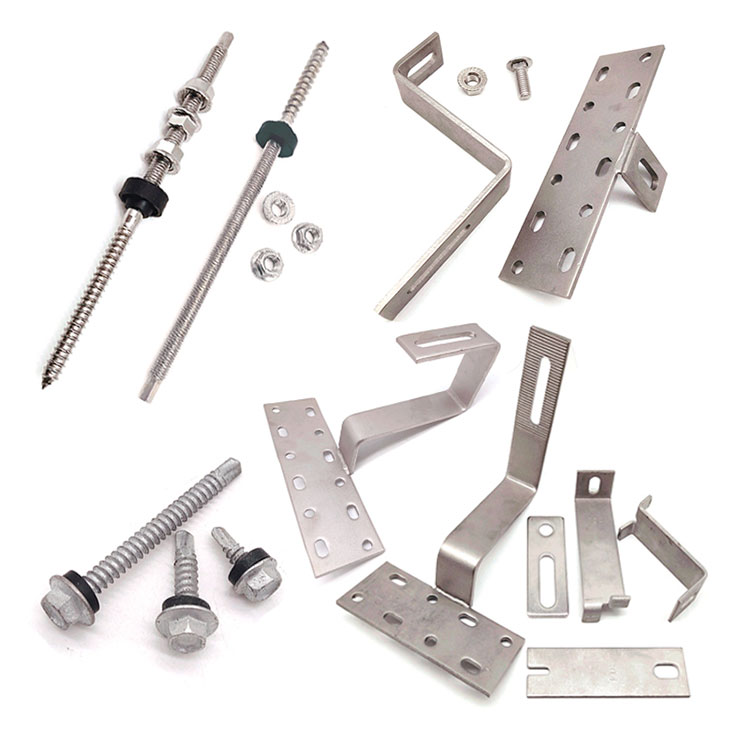
The Solar Bracket in a rail-less system is not a single long rail. It is a series of small brackets that are positioned at the module attachment points. Each bracket is designed to match the roof profile and the module frame height. In our factory, we manufacture rail-less mounting accessories for standing seam roofs, corrugated metal roofs, and trapezoidal metal roofs. Ningbo Gangtong Zheli Fasteners Co.,Ltd has been producing these accessories for over 10 years.
2. When Is Rail-less Mounting Appropriate?
Rail-less mounting is appropriate when the roof is structurally sound and the roof profile is compatible with the bracket design. The most common applications are standing seam metal roofs, corrugated metal roofs, and trapezoidal metal roofs. It is also used on some concrete flat roofs where the brackets are anchored directly to the concrete. Rail-less mounting is not appropriate for asphalt shingle roofs, clay tile roofs, or roofs with irregular surfaces. The table below shows the suitability of rail-less mounting for different roof types.
| Roof type | Rail-less suitability | Typical bracket type | Notes |
| Standing seam metal | Excellent | Seam clamp | No roof penetration |
| Corrugated metal | Good | Self-drilling screw bracket | Requires sealing washer |
| Trapezoidal metal | Good | Self-drilling screw bracket | Requires sealing washer |
| Concrete flat | Moderate | Anchor bolt bracket | Requires ballast or adhesive |
| Asphalt shingle | Poor | Not recommended | Use rail-based system |
| Clay tile | Poor | Not recommended | Use rail-based system |
In our factory, we recommend rail-less mounting for metal roofs where the seam spacing is uniform and the roof structure can support the point loads. We also recommend rail-less mounting for projects where the installation labor cost is high and the schedule is tight. For roofs with irregular seam spacing or fragile surface materials, a rail-based system is more appropriate. Ningbo Gangtong Zheli Fasteners Co.,Ltd provides a roof assessment guide to help installers determine the right approach.
3. How Do You Select the Right Rail-less Accessories for a Specific Roof?
The selection depends on three factors: the roof profile, the module frame height, and the wind load requirement. The roof profile determines the type of bracket. The module frame height determines the clamp size. The wind load determines the number of brackets per module and the fastener specification. The table below shows the selection criteria for common roof profiles.
| Roof profile | Bracket type | Module frame height | Brackets per module | Fastener specification |
| Standing seam (25 mm) | Seam clamp with M8 bolt | 30 – 35 mm | 4 | Stainless steel 304 |
| Standing seam (32 mm) | Seam clamp with M8 bolt | 30 – 40 mm | 4 | Stainless steel 304 |
| Corrugated metal | Self-drilling screw bracket | 30 – 40 mm | 4 – 6 | Stainless steel 304 with EPDM washer |
| Trapezoidal metal | Self-drilling screw bracket | 30 – 40 mm | 4 – 6 | Stainless steel 304 with EPDM washer |
| Concrete flat | Anchor bolt bracket | 30 – 40 mm | 4 – 6 | Stainless steel 316 anchor |
Installer's tip: Always verify the seam spacing and the seam height before ordering rail-less accessories. A bracket that fits a 25 mm seam will not fit a 32 mm seam. Also check the module frame height. Most modules have a 30 mm or 35 mm frame. The clamp must match the frame height to provide a secure grip. In our factory, we provide a sample kit that includes brackets for different seam heights so that installers can verify the fit before committing to a full order.
4. What Are the Limitations and Risks of Rail-less Mounting?
Rail-less mounting has three limitations. The first is adjustability. Once the brackets are installed, the module position is fixed. If the roof surface is uneven, the modules may not be coplanar. The second is point loading. The brackets transfer the module load to the roof at discrete points. If the roof structure is not strong enough, the roof can deform or leak. The third is thermal expansion. The module frame expands and contracts with temperature. In a rail-less system, the clamps must allow for this movement without loosening. The table below shows the risk factors and mitigation measures.
| Risk factor | Mitigation measure |
| Uneven roof surface | Use adjustable brackets; verify coplanarity with a laser level |
| Point loading on roof | Use load-spreading washers; verify roof structure capacity |
| Thermal expansion | Use clamps with a sliding interface; do not over-tighten |
| Water leakage | Use EPDM sealing washers; apply sealant at penetrations |
| Wind uplift | Increase bracket count; use wind-rated fasteners |
Ningbo Gangtong Zheli Fasteners Co.,Ltd has tested its rail-less mounting accessories for wind uplift according to ASTM D3161 and for water leakage according to ASTM E2140. The test data is available for project submittals. We also provide installation training for our customers.
Frequently Asked Questions About Rail-less Mounting Accessories for Solar Brackets
Summary for Solar Installers and Project Managers
Rail-less mounting accessories for Solar Bracket systems eliminate the rail as a separate component, which reduces material weight, installation time, and roof penetrations. They are appropriate for standing seam metal roofs, corrugated metal roofs, and trapezoidal metal roofs. The selection of the right bracket depends on the roof profile, the module frame height, and the wind load requirement. The limitations include reduced adjustability, point loading, and thermal expansion. By understanding these factors, installers can choose the right mounting approach for each project. Ningbo Gangtong Zheli Fasteners Co.,Ltd has been manufacturing rail-less mounting accessories for over 10 years and supplies to solar projects worldwide.
Ningbo Gangtong Zheli Fasteners Co.,Ltd manufactures rail-less mounting accessories for Solar Bracket systems, including seam clamps, self-drilling screw brackets, and anchor bolt brackets. We provide wind load test reports, installation guides, and sample kits for our products.