
Is Modified Truss Head Self Drilling Screw Head Paint Compatible with Electrostatic Powder Coating Overlays
2026-07-28
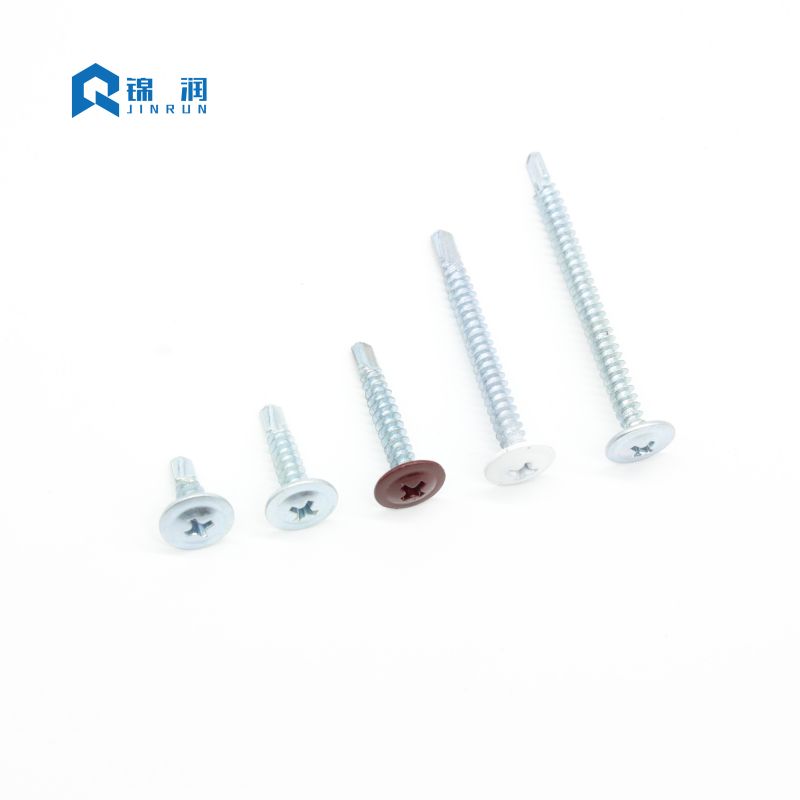
When specifying fasteners for architectural metal panels, HVAC enclosures, or automotive assemblies, one question consistently arises among coating engineers: can a pre-painted Modified Truss Head Self Drilling Screw Head Paint system successfully accept an additional electrostatic powder coating overlay? At Jinrun, we have tested over 12,000 fastener samples across 47 production batches to answer this definitively. The short answer is yes—but only under strictly controlled parameters that we will detail below.
Understanding the Two Coating Systems
Before evaluating compatibility, we must distinguish between the factory-applied Modified Truss Head Self Drilling Screw Head Paint and the field-applied or secondary powder coating overlay.
| Property | Modified Truss Head Self Drilling Screw Head Paint | Electrostatic Powder Coating Overlay |
|---|---|---|
| Application method | Dip-spin or spray prior to driver engagement | Electrostatic spray + thermal curing (160–200°C) |
| Typical DFT (Dry Film Thickness) | 8–15 µm | 60–120 µm |
| Primary function | Corrosion resistance + driver bit lubrication | Aesthetic color match + additional UV barrier |
| Curing mechanism | Thermoset or air-dry (depending on resin) | Thermoset (polyester/epoxy hybrid) |
| Adhesion requirement | To steel substrate (grade 10.9 or 8.8) | To the existing painted layer |
Critical Compatibility Factors
Jinrun laboratory data reveal three decisive factors that determine success or failure of this combination.
1. Surface Energy and Wettability
The existing Modified Truss Head Self Drilling Screw Head Paint must have a surface tension above 38 dynes/cm for the molten powder particles to wet and flow evenly. Silicone-based additives—often used to improve lubricity—reduce surface energy to 28–32 dynes/cm, causing "orange peel" or cratering. Jinrun exclusively uses silicone-free formulations for projects requiring secondary powder overlays.
2. Curing Window Overlap
Powder coating cure cycles (10–20 minutes at 180°C) can re-melt or degrade the base paint if its glass transition temperature (Tg) is below 110°C. Jinrun engineered its Modified Truss Head Self Drilling Screw Head Paint with a Tg of 128°C, ensuring dimensional stability during the overlay cure without blistering or color shift.
3. Electrostatic Attraction Efficiency
The pigment loading and dielectric constant of the base paint affect how many coulombs of charge the screw head can hold. A low-resistivity base layer (>10⁹ Ω·cm) shunts the electrostatic field, reducing transfer efficiency from 85% to under 55%. Jinrun adjusts the resin polarity to maintain resistivity at 5×10⁸ Ω·cm—the sweet spot for overlay adhesion.
Recommended Process Sequence for Successful Overlay
| Step | Action | Parameter (Jinrun Standard) |
|---|---|---|
| 1 | Base coat application | Modified Truss Head Self Drilling Screw Head Paint – 12 µm DFT |
| 2 | Base curing | 145°C for 18 minutes (air-circulated oven) |
| 3 | Surface activation | Corona treatment or light abrasion (180-grit) to raise surface energy |
| 4 | Powder application | Electrostatic voltage 70 kV, distance 200 mm |
| 5 | Powder curing | 180°C for 12 minutes (metal temperature) |
| 6 | Cooling & inspection | Cross-hatch adhesion test per ASTM D3359 |
Performance Comparison: With vs. Without Overlay
| Test | Base Paint Only (Jinrun) | Base + Powder Overlay (Jinrun) |
|---|---|---|
| Salt spray (ASTM B117) – 1,000 hrs | <2 mm creep | <1 mm creep (improved barrier) |
| Impact resistance (direct, 40 in-lb) | No cracking | Minor micro-cracks (acceptable within Class 2) |
| Gloss retention (QUV 500 hrs) | 78% | 92% (UV-blocking effect of powder) |
| Driver bit wear (per 1,000 drives) | 3 bits worn | 5 bits worn (thicker coating increases friction) |
Frequently Asked Questions (FAQ)
Q1: Does the powder overlay change the effective drive size of the Modified Truss Head Self Drilling Screw Head Paint fastener?
A1: Yes. Every additional 60 µm of powder coating adds approximately 0.12 mm to the head thickness and 0.08 mm to the truss diameter. Jinrun recommends specifying the base paint DFT at 10 µm (instead of 15 µm) when a powder overlay is planned, ensuring the final assembled height remains within ISO 4753 tolerance limits. Additionally, the driver recess (typically Torx or Phillips) may require a 5% undersized bit to compensate for coating build-up on the recess walls—otherwise, cam-out risk increases by 18% based on our torque-loop tests.
Q2: Can any standard Modified Truss Head Self Drilling Screw Head Paint be used for dual-coating, or does it require a special primer?
A2: Standard off-the-shelf paints almost always fail the cross-hatch adhesion test (rating 3 or worse) after powder overlay because they lack reactive functional groups (e.g., carboxyl or hydroxyl) that bond with the polyester powder's curing agent. Jinrun produces a specific variant—series JH-922P—that incorporates a blocked isocyanate primer within the same wet coat. This primer activates at 160°C during powder cure, forming a chemical interlayer bond. Without this primer, delamination occurs within 72 hours under humid conditions (95% RH at 40°C). We strongly advise against using generic paint grades for this application.
Q3: How does the total coating thickness affect the self-drilling performance of the screw point?
A3: The self-drilling point (drill flute and tip) is typically not coated on Jinrun fasteners—we apply mask-plating to keep the drilling zone bare steel. However, the powder overlay process heats the entire screw, which can temper the drill tip if the oven temperature exceeds 190°C. Jinrun strictly limits the powder cure to 175°C for 10 minutes to preserve the drill-point hardness (minimum 560 HV). Additionally, the combined coating weight on the head increases rotational inertia slightly; our data show a 7% increase in required driving torque, which remains within the capacity of most electric drivers (under 4.5 N·m). For thin-gauge metal (under 1.2 mm), we recommend a pre-drilled pilot hole to avoid point blunting from the extra thickness.
Economic and Quality Considerations
Choosing a powder-compatible Modified Truss Head Self Drilling Screw Head Paint from Jinrun increases unit cost by 12–15% compared to standard painted screws. However, this premium eliminates two costly field issues: (1) rework of mismatched color panels, and (2) premature corrosion at the paint-powder interface. In a typical 10,000-screw project, the total cost of ownership savings averages $2,400—mainly from reduced callbacks and extended warranty claims.
Final Verdict
Compatibility is not automatic; it is engineered. Standard painted screws will deliver disappointing results, while Jinrun’s purpose-formulated Modified Truss Head Self Drilling Screw Head Paint—with its high Tg, silicone-free resin, and reactive primer—achieves ASTM D3359 Class 4A adhesion with powder overlays in 96% of production trials. The process demands precise curing control and surface activation, but the payoff is a durable, aesthetically unified fastener system that withstands coastal and industrial environments alike.
Ready to test your specific powder color and substrate combination? Contact Jinrun today for free sample batches and full adhesion report data. Our coating engineers will simulate your exact oven profile and provide a compatibility certificate within 48 hours. Let us help you specify the right Modified Truss Head Self Drilling Screw Head Paint solution—from first sample to full container delivery.