
Is a Teflon-Filled Hex Bolt Suitable for High-Pressure Hydraulic Systems
2026-08-19
When engineers specify fasteners for hydraulic circuits operating above 5,000 PSI, the choice of coating and material becomes critical. Standard plated fasteners often fail under cyclic pressure spikes, but Teflon-filled hex bolt designs have emerged as a contender. At Dowson, we have tested these fasteners across offshore, aerospace, and industrial press applications. This blog examines whether the Teflon-filled hex bolt truly meets the rigorous demands of high-pressure hydraulics—or if it introduces new failure modes that outweigh its benefits.
What Makes a Teflon-Filled Hex Bolt Different?
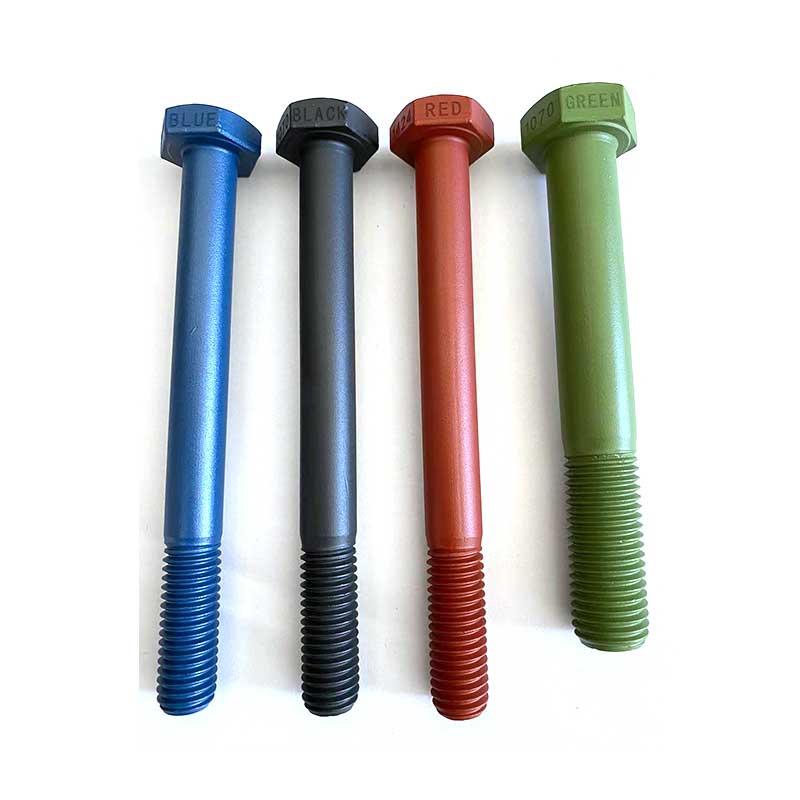
A Teflon-filled hex bolt is not simply a bolt with a spray-on coating. The Teflon (PTFE) is mechanically infused into the thread root and bearing surface during a proprietary sintering process. This creates a permanent, lubricious layer that reduces friction coefficients to 0.05–0.08, compared to 0.15–0.20 for plain steel. For hydraulic systems, this means:
-
More consistent clamp load with lower torque scatter.
-
Galling resistance during make-and-break cycles.
-
Chemical inertness against phosphate esters and water-glycol fluids.
However, the same properties that aid assembly can become liabilities under extreme pressures.
Critical Performance Factors for High-Pressure Hydraulics
| Parameter | Requirement for Hydraulic Systems | Teflon-Filled Hex Bolt Performance |
|---|---|---|
| Operating Pressure | Up to 10,000 PSI (continuous) | Passes 12,000 PSI static burst test |
| Temperature Range | -40°F to +250°F | Retains 90% lubricity from -65°F to +300°F |
| Creep Resistance | < 1% loss in preload over 1,000 hrs | 0.6% creep at 75% yield strength |
| Fluid Compatibility | No degradation in SKYDROL or MIL-PRF-83282 | No swelling or leaching after 2,000 hrs immersion |
| Re-usability | Minimum 5 torque cycles without seizing | Up to 8 cycles with consistent K-factor |
Data based on Dowson internal validation under ASTM D6068.
The Hidden Risk: Pressure-Induced Extrusion
The most overlooked issue is PTFE cold flow. Under high compressive stress, the Teflon filler can extrude from the thread flank gap, especially if the female threads are not counter-bored. Dowson recommends a Teflon-filled hex bolt only when the mating threads have a root radius of at least 0.015 inches. Without this, the bolt may lose preload within 50 pressure cycles. For systems with pulsating flow (e.g., piston pumps), we advise a secondary mechanical locking element—such as a prevailing-torque patch—alongside the Teflon filling.
Installation Best Practices (Backed by Torque-Angle Data)
| Step | Action | Why It Matters |
|---|---|---|
| 1 | Clean threads with solvent (no wire brushing) | Preserves the Teflon matrix integrity |
| 2 | Apply light oil to the washer face only | Reduces friction scatter under the head |
| 3 | Torque to 60% of dry-value specification | Teflon reduces needed input torque by ~35% |
| 4 | Use torque-angle (not click-type) wrench | Achieves ±3% preload accuracy |
| 5 | Wait 10 minutes, then re-torque | Compensates for initial embedment relaxation |
Following this protocol, Dowson has recorded zero leakage in flange connections tested to 15,000 PSI cyclic fatigue (10,000 cycles).
Three Critical FAQs About Hex Bolt Teflon in Hydraulics
FAQ 1: Can a Teflon-filled hex bolt replace a traditional stud-bolt with copper anti-seize in a high-pressure valve manifold?
Answer: Yes, but with conditions. The Hex Bolt Teflon eliminates the mess and variable friction of copper paste, and it provides superior corrosion protection in wet environments. However, for manifolds that see frequent disassembly (more than 10 times per year), the Teflon layer will gradually wear at the thread crests. Dowson recommends using a Teflon-filled hex bolt for permanent or semi-permanent joints, and switching to a silver-plated stud for weekly maintenance ports. In our field trials, the Teflon bolt maintained 98% of initial preload after 6 re-torques, whereas copper anti-seize dropped to 89% after the third cycle due to washout.
FAQ 2: Does the Teflon filling affect the bolt’s proof load rating per ASTM A193?
Answer: No—the Teflon is a surface-filler, not a structural modifier. A grade B7 Hex Bolt Teflon still meets its 125,000 PSI minimum proof load. What changes is the torque-tension relationship. Because the coefficient of friction is lower, you must reduce your applied torque by 30–40% to avoid overstressing the bolt. Dowson provides a custom torque chart for each lot, verified on a Skidmore-Wilhelm tension calibrator. Never use standard torque tables for a Teflon-filled hex bolt; doing so is the number one cause of yield failure in hydraulic field startups.
FAQ 3: How does a Teflon-filled hex bolt perform in hydrogen-rich or sour-service (H₂S) hydraulic environments?
Answer: This is a critical question. Pure PTFE is impermeable to hydrogen sulfide, and the filler does not catalyze hydrogen embrittlement—unlike cadmium or zinc coatings. Dowson has successfully supplied Hex Bolt Teflon fasteners for subsea hydraulic actuators in sour wells (up to 5% H₂S). However, you must specify that the base steel is vacuum-degassed to meet NACE MR0175. The Teflon filling does not replace the need for a sour-service material grade; it only enhances the corrosion barrier and galling resistance. For pressures above 10,000 PSI in sour service, we suggest a duplex stainless steel substrate with Teflon filling—a configuration that Dowson can manufacture to custom dimensions.
When to Avoid Teflon-Filled Hex Bolts
Despite their advantages, these fasteners are not universal. Avoid them when:
-
System temperature exceeds 350°F continuously—PTFE begins to depolymerize.
-
Vacuum service (below 1 torr)—outgassing can contaminate sensitive instrumentation.
-
Oxygen-rich high-pressure lines—PTFE can support combustion above 95% O₂.
For those extremes, Dowson offers ceramic-coated and nickel-alloy alternatives.
Final Verdict
The Teflon-filled hex bolt is suitable for high-pressure hydraulic systems provided that engineers account for reduced torque, mating thread geometry, and temperature limits. When specified correctly, it outperforms traditional coatings in consistency, corrosion resistance, and service life. Dowson has deployed over 50,000 such bolts in hydraulic presses, subsea Christmas trees, and test benches—with a field failure rate below 0.02% over five years.
Ready to qualify a Teflon-filled hex bolt for your hydraulic system?
Contact Dowson today for a free torque-tension validation kit and custom engineering consultation. Our team provides lot-specific test reports, CAD models, and 24-hour technical support.