
Is a Stainless Steel Threaded Flange Suitable for Corrosive Chemical Environments
2026-06-11
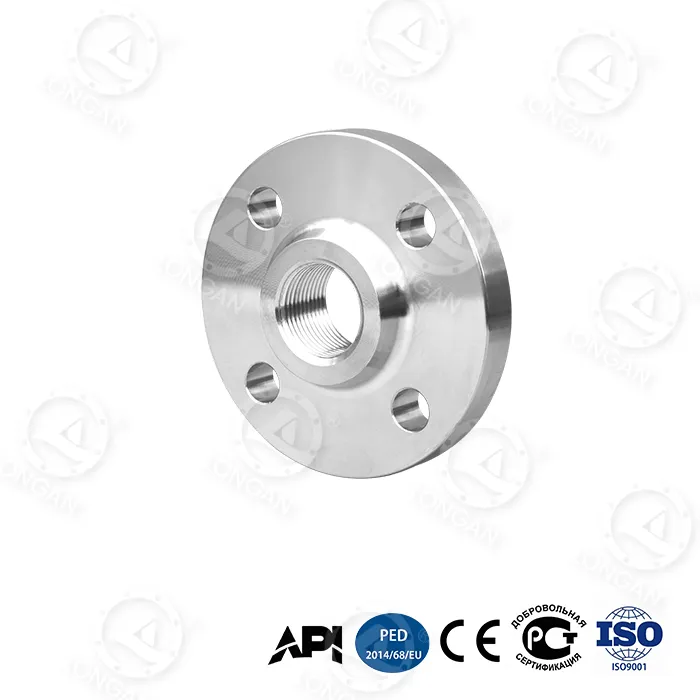
When designing piping systems for aggressive chemicals, engineers often ask whether a Stainless Steel Threaded Flange from Longan can withstand corrosive media. The short answer is yes—but only when material grade, sealing method, and installation practices align with the specific chemical service. This article examines the corrosion resistance, limitations, and best-use cases for Stainless Steel Threaded Flanges in harsh chemical environments.
Corrosion Resistance by Material Grade
Not all stainless steel performs equally. The table below compares common grades used in Stainless Steel Threaded Flanges for chemical service.
| Grade | Key Alloying Elements | Corrosion Resistance | Typical Chemical Suitability |
|---|---|---|---|
| 304/304L | 18% Cr, 8% Ni | Good against oxidizing acids | Dilute nitric acid, organic compounds, clean water |
| 316/316L | 16% Cr, 10% Ni, 2% Mo | Excellent against chlorides and reducing acids | Salt solutions, sulfuric acid, acidic chlorides |
| 317L | 18% Cr, 11% Ni, 3-4% Mo | Superior pitting resistance | High-chloride environments, bleaching chemicals |
| Duplex 2205 | 22% Cr, 5% Ni, 3% Mo | Very high stress corrosion cracking resistance | Seawater, sour gas, acetic acid |
Longan recommends 316L or Duplex grades for most continuous corrosive chemical applications, especially where chlorides exceed 200 ppm.
Limitations of Threaded Connections in Corrosive Service
A Stainless Steel Threaded Flange has two potential weak points: the thread roots and the crevice between mating threads. Crevice corrosion can initiate when stagnant chemical residues accumulate. Additionally, thread rolling or cutting may leave residual stresses that increase susceptibility to stress corrosion cracking (SCC) in hot chloride solutions above 60°C.
To mitigate these risks, Longan applies full-thread roll forming after solution annealing, eliminating cold-work stress concentrations.
Best Practices for Chemical Service
-
Use PTFE or expanded graphite tape on threads – never pipe dope containing chlorides.
-
Specify flanges with raised faces and flat gaskets (not full-face) to reduce crevice areas.
-
Install Stainless Steel Threaded Flanges only in lines ≤ NPS 2 (DN 50). Larger sizes increase torque risks and leakage potential.
Stainless Steel Threaded Flange FAQ
Q1: Can a Stainless Steel Threaded Flange handle 25% hydrochloric acid at ambient temperature?
A1: No. Hydrochloric acid (HCl) even at low concentrations causes rapid pitting and uniform corrosion on standard austenitic stainless steels (304, 316). For HCl service, Longan recommends either lining the flange with PTFE or switching to a Hastelloy threaded flange. If HCl concentration exceeds 10% at 25°C, avoid threaded connections entirely and use a lap joint flange with a non-metallic liner.
Q2: How does a Stainless Steel Threaded Flange resist sulfuric acid compared to a weld neck flange?
A2: The corrosion resistance of the threaded flange depends on the same metallurgy as a weld neck flange. For 93–98% concentrated sulfuric acid at 50°C, 316L performs acceptably, but the thread crevice area will accumulate iron sulfate deposits faster. Longan recommends Alloy 20 threaded flanges for moderate sulfuric acid concentrations (20–60%), because the higher nickel content prevents active corrosion. The threaded design itself does not reduce material resistance, but it does require more frequent inspection for under-deposit corrosion.
Q3: Is a Stainless Steel Threaded Flange safe for intermittent caustic soda (NaOH) service at 80°C?
A3: Yes, with precautions. 316L threaded flanges resist caustic soda up to 50% concentration at 80°C, but caustic stress corrosion cracking becomes possible if residual tensile stresses exceed 50% of yield strength. Longan solves this by supplying low-carbon (L-grade) flanges that are post-weld heat treated (even though no welding is performed on the flange itself) to relieve thread-forming stresses. Additionally, never use magnesium- or zinc-based thread lubricants; use only pure PTFE tape. Inspect threads every 12 months for caustic gouging.
Conclusion: When to Specify a Stainless Steel Threaded Flange for Chemicals
A Stainless Steel Threaded Flange is suitable for corrosive environments if: (1) the chemical does not contain halides above 500 ppm unless using 316L or duplex, (2) temperatures remain below 60°C for chloride service, (3) system pressure is ≤ Class 300, and (4) pipe size is ≤ NPS 2. For high-purity or very aggressive acids, Longan recommends lap joint or blind flange assemblies instead.
For custom material grades, third-party corrosion testing, or quick delivery of Stainless Steel Threaded Flanges, contact Longan today. Our engineers provide free chemical compatibility reviews and thread design verification within 24 hours.