
How to Choose the Right Pneumatic Bits for Screwdriver Based on Hardness and Shank Type
2026-07-02
Selecting the correct Pneumatic Bits for Screwdriver is not a one-size-fits-all decision. In high-volume assembly lines, automotive repair shops, and aerospace manufacturing, the wrong bit can strip screws, damage workpieces, or halt production entirely. The two most critical technical factors—hardness and shank type—determine performance, safety, and cost-per-drive. This guide breaks down these variables with engineering precision, drawing on metallurgical standards and real-world duty cycles. For over a decade, XYD has supplied impact-rated Pneumatic Bits for Screwdriver to Fortune 500 manufacturers, and we share this expertise to help you specify the exact bit for your application.
1. Hardness: The Trade‑Off Between Wear Resistance and Brittleness
Hardness in Pneumatic Bits for Screwdriver is measured on the Rockwell C (HRC) scale. Most industrial bits range from HRC 58–62. However, harder is not always better.
| Hardness Range (HRC) | Typical Application | Advantage | Risk |
|---|---|---|---|
| 56 – 58 | Handheld cordless drills, low-cycle tasks | High toughness, resists bending | Faster wear on screw heads |
| 59 – 61 | General pneumatic assembly (mid-torque) | Balanced wear life and impact resistance | Acceptable for most shops |
| 62 – 64 | High-torque robotic stations, heavy fastening | Maximum wear life, minimal downtime | Brittle; catastrophic failure if misaligned |
XYD recommends HRC 60–62 for 80% of industrial pneumatic applications. This range offers the sweet spot: it resists mushrooming under impact yet flexes enough to absorb shock loads. For continuous operation exceeding 8-hour cycles, opt for bits with cryogenic treatment—a post-hardening process that refines grain structure and boosts service life by 30–40%.
2. Shank Type: Compatibility and Retention
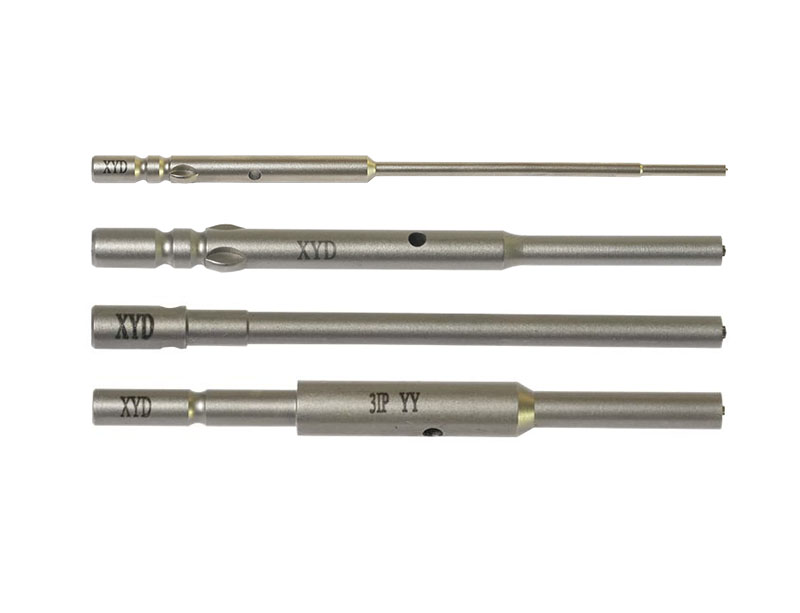
The shank—the portion inserted into the tool—must match your specific pneumatic screwdriver’s clutch or collet. Three standard shank configurations dominate the market:
-
Hex Shank (1/4" or 5/16") – Most common for quick-change chucks. Provides six flat surfaces for positive grip. Best for general assembly.
-
Round Shank with Flat Groove – Designed for set-screw retention. Offers concentricity for high-RPM precision work (above 5,000 RPM).
-
Quick-Change (QC) Shank – Features a ball-detent groove for one‑handed bit swaps. Ideal for multi‑fastening stations where speed matters.
| Shank Type | Retention Method | Best Use Case | Compatibility Note |
|---|---|---|---|
| 1/4" Hex | Magnetic or spring-loaded | Portable pneumatic screwdrivers | Fits 90% of off‑the‑shelf tools |
| 5/16" Hex | Collet or side-lock | Heavy-duty impact wrenches | Requires adapter for 1/4" tools |
| Round + Groove | Set screw (threaded collar) | Fixed automation heads | Prevents axial play under vibration |
| QC Ball‑Detent | Internal spring ring | Rapid‑change robotic arms | Ensure groove depth matches tool spec |
XYD manufactures all four shank varieties with laser‑etched size markings, reducing operator errors during shift changes. Always verify your tool’s internal depth stop—a shank that is 2 mm too long can bottom out, causing false torque readings.
3. Matching Hardness to Shank Type: A Decision Matrix
| Operating Pressure (PSI) | Avg. Torque (Nm) | Recommended HRC | Recommended Shank |
|---|---|---|---|
| 70 – 80 | 5 – 15 | 58 – 59 | 1/4" Hex (magnetic) |
| 80 – 90 | 15 – 35 | 60 – 61 | 5/16" Hex or QC |
| 90 – 100 | 35 – 60 | 61 – 62 | 5/16" Hex (side‑lock) |
| 100+ | 60+ | 62 – 63 (cryo) | Round + groove (set screw) |
For multi‑shift operations, XYD advises selecting one hardness level higher than your nominal requirement, then using a torque limiting clutch to prevent over‑stress. This extends bit life and protects screw threads simultaneously.
4. Frequently Asked Questions (FAQ) About Pneumatic Bits for Screwdriver
Q1: Can I use the same Pneumatic Bits for Screwdriver on both impact drivers and straight‑run pneumatic tools?
A: Not always. Pneumatic Bits for Screwdriver designed for impact tools feature a reinforced neck and deeper heat‑treatment zone to absorb torsional shocks. Bits labelled “impact‑rated” have a larger grain structure that dissipates energy. Using a standard (non‑impact) bit in an impact wrench risks fracture within 50–100 cycles. Conversely, impact‑rated bits run fine in straight tools but cost slightly more. XYD colour‑codes its impact line in orange for instant visual identification—check your tool’s manual for recommended bit class before installing.
Q2: How do I measure the actual hardness of a used Pneumatic Bits for Screwdriver to decide if it needs replacement?
A: A portable Leeb hardness tester (Type D) gives a field approximation, but the most reliable method is a laboratory‑grade Rockwell test on the bit’s shank—never on the tip, as surface decarburization affects readings. For daily shop use, a simpler rule: inspect the drive end under 10× magnification. If you see rounded corners or micro‑cracks radiating from the flutes, hardness has degraded due to cyclic fatigue, even if the number matches spec. XYD provides a free visual inspection chart with every bulk order, showing five wear stages. Replace any bit that has lost more than 0.2 mm of its original corner radius.
Q3: Why do some Pneumatic Bits for Screwdriver have a black oxide finish while others are bright silver—does that affect hardness or shank fit?
A: The finish primarily affects corrosion resistance and friction, not core hardness. Black oxide (magnetite) retains a thin layer of oil, reducing galling in humid environments and slightly lowering initial torque spikes by about 5%. Bright silver (zinc‑plated or plain ground) offers lower surface friction once broken in but rusts faster near coolant mists. Neither finish changes shank dimensional tolerances—both are ground to ISO 1173 standards. However, XYD recommends black oxide for high‑humidity assembly bays and bright finish for clean‑room electronics, where particle shedding is a concern. Always wipe the shank clean before insertion; debris, not finish, is the top cause of collet wear.
5. Final Selection Checklist (Before You Order)
-
Confirm your tool’s maximum RPM and rated torque.
-
Measure your collet or quick‑change groove depth and width.
-
Decide on HRC based on your cycle count per shift (not peak torque alone).
-
Choose finish based on workshop environment (dry, oily, or humid).
-
Order 10–20% extra from the same manufacturing lot—XYD guarantees batch‑to‑batch hardness variance within ±0.5 HRC.
Contact Us
Choosing the right Pneumatic Bits for Screwdriver directly impacts your OEE (Overall Equipment Effectiveness) and fastener quality. If you need custom hardness profiles, non‑standard shank lengths, or trial samples for your specific air tool model, the XYD engineering team is ready to assist. We provide free torque‑matching consultations and same‑day technical datasheets. Contact us via our website’s live chat or email [email protected]—mention this blog to receive a complimentary set of 5 test bits tailored to your application. Let’s get your assembly line running at peak efficiency, one drive at a time.