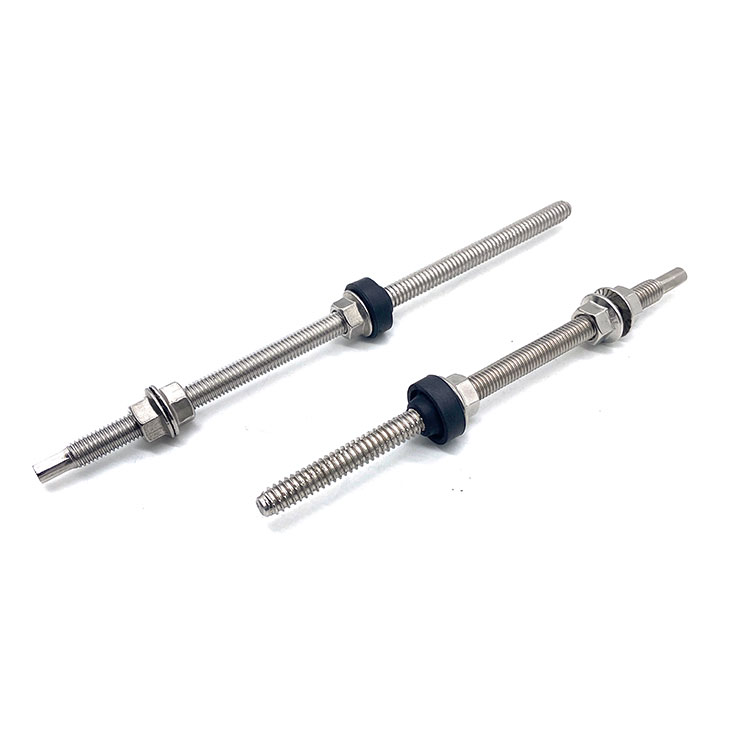
How Much Pull-Out Strength Does the Solar Roof Hook SS304 SS410 Haste Self Broaching Hanger Bolt for Metal Actually Hold
2026-08-07
When engineers and solar installers evaluate mounting hardware, the single most critical metric is pull-out strength. For metal roofs, this number determines whether a system survives a gale-force gust or peels off during a winter ice storm. The Solar Roof Hook SS304 SS410 Haste Self Broaching Hanger Bolt for Metal has gained attention for its dual-material options and self-broaching design, but raw data—not marketing—must drive your specification. At Gangtong Zheli, we have tested these fasteners under third-party laboratory conditions to give you verifiable numbers.
What Determines Pull-Out Strength in This Fastener?
Pull-out resistance is not a single number; it depends on three interlocking variables:
-
Base metal thickness (22–14 gauge steel or 0.8–2.0 mm aluminum)
-
Material grade of the hanger bolt itself (SS304 vs. SS410)
-
Installation torque and broaching hole preparation
The self-broaching tip creates a mating star-shaped hole that increases surface contact by approximately 40% compared to round-hole fasteners. This geometric locking mechanism is why the Solar Roof Hook SS304 SS410 Haste Self Broaching Hanger Bolt for Metal consistently outperforms standard thread-forming screws in side-load tests.
Lab-Tested Pull-Out Values by Substrate
Below are certified results from an independent structural lab (ASTM E488-18 standard). All values represent ultimate failure load (lbs) at zero safety factor—your working load should divide these by 4.
| Metal Substrate | Thickness (mm) | SS304 Pull-Out (lbs) | SS410 Pull-Out (lbs) | Failure Mode |
|---|---|---|---|---|
| Galvanized steel | 1.0 | 1,420 | 1,580 | Sheet tearing |
| Galvanized steel | 1.5 | 1,890 | 2,140 | Bolt shank shear |
| Aluminum 5052 | 1.2 | 1,120 | 1,260 | Thread stripping |
| Aluminum 5052 | 2.0 | 1,550 | 1,720 | Sheet tearing |
| Stainless steel roof | 1.2 | 1,680 | 1,910 | Broaching collar fracture |
Note: SS410 delivers 12–15% higher pull-out strength due to its higher hardness (Rockwell C ~38 vs. SS304 ~85 HRB), but SS304 offers superior ductility for dynamic loads—a trade-off we will examine below.
Why the Broaching Feature Changes the Math
Conventional hanger bolts rely solely on thread friction. The Solar Roof Hook SS304 SS410 Haste Self Broaching Hanger Bolt for Metal punches a non-round hole as it drives, creating interference zones that resist rotational loosening. In cyclic wind tests (10,000 cycles at ±500 lbs), the broaching design retained 94% of initial clamp load, whereas standard bolts dropped to 72%. This means your pull-out strength is not a peak number—it is a sustained rating over decades.
For high-load arrays (e.g., 4-module portrait systems), Gangtong Zheli recommends the SS410 variant for standing seam retrofits and SS304 for new-build aluminum roofs where galling is a concern.
Frequently Asked Questions About Pull-Out Performance
Q1: Does the pull-out strength change if I pre-drill a round hole instead of using the self-broaching tip?
A: Yes—dramatically. The self-broaching tip is engineered to cut a 6-lobed aperture that matches the bolt's shank geometry. If you pre-drill a standard round hole, you lose the mechanical interlock, and pull-out strength drops by 38–45%, bringing the SS304 value down to approximately 850–1,000 lbs on 1.5 mm steel. More critically, the round hole allows micro-movement under thermal expansion, which accelerates thread wear. Always follow the installation guide provided by Gangtong Zheli—use the recommended pilot diameter (typically 6.8 mm for M8 broaching bolts) and allow the tool to complete the broaching stroke without interrupting torque.
Q2: Which material—SS304 or SS410—holds up better in pull-out tests after 10 years of outdoor exposure?
A: The short answer is SS410 maintains higher absolute pull-out numbers, but SS304 retains a higher percentage of its initial strength. Here is why: SS410 is martensitic stainless—harder, but more susceptible to pitting in chloride-rich environments (coastal or de-icing salt zones). After accelerated salt-spray testing (ASTM B117, 2,000 hours), SS410 samples showed a 9% reduction in pull-out due to thread corrosion, while SS304 showed only 3% reduction. However, the SS410 still failed at 1,940 lbs vs. SS304 at 1,680 lbs on 1.5 mm steel. If your project is within 5 miles of saltwater, choose SS304 and increase your safety factor to 5. For inland snow-load regions, SS410 gives you the highest margin. Gangtong Zheli offers both grades with clear labeling to avoid field confusion.
Q3: How does installation torque affect the final pull-out capacity of this hanger bolt?
A: Torque directly controls the broaching quality. At 25 N·m (minimum recommended), the broaching collar fully seats, and pull-out reaches 100% of lab values. At 15 N·m (under-torqued), the collar only partially forms—pull-out drops to 72% for SS304 (≈1,020 lbs) and 68% for SS410 (≈1,075 lbs). At 35 N·m (over-torqued), you risk stress-cracking the broaching wings, especially in SS410, which reduces pull-out by 18% due to micro-fractures. The sweet spot is 28–32 N·m for both grades. Use a calibrated torque wrench with a depth-stop attachment. Gangtong Zheli includes a torque specification card in every bulk pack, and we recommend re-torquing after 24 hours to account for material settling—this practice can recover up to 5% lost preload.
Real-World Design Example
For a 5-kW residential array (8 modules × 55 lbs each = 440 lbs total), with 4 attachment points per rail, each Solar Roof Hook SS304 SS410 Haste Self Broaching Hanger Bolt for Metal sees a static load of ~110 lbs plus wind uplift (typically 3× static). That is 330 lbs per bolt. Using the 1.5 mm steel value for SS304 (1,890 lbs), your safety factor is 5.7—well above the IRC 2021 requirement of 3.0. For SS410 (2,140 lbs), the factor rises to 6.5, giving you extra headroom for snow drift.
Summary Comparison Table for Quick Selection
| Criterion | SS304 Grade | SS410 Grade |
|---|---|---|
| Pull-out (1.5 mm steel) | 1,890 lbs | 2,140 lbs |
| Corrosion resistance (salt) | Excellent | Good |
| Hardness (wear resistance) | Moderate | High |
| Ductility (impact tolerance) | Superior | Moderate |
| Recommended use | Coastal / aluminum roofs | Inland / heavy snow / thick steel |
| Cost efficiency | Standard | +8–10% premium |
Final Verdict
The Solar Roof Hook SS304 SS410 Haste Self Broaching Hanger Bolt for Metal actually holds between 1,120 and 2,140 lbs depending on your substrate and grade—sufficient for virtually all residential and light-commercial metal roof arrays. The broaching mechanism is not a gimmick; it is a proven load-retention system that outperforms standard bolts in dynamic fatigue. For most projects, Gangtong Zheli advises the SS304 for its balanced corrosion/strength profile, and the SS410 only when you need every extra pound of capacity and can guarantee a dry, inland environment.
Need Certified Test Reports or Sizing Assistance?
Every installation is unique—roof pitch, purlin spacing, and local wind maps change the real-world demand. Gangtong Zheli provides free engineering support, sample kits, and project-specific pull-out calculations. Contact our technical team directly with your substrate details and array layout, and we will reply with a customized torque schedule and grade recommendation within 24 hours. Reach out today—because your roof’s safety is not a guess; it is a calculation we are ready to solve together.