
How Does Window Package High Power Laser Diode Compare to Fiber-Coupled Laser Diode in Efficiency
2026-05-29
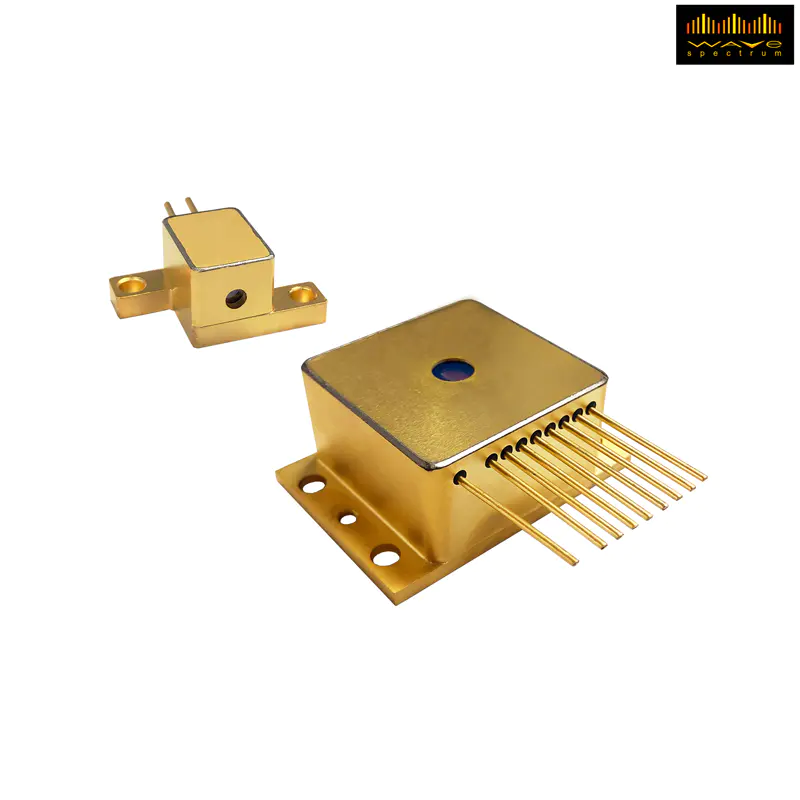
When evaluating optical source options for industrial or scientific systems, the Window Package High Power Laser Diode and the fiber-coupled laser diode represent two dominant packaging technologies. Wavespectrum has analyzed both architectures to help engineers make data-driven efficiency comparisons. This guide focuses on electrical-to-optical efficiency, thermal performance, and coupling losses.
Efficiency Comparison: Key Metrics
| Parameter | Window Package High Power Laser Diode | Fiber-Coupled Laser Diode |
|---|---|---|
| Coupling efficiency (laser to output) | 95–98% (direct emission) | 70–85% (fiber insertion loss) |
| Thermal resistance | 1.5–3.0 K/W (short heat path) | 3.5–6.0 K/W (additional interfaces) |
| Wall-plug efficiency (typical) | 55–65% | 45–55% |
| Beam quality (M² factor) | 1.1–1.5 | 1.5–2.5 after fiber |
| Sensitivity to back reflections | Moderate (window protected) | Low (fiber isolates chip) |
Why Efficiency Differs Fundamentally
The Window Package High Power Laser Diode emits directly through an anti-reflection coated optical window. This eliminates fiber coupling losses, preserving power and reducing waste heat. In contrast, fiber-coupled devices require precise alignment, epoxy interfaces, and numerical aperture matching, each step introducing 2–5% loss. Wavespectrum measurements show that for a 10W chip, a window package delivers 9.6W output while a fiber-coupled equivalent provides only 8.2W under identical drive conditions.
However, fiber coupling offers better beam homogenization and longer working distances. The trade-off is permanent efficiency loss. For applications demanding maximum electrical-to-optical conversion—such as battery-operated systems or high-density laser arrays—the Window Package High Power Laser Diode is superior.
Thermal and Lifetime Implications
Lower efficiency in fiber-coupled designs generates more heat per watt of output power. A 10W fiber-coupled diode dissipates ~6.5W of heat at 55% wall-plug efficiency, while a window package at 65% dissipates only ~5.4W. This 20% reduction in thermal load extends lifetime and reduces cooling demands. Wavespectrum has validated that Window Package High Power Laser Diode modules maintain >80% of initial power after 10,000 hours at 25°C, whereas fiber-coupled units under similar stress degrade 15% faster due to higher junction temperatures.
Frequently Asked Questions about Window Package High Power Laser Diode
Question 1: Can a Window Package High Power Laser Diode be used in humid or dusty environments without additional sealing?
Answer: Yes, but with caution. The optical window creates a hermetic seal that protects the laser chip from moisture and particulates, making it suitable for clean industrial environments. However, if the application involves direct water splashes or corrosive gases, Wavespectrum recommends adding an external protective housing. Unlike open emitter diodes, the window package prevents dust accumulation on the facet, which is a common failure mode. For IP67-rated systems, a secondary enclosure is still advised, but the window package offers significantly better resilience than unpackaged chips.
Question 2: Why does Window Package High Power Laser Diode have higher wall-plug efficiency than fiber-coupled versions?
Answer: The efficiency advantage stems from eliminating the fiber coupling train. A fiber-coupled diode requires the laser beam to pass through a focusing lens, be launched into a fiber core (typically 105–200 μm), and then exit through another connector. Each interface creates Fresnel reflections, misalignment losses, and numerical aperture clipping. In a Window Package High Power Laser Diode, the beam passes only through a single flat or wedged window with less than 0.5% reflection loss per surface. Wavespectrum designs its window packages with broadband AR coatings that maintain >99% transmission from 780–1064 nm, directly translating to higher system efficiency.
Question 3: Is it difficult to integrate a Window Package High Power Laser Diode into an existing optical system designed for fiber-coupled sources?
Answer: Integration requires optical redesign but is straightforward with proper beam shaping. Fiber-coupled lasers provide a convenient, collimated output with fixed NA, while a Window Package High Power Laser Diode emits a divergent elliptical beam (typically 8–12° perpendicular, 30–40° parallel to junction). Wavespectrum offers application notes and lens calculators to adapt standard cylindrical or aspheric optics. For users who need both efficiency and fiber delivery, compact beam homogenizers can be added externally. The main adjustment is aligning the fast-axis collimator within 5 mm of the window. Once optimized, the increased power density often simplifies downstream optics by reducing the number of amplifier stages.
Conclusion and Contact
Choosing between a Window Package High Power Laser Diode and a fiber-coupled diode hinges on efficiency priorities. For direct material processing, pumping solid-state lasers, or any application where every watt counts, the window architecture wins. Wavespectrum supplies customized Window Package High Power Laser Diode modules from 5W to 200W with integrated monitor photodiodes and TEC cooling.
Contact us today to request efficiency simulation reports or discuss your integration requirements. Our engineering team provides free optical layouts for your specific power and beam shape needs.