
How Does the Extended Neck of a Long Weld Neck Flange Improve Stress Distribution in Piping
2026-01-19
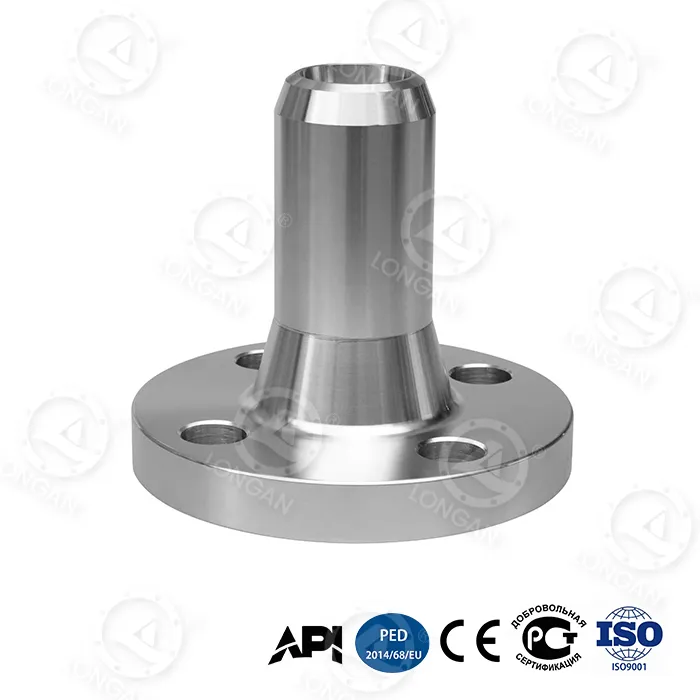
In complex piping systems, managing mechanical and thermal stress is paramount to ensuring safety, longevity, and leak-free operation. This is where the unique design of a Long Weld Neck Flange becomes a critical engineering solution. Unlike standard flanges, the Longan Long Weld Neck Flange features a precisely manufactured extended neck, a design element that fundamentally enhances the structural integrity of the pipe-to-flange junction. But how exactly does this extended profile work to optimize stress distribution? The answer lies in its ability to act as a graduated transition zone, effectively redirecting and minimizing concentrated stress points that could otherwise lead to failure.
The extended neck, or hub, serves as a built-in reinforcement. Its tapered design provides a smooth, gradual shift in rigidity from the flexible pipe wall to the rigid flange ring. This geometry is key to its performance.
Primary Benefits for Stress Management:
-
Reduces Stress Concentration: It eliminates sharp discontinuities where the pipe meets the flange, preventing high-stress hotspots.
-
Improves Fatigue Resistance: By distributing stresses more evenly, it significantly increases the system's resistance to pressure cycles and thermal cycling.
-
Enhances Misalignment Tolerance: The longer hub allows for better alignment during welding, reducing secondary bending stresses.
-
Provides Inherent Reinforcement: The added material acts as a natural stiffener, supporting the weld and adjacent piping.
Comparative Stress Distribution: Standard vs. Long Weld Neck
| Feature | Standard Weld Neck Flange | Longan Long Weld Neck Flange |
|---|---|---|
| Hub Length | Relatively Short | Extended, Tapered |
| Stress Transition | More Abrupt | Gradual and Smooth |
| Ideal For | General Service | High-Pressure, High-Temperature, Cyclic Duty |
| Bending Stress | Higher at the weld junction | Dissipated along the neck's length |
Long Weld Neck Flanges FAQ
Q: In which applications are Long Weld Neck Flanges absolutely essential?
A: Long Weld Neck Flanges are critical in severe-service applications such as high-pressure hydrocarbon systems, refinery and chemical process piping, offshore platforms, and power generation. They are specified wherever systems experience significant thermal expansion, pressure fluctuations, or external forces to ensure a reliable, leak-tight connection over the long term.
Q: How does the extended neck impact the welding and installation process?
A: The extended neck of a Long Weld Neck Flange provides a longer landing area for the pipe, facilitating superior alignment before welding. This results in higher quality weld preparation, allows for more precise NDT (Non-Destructive Testing), and enables a stronger, more homogenous weld joint that is integral to the improved stress distribution.
Q: Are there specific standards that govern the dimensions of the extended neck?
A: Yes. The critical dimensions of the hub—including its length, taper, and bore—are strictly defined by international standards such as ASME B16.5 and B16.47. Reputable manufacturers like Longan adhere precisely to these specifications, ensuring that every Long Weld Neck Flange performs its stress-redistributing function as engineered for safety and compliance.
Understanding the engineering principle behind the extended neck is crucial for specifying the right component for demanding installations. It’s not merely an extra piece of metal; it’s a calculated design for resilience. For projects where failure is not an option, choosing a correctly specified flange is the foundation of system integrity.
Contact us today at Longan to discuss your specific project requirements. Our technical experts can help you select the optimal Long Weld Neck Flange to ensure superior stress distribution and long-term performance in your most critical piping systems.