
How Does Single Screw Melt Flow Stability Cut Thickness Deviation?
2026-10-08
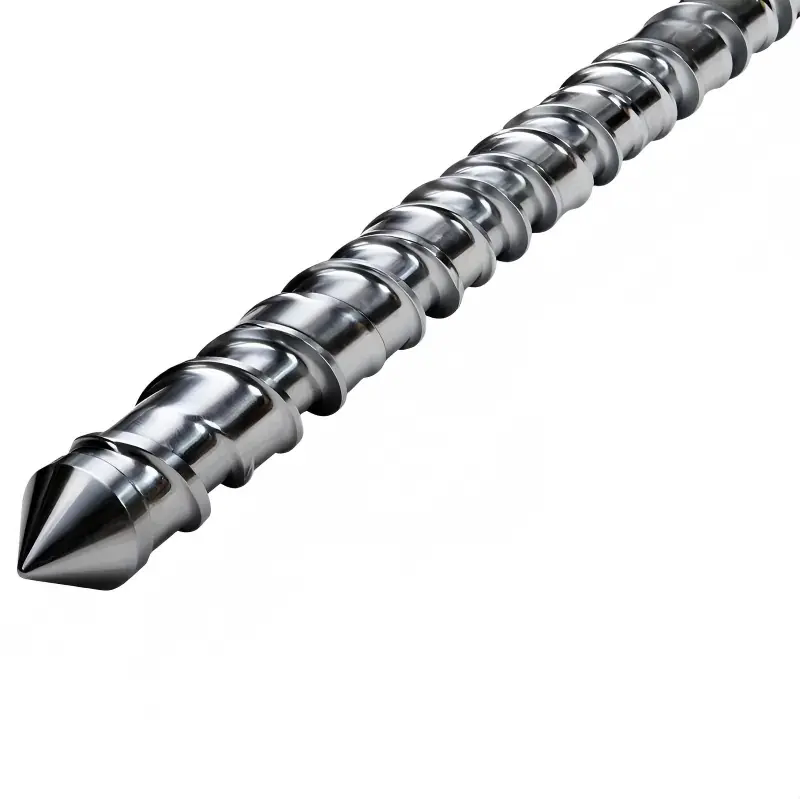
A film producer runs a 3-layer co-extrusion line. The gauge variation in the machine direction is ±8 percent, which is outside the ±3 percent tolerance required by the customer. The operator adjusts the die, changes the temperature profile, and slows the line speed. Nothing works. The problem is not the die or the temperature. It is the Single Screw For Extrusion Machine. The screw is not delivering a stable melt flow. The pressure at the die inlet fluctuates by 15 bar, which translates directly to thickness variation. When the screw was replaced with a barrier design, the pressure fluctuation dropped to 3 bar, and the gauge variation dropped to ±2 percent. This guide explains why melt flow stability is the root cause of thickness deviation and how screw design affects it.
1. Why Does Melt Pressure Fluctuation Cause Thickness Deviation?
In an extrusion line, the thickness of the final product is determined by the volumetric flow rate of the melt through the die. The flow rate is determined by the pressure drop across the die and the viscosity of the melt. If the pressure fluctuates, the flow rate fluctuates, and the thickness varies. The pressure fluctuation originates in the Single Screw For Extrusion Machine. The screw pumps the melt forward in a pulsating manner. The pulsation is caused by the flight of the screw as it rotates. Each time a flight passes the die inlet, the pressure spikes. The amplitude of the spike depends on the screw design, the compression ratio, and the speed. The table below shows the relationship between pressure fluctuation and thickness deviation for a typical LDPE film line.
| Pressure fluctuation (bar) | Flow rate variation (%) | Thickness deviation (µm) | Thickness deviation (%) |
| 1 | 0.5 | 1.5 | 0.5 |
| 3 | 1.5 | 4.5 | 1.5 |
| 5 | 2.5 | 7.5 | 2.5 |
| 10 | 5.0 | 15.0 | 5.0 |
| 15 | 7.5 | 22.5 | 7.5 |
In our factory, we have measured the pressure fluctuation of different screw designs on the same extrusion line with the same LDPE resin. A standard single-flight screw produced a fluctuation of 12 to 15 bar. A barrier screw with a Maddock mixing section produced a fluctuation of 3 to 4 bar. The thickness deviation dropped from ±7.5 percent to ±2 percent. This is why the screw design is the first place to look when thickness tolerance is not met. Zhoushan Happy Plastics Machinery Co., Ltd. has been manufacturing Single Screw For Extrusion Machine units for over 15 years.
2. How Does Screw Compression Ratio Affect Melt Stability?
The compression ratio is the ratio of the channel depth in the feed section to the channel depth in the metering section. A higher compression ratio compresses the melt more, which increases the pressure and improves the melting rate. But a compression ratio that is too high can cause surging, which is a cyclic variation in output. Surging occurs when the solid bed breaks up and the melt flow becomes unstable. The optimal compression ratio depends on the resin. LDPE typically uses a compression ratio of 2.5:1 to 3.0:1. HDPE uses 3.0:1 to 3.5:1. PP uses 2.8:1 to 3.2:1. The table below shows the recommended compression ratio for common resins.
| Resin | Recommended compression ratio | Channel depth feed (mm) | Channel depth metering (mm) |
| LDPE | 2.5:1 – 3.0:1 | 8.0 – 10.0 | 3.0 – 3.5 |
| HDPE | 3.0:1 – 3.5:1 | 7.0 – 9.0 | 2.0 – 2.5 |
| PP | 2.8:1 – 3.2:1 | 7.5 – 9.5 | 2.5 – 3.0 |
| PS | 2.2:1 – 2.8:1 | 8.0 – 10.0 | 3.5 – 4.0 |
| PVC (rigid) | 2.0:1 – 2.5:1 | 9.0 – 11.0 | 4.0 – 5.0 |
Our factory designs Single Screw For Extrusion Machine units with the compression ratio optimized for the customer's resin and product. We use a computer simulation to predict the melting profile and the pressure fluctuation before the screw is manufactured. This reduces the trial and error on the production line. Zhoushan Happy Plastics Machinery Co., Ltd. provides a screw design report with every order.
3. What Is the Role of the Barrier Section in Melt Flow Stability?
The barrier section is a feature that separates the solid bed from the melt pool. In a standard screw, the solid bed and the melt are in the same channel. As the screw rotates, the solid bed can break up, causing unmelted particles and pressure fluctuations. A barrier screw has a second flight that separates the solid from the melt. The solid stays in one channel and the melt is forced into the other. This ensures that only fully melted material reaches the metering section. The result is a more stable pressure and a more uniform output. The table below compares the performance of a standard screw and a barrier screw.
| Parameter | Standard screw | Barrier screw (our design) |
| Pressure fluctuation | 10 – 15 bar | 3 – 4 bar |
| Melt temperature uniformity | ±5°C | ±2°C |
| Unmelted particle count | 5 – 10 per 100 cm² | < 1 per 100 cm² |
| Thickness deviation | ±5 – 8% | ±1.5 – 2.5% |
| Output rate | Baseline | 5 – 10% higher |
In our factory, we have tested barrier screws with different barrier flight clearances and different lead lengths. The optimal design depends on the resin viscosity and the output rate. For a 90 mm screw running at 100 RPM, a barrier flight clearance of 0.5 mm and a lead length of 1.5 times the diameter produced the best results. Zhoushan Happy Plastics Machinery Co., Ltd. offers barrier screws as an upgrade for existing Single Screw For Extrusion Machine units.
4. How Do Mixing Sections and Shear History Affect Thickness?
The mixing section at the end of the screw is the final opportunity to homogenize the melt before it enters the die. A Maddock mixer or a pineapple mixer creates a series of shear gaps that break up agglomerates and equalize the temperature. The shear history of the melt is also important. If the melt experiences excessive shear, it can degrade. If it experiences insufficient shear, it can have unmelted particles. The table below shows the effect of mixing section type on thickness deviation.
| Mixing section type | Pressure fluctuation | Thickness deviation | Temperature uniformity |
| None | 12 – 15 bar | ±6 – 8% | ±5°C |
| Maddock mixer | 4 – 5 bar | ±2 – 3% | ±2°C |
| Pineapple mixer | 3 – 4 bar | ±1.5 – 2.5% | ±1.5°C |
| Barrier + Maddock | 3 – 4 bar | ±1.5 – 2% | ±1.5°C |
| Barrier + pineapple | 2 – 3 bar | ±1 – 1.5% | ±1°C |
Process tip: When troubleshooting thickness deviation, check the screw first. If the screw is worn or the compression ratio is incorrect for the resin, no amount of die adjustment will solve the problem. A screw with a barrier section and a mixing section can reduce thickness deviation by 60 to 80 percent compared to a standard screw.
Frequently Asked Questions About Single Screw Melt Flow Stability and Thickness Deviation
Summary for Process Engineers
Melt flow stability is the foundation of thickness control in extrusion. The Single Screw For Extrusion Machine determines the stability of the melt flow. A screw with the correct compression ratio, a barrier section, and a mixing section can reduce pressure fluctuation from 15 bar to 3 bar, which cuts thickness deviation from ±8 percent to ±2 percent. When troubleshooting thickness problems, always check the screw first. A worn or incorrectly designed screw cannot be compensated by die adjustment or temperature changes. Zhoushan Happy Plastics Machinery Co., Ltd. has been designing and manufacturing Single Screw For Extrusion Machine units for over 15 years and provides full process support for our customers.
Zhoushan Happy Plastics Machinery Co., Ltd. manufactures Single Screw For Extrusion Machine units with barrier sections, mixing sections, and optimized compression ratios. We provide screw design reports and process recommendations for all of our products.