
How Does an Automotive Door Panel Main Body Injection Mold Improve Vehicle Interior Manufacturing?
2026-08-25
The Automotive Door Panel Main Body Injection Mold is a critical tooling solution for producing large, complex automotive door-panel components with stable dimensions, consistent appearance, and efficient cycle times. Because door panels often combine broad decorative surfaces with ribs, mounting points, speaker openings, storage areas, clips, and other functional structures, their molds require careful engineering rather than a simple cavity-and-core design. For manufacturers and automotive parts suppliers, choosing the right mold directly influences product quality, production efficiency, tooling life, and overall project cost. Sikaida (Tianjin) Int'L Trading Co.,Ltd. provides customized automotive mold solutions designed around different vehicle platforms, materials, structures, and production requirements.
What Is an Automotive Door Panel Main Body Injection Mold?
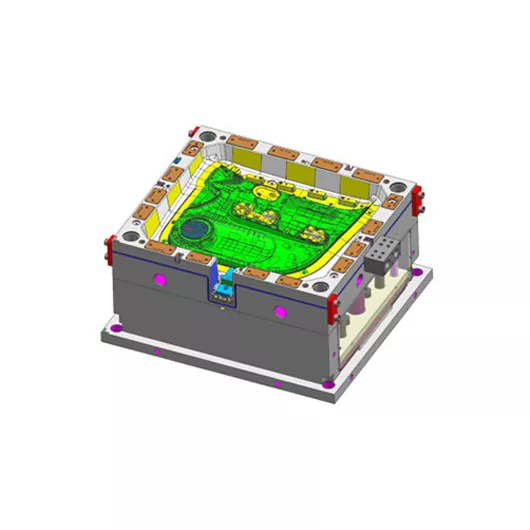
An Automotive Door Panel Main Body Injection Mold is a precision mold used to form the main plastic structure of a vehicle door panel through injection molding. Molten thermoplastic is injected into the mold cavity, cooled under controlled conditions, and then ejected to create the required door-panel geometry.
Automotive door panels are generally large parts with demanding surface and dimensional requirements. Some designs may include multiple undercuts and side mechanisms, making mold opening and part demolding technically challenging. Large door-panel molds can also require sophisticated hot-runner systems and multiple core-pulling mechanisms to achieve reliable filling and release.
Typical design considerations include:
-
Large mold dimensions and high structural strength
-
Complex ribs, clips, bosses, and mounting features
-
Multiple lifters or sliders for undercut structures
-
Hot-runner or valve-gate injection systems
-
Controlled cooling and efficient heat dissipation
-
Textured, matte, leather-grain, or high-quality appearance surfaces
-
Accurate dimensional matching with other vehicle components
Why Is the Mold So Important for Door Panel Production?
The door panel is both a visible interior component and a structural carrier for various functional elements. A poorly designed mold may cause warpage, sink marks, weld lines, flash, uneven texture, short shots, or dimensional deviations.
For appearance-critical automotive interiors, surface quality is especially important. Door-panel molds may need carefully controlled gating, cooling, exhaust, and ejection systems to maintain consistent appearance and dimensional stability.
A well-engineered mold can provide three major benefits:
| Key factor | Manufacturing benefit |
|---|---|
| Precise cavity design | Stable part dimensions |
| Optimized runner and gate system | More balanced filling |
| Efficient cooling | Shorter and more consistent cycles |
| Reliable ejection system | Lower risk of deformation |
| Durable mold steel | Longer tooling service life |
| Customized texture | Consistent interior appearance |
What Role Does the Mold Play in Actual Production?
The effect of an Automotive Door Panel Main Body Injection Mold becomes clear during continuous mass production. Automotive suppliers need to manufacture thousands or even hundreds of thousands of components while keeping quality deviations under control.
A professionally designed mold helps manufacturers achieve:
1. Consistent Product Quality
The cavity and core reproduce the required geometry repeatedly. Proper positioning and precision machining help ensure that mounting holes, clips, ribs, and assembly interfaces remain consistent.
2. Better Surface Appearance
Door panels are often exposed directly to passengers. The mold surface can be engineered for different textures and finishes, including leather-grain patterns, matte surfaces, and other decorative effects. Sikaida's automotive mold solutions cover customized surface and process requirements for different interior applications.
3. Improved Production Efficiency
A balanced hot-runner system can help control melt distribution, while optimized cooling can improve cycle stability. These factors are particularly important for large-area components where uneven filling or cooling can lead to deformation.
4. Reduced Production Risk
Complex door panels may contain numerous undercuts. Appropriate sliders, lifters, and core-pulling mechanisms allow these features to be released safely without damaging the molded part.
How Does Customization Make the Mold More Valuable?
One of the key advantages of working with Sikaida (Tianjin) Int'L Trading Co.,Ltd. is its ability to support vehicle-model customization.
Different car models have different door dimensions, styling concepts, material specifications, assembly methods, and functional layouts. Therefore, a universal mold is rarely an ideal solution for every vehicle platform.
Sikaida can develop customized tooling according to requirements such as:
-
Vehicle model and platform
-
Front or rear door configuration
-
Left-hand or right-hand door design
-
New-energy vehicle or conventional vehicle applications
-
PP, ABS, PP+EPDM+T20 and other suitable materials
-
Surface texture and decorative requirements
-
Mounting clips, ribs, bosses, speaker openings, and storage features
-
Injection machine capacity
-
Production volume and expected mold life
This vehicle-model customization capability is particularly valuable for automotive OEMs, Tier 1 suppliers, and plastic injection molding companies developing new vehicle programs. Instead of forcing a vehicle design into an existing mold structure, the tooling can be engineered around the actual part geometry and manufacturing conditions.
Automotive Door Panel Main Body Injection Mold vs. Standard Plastic Mold
Although both are injection molds, automotive door-panel tooling generally has more demanding requirements.
| Comparison | Automotive Door Panel Main Body Mold | Standard Plastic Mold |
|---|---|---|
| Part size | Usually large | Small to medium |
| Geometry | Complex | Often simpler |
| Surface requirements | High | Application dependent |
| Core pulling | Frequently complex | Usually simpler |
| Injection system | Often hot runner | Hot or cold runner |
| Customization | Strongly vehicle-specific | Often product-specific |
| Production requirement | High-volume automotive production | Broad range |
This difference explains why automotive tooling requires stronger engineering capabilities, more detailed flow analysis, and tighter quality control.
What Materials and Technologies Can Be Considered?
Automotive door-panel applications commonly use engineering plastics and modified polypropylene materials selected according to strength, weight, appearance, durability, and cost requirements. PP-based materials are widely used in automotive interior applications, while reinforced grades can provide an appropriate balance between rigidity and weight.
Depending on the project, mold design may incorporate:
-
Hot-runner technology for controlled material delivery.
-
Valve-gate systems for better control of injection timing and gate appearance.
-
Mold-flow analysis to evaluate filling, pressure, cooling, and potential defects.
-
Slider and lifter mechanisms for complex undercuts.
-
Precision CNC machining for accurate cavity and core geometry.
-
Customized cooling channels to improve temperature control.
-
Special surface treatment or texture processing for decorative surfaces.
What Can Users Expect from a Properly Designed Mold?
The practical value of a high-quality Automotive Door Panel Main Body Injection Mold can be measured through its production results.
Expected Production Effects
-
More consistent door-panel dimensions
-
Improved surface appearance
-
Reduced risk of molding defects
-
More stable repeated production
-
Easier automated demolding
-
Better compatibility with high-volume production
-
Reduced long-term maintenance and production risks
-
Greater flexibility for different vehicle platforms
For automotive manufacturers, these improvements are not only technical benefits. They can also translate into fewer rejected parts, smoother assembly, lower downtime, and better control over manufacturing costs.
Why Choose Sikaida (Tianjin) Int'L Trading Co.,Ltd.?
Sikaida (Tianjin) Int'L Trading Co.,Ltd. focuses on customized automotive interior and exterior injection mold solutions. Its product portfolio includes door-panel molds and other automotive tooling applications, with services designed to accommodate different materials, surface finishes, structural designs, and manufacturing requirements.
The company's key strengths include:
-
Vehicle-model customization: tooling can be developed according to specific vehicle platforms and door-panel structures.
-
Complex-part capability: suitable for large automotive interior components with ribs, undercuts, mounting structures, and decorative surfaces.
-
Process-oriented design: mold design considers injection, cooling, ejection, and surface-quality requirements.
-
Automotive application experience: solutions cover passenger vehicles, SUVs, new-energy vehicles, and other automotive applications.
-
One-stop support: customers can receive assistance throughout the mold-development process.
For projects where the door panel has unusual dimensions, complicated styling, special textures, or customized assembly requirements, vehicle-specific tooling can provide a significant advantage over standardized solutions.
How Can Buyers Select the Right Door Panel Mold?
Before ordering an Automotive Door Panel Main Body Injection Mold, buyers should confirm several technical points:
-
What is the exact vehicle model or platform?
-
What are the finished-part dimensions?
-
Which plastic material will be used?
-
What surface texture or appearance is required?
-
How many cavities are needed?
-
What injection machine will be used?
-
Are there complex undercuts or side features?
-
What production volume is expected?
-
What mold life is required?
-
What are the quality and dimensional tolerances?
Providing these details at the beginning of a project helps the mold supplier develop a more appropriate tooling structure and reduce later modifications.
Conclusion
A high-quality Automotive Door Panel Main Body Injection Mold is more than a production tool—it is an important part of an automotive manufacturing strategy. Its structure affects filling quality, surface appearance, dimensional accuracy, cycle stability, demolding performance, tooling durability, and ultimately the consistency of the finished vehicle interior.
For automotive projects with different door shapes, materials, textures, and functional requirements, vehicle-model customization is one of the most important advantages. Sikaida (Tianjin) Int'L Trading Co.,Ltd. can provide customized automotive injection mold solutions based on specific vehicle platforms and production needs.
If you are developing a new vehicle door panel or looking for a reliable solution for large-scale automotive plastic-part production, contact us today. Sikaida (Tianjin) Int'L Trading Co.,Ltd. can help evaluate your door-panel design, recommend an appropriate mold structure, and develop a customized tooling solution for your specific vehicle model and manufacturing requirements.