
How Does a Hollow Motor Shaft Improve Precision, Efficiency, and Custom Machine Design?
2026-09-04
A Hollow Motor Shaft is more than a lightweight alternative to a conventional solid shaft. By removing material from the shaft center while maintaining an appropriate load-bearing outer structure, this design can reduce rotating mass, lower inertia, and create valuable internal space for cables, tubing, shafts, or other components. Hollow shaft structures are increasingly used in precision machinery, automation, robotics, electric drive systems, and other applications where compactness and controlled motion are important. Research and industrial applications also show that hollow designs can contribute to weight reduction and improved dynamic performance when properly engineered.
For manufacturers looking for precision transmission components, Ningbo Guanshuo Precision Hardware Co., Ltd. provides a professional approach to customized shaft manufacturing, with particular attention to application requirements. One notable advantage is the ability to support customized shaft types, helping customers develop solutions according to different machine structures, including specialized shaft configurations for different vessel types and marine equipment.
What Is a Hollow Motor Shaft?
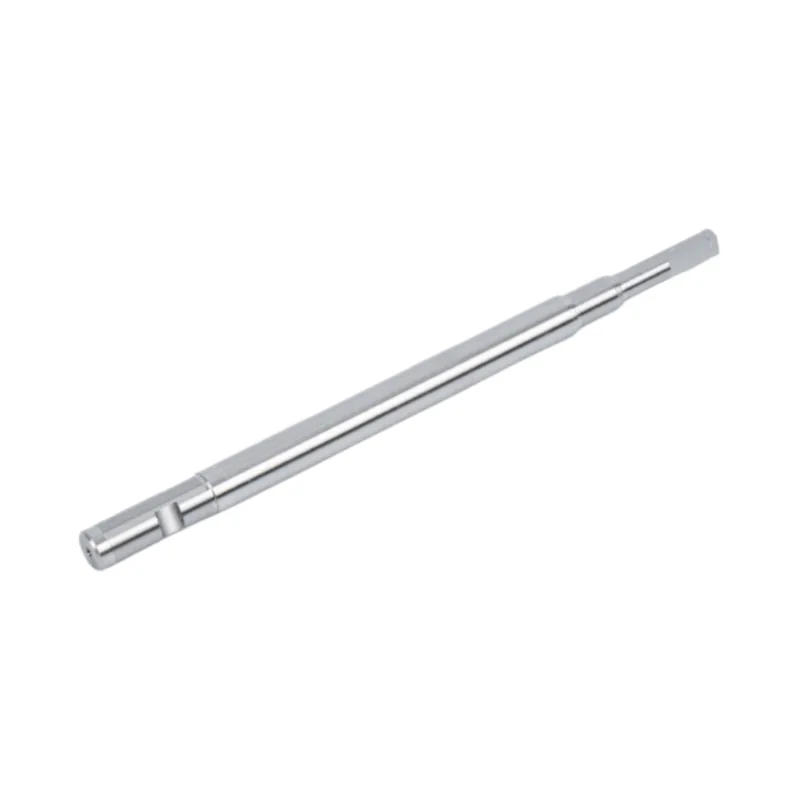
A Hollow Motor Shaft is a motor transmission shaft featuring an internal bore rather than a completely solid cross-section. The hollow structure can be designed as a through-hole or, depending on the application, a blind-hole configuration.
Its basic functions include:
- Transmitting motor torque to the driven component
- Supporting rotating components
- Connecting gears, couplings, pulleys, or other mechanisms
- Reducing unnecessary rotating mass
- Providing an internal passage for cables, tubes, or other components
- Helping create a more compact mechanical structure
Compared with a solid shaft of similar external dimensions, a hollow structure can achieve lower mass and rotational inertia while retaining sufficient mechanical strength when wall thickness, material, geometry, and manufacturing tolerances are correctly designed.
Why Is the Hollow Motor Shaft Important?
The shaft is a critical component in a motor system because it directly participates in torque transmission and rotational motion. Any problems involving dimensional accuracy, concentricity, balance, surface finish, or material strength can affect the performance of the entire machine.
A properly engineered Hollow Motor Shaft can provide several practical benefits.
1. Reduced Weight
Removing material from the center can significantly reduce shaft weight. Lower rotating mass may help reduce inertia and improve acceleration and deceleration characteristics.
This is especially useful for equipment requiring frequent start-stop cycles or rapid positioning. A recent study on hollow railway motor shafts demonstrated that a hollow design could achieve substantial weight reduction while maintaining suitable mechanical properties.
2. Lower Rotational Inertia
Rotational inertia directly affects how easily a rotating assembly changes speed. A lighter shaft can therefore contribute to faster response under suitable operating conditions.
For precision equipment, this can be particularly valuable when the motor repeatedly changes direction or performs high-speed positioning.
3. Internal Installation Space
The central opening is not simply empty space. It can become a useful engineering channel.
Depending on the machine design, the hollow area can accommodate:
- Electrical wiring
- Sensor cables
- Pneumatic tubes
- Vacuum lines
- Optical components
- Cooling passages
- Secondary shafts
- Other mechanical elements
This approach can simplify routing and help reduce interference around rotating components.
Hollow Motor Shaft vs. Solid Motor Shaft
| Feature | Hollow Motor Shaft | Solid Motor Shaft |
|---|---|---|
| Weight | Lower potential weight | Generally higher |
| Rotational inertia | Lower potential inertia | Generally higher |
| Internal passage | Available | Not available |
| Cable/tube routing | Convenient | Requires external routing |
| Material usage | Potentially reduced | More material required |
| Design flexibility | High for specialized applications | Simple and conventional |
| Manufacturing | More demanding | Relatively straightforward |
| Customization | Suitable for complex designs | Suitable for standard designs |
The choice should not be based on weight alone. Torque, bending loads, operating speed, wall thickness, material properties, fatigue requirements, dimensional tolerances, and dynamic balance must all be evaluated.
What Are the Main Uses of a Hollow Motor Shaft?
Hollow shaft technology is suitable for many types of machinery where space, weight, and integration are important.
Industrial Automation
In automated machinery, a Hollow Motor Shaft can provide a clean internal path for cables and pneumatic lines while helping reduce the footprint of rotating assemblies.
Robotics
Robot joints and rotating end-effectors often require multiple cables and tubes. A hollow shaft can provide coaxial routing and help reduce external cable interference.
Precision Equipment
Inspection machines, rotary tables, positioning systems, and other precision equipment can benefit from reduced inertia and compact mechanical integration.
Electric Drive Systems
Lightweight shaft structures are particularly relevant to modern electric drive systems, where reducing rotating mass can contribute to overall system efficiency and dynamic response.
Marine and Vessel Equipment
For marine applications, shaft geometry often needs to correspond closely with the equipment's available installation space, load conditions, connection method, and operating environment.
This is where customized shaft design for different vessel types becomes especially valuable. Instead of forcing different marine systems to use one standard shaft, manufacturers can develop shaft dimensions and connection configurations according to the requirements of fishing vessels, workboats, service vessels, yachts, or other specialized marine equipment.
How Does Customization Improve Hollow Motor Shaft Performance?
A standard shaft may not perfectly match the mechanical requirements of every machine. Customization allows key parameters to be adjusted around the actual application.
Ningbo Guanshuo Precision Hardware Co., Ltd. can focus on application-oriented customization, including considerations such as:
- Outer diameter – matched to available installation space and load requirements.
- Inner diameter – optimized according to weight reduction and structural strength.
- Overall length – adapted to the equipment's transmission layout.
- Keyways and grooves – designed for compatible torque-transmission components.
- Stepped sections – used where different bearing or connection dimensions are required.
- Threads and mounting structures – adapted to specific assembly requirements.
- Surface treatment – selected according to wear, corrosion, and environmental conditions.
- Material selection – determined according to strength, durability, weight, and application conditions.
For marine projects, customization can go further by adapting the shaft to the specific vessel type, propulsion or auxiliary equipment layout, available installation space, and connection requirements.
Why Choose Customized Hollow Motor Shafts for Different Vessel Types?
Marine equipment does not always follow one standard mechanical configuration. Different vessels can have different requirements for space, load, vibration, corrosion resistance, shaft dimensions, and installation interfaces.
For example:
| Vessel Type | Potential Shaft Considerations |
|---|---|
| Fishing Vessel | Compact structure, durability, continuous operation |
| Workboat | Heavy-duty loading and reliable transmission |
| Service Vessel | Space optimization and easy maintenance |
| Yacht | Lightweight construction and compact integration |
| Specialized Vessel | Non-standard dimensions and customized interfaces |
Therefore, a Hollow Motor Shaft manufacturer capable of supporting vessel-specific customization can provide greater flexibility than a supplier limited to standard dimensions.
What Should Buyers Consider When Selecting a Hollow Motor Shaft?
Before placing an order, buyers should provide as much technical information as possible.
Key specification checklist
- Shaft drawing or 3D model
- Material requirements
- Outer and inner diameters
- Shaft length
- Required tolerance
- Keyway or spline dimensions
- Operating speed
- Required torque
- Radial and axial loads
- Surface treatment requirements
- Application environment
- Quantity
- Vessel or equipment type
For high-speed applications, dimensional accuracy and dynamic balance deserve particular attention because manufacturing deviations can influence vibration and operating stability.
How Does Precision Manufacturing Affect Results?
The advantages of a Hollow Motor Shaft depend heavily on manufacturing quality. A hollow design introduces an additional internal surface that must be produced and inspected accurately.
Important quality-control factors include:
- Concentricity
- Straightness
- Roundness
- Inner-hole dimensional accuracy
- Outer-diameter tolerance
- Surface roughness
- Material consistency
- Dynamic balance
- Heat-treatment condition
For precision hardware applications, these parameters should be evaluated together rather than considering dimensional accuracy alone.
Why Work With Ningbo Guanshuo Precision Hardware Co., Ltd.?
For customers requiring specialized transmission components, Ningbo Guanshuo Precision Hardware Co., Ltd. combines a precision-oriented manufacturing approach with customized product development.
Its Hollow Motor Shaft solutions can be developed around the customer's actual equipment rather than relying solely on standard shaft dimensions. This is particularly useful for projects involving different vessel types, where installation conditions and mechanical interfaces can vary considerably.
The customization concept can help customers achieve a better balance between:
Strength + Weight + Precision + Installation Space + Application Compatibility
Whether the requirement involves industrial machinery, automation equipment, electric drive systems, or marine applications, a drawing-based customization process can make the final shaft more closely aligned with the intended equipment.
Conclusion
A Hollow Motor Shaft can provide important engineering advantages, including reduced rotating mass, lower potential inertia, internal routing space, and greater freedom in compact machine design. However, achieving these benefits requires careful consideration of material, wall thickness, geometry, tolerance, balance, torque, and operating conditions.
For buyers with non-standard requirements, customization is often the key to obtaining the right solution. In particular, the ability to customize shafts for different vessel types gives marine equipment manufacturers greater flexibility when dealing with different installation environments and mechanical configurations.
If you are looking for a precision Hollow Motor Shaft tailored to your equipment, vessel type, dimensions, or transmission requirements, Ningbo Guanshuo Precision Hardware Co., Ltd. can help turn your specifications into a practical customized solution. Contact us today to discuss your drawings, technical requirements, and customized shaft project.