
How Do You Choose the Right Stainless Steel Forging Flanges for High-Temperature and Corrosive Environments
2026-07-07
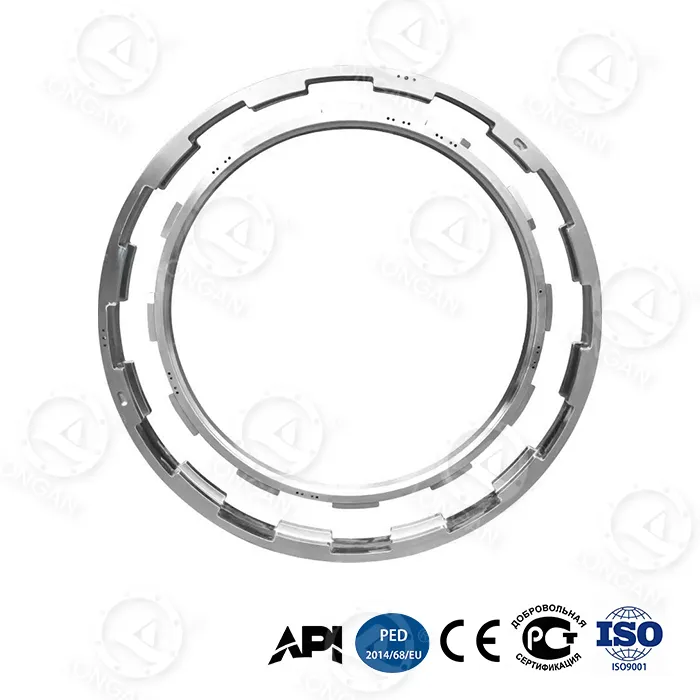
Selecting the correct Stainless Steel Forging Flanges for aggressive service conditions is not a commodity purchase—it is a critical engineering decision. In high-temperature and corrosive environments, the wrong flange can lead to creep failure, stress corrosion cracking, or catastrophic leakage. At Longan, we have supplied forged flange solutions for refineries, chemical plants, and offshore platforms for over two decades. This guide provides a structured, data-driven method to match your application with the optimal Stainless Steel Forging Flanges.
1. Define Your Operating Envelope (The Non-Negotiable Trio)
Before evaluating any flange, you must quantify three parameters. Without these, no supplier—including Longan—can offer a valid recommendation.
| Parameter | Critical Thresholds | Why It Matters |
|---|---|---|
| Maximum Continuous Temperature | °C / °F (e.g., 650°C+) | Above 540°C, creep strength becomes the primary design driver. |
| Peak Cyclic Temperature Spikes | Number of cycles / hour | Thermal fatigue cracks originate at flange hubs. |
| Corrosive Media & Concentration | e.g., 25% H₂SO₄, seawater, sour gas (H₂S) | Determines pitting resistance equivalent number (PREN) requirements. |
| Design Pressure (MAWP) | psi / bar (e.g., 1500# Class) | Directly affects minimum hub thickness and bolt loading. |
2. Grade Selection Matrix – Austenitic vs. Duplex vs. Nickel-Alloy
Not all Stainless Steel Forging Flanges perform equally. For high-temperature creep, you need stabilized grades. For chlorides, you need molybdenum and nitrogen. The table below illustrates Longan’s standard recommendation matrix based on combined thermal-chemical duty.
| Service Environment | Recommended Forging Grade | Key Property | Max Continuous Temp |
|---|---|---|---|
| Dry heat (no chlorides), ≤ 550°C | SS 310H | High creep-rupture strength | 550°C |
| Wet heat with chlorides, ≤ 320°C | SS 316L (low carbon) | Resists intergranular corrosion | 320°C |
| Sour gas / seawater, ≤ 280°C | Duplex 2205 (UNS S31803) | PREN ≥ 35, excellent SSC resistance | 280°C |
| Severe acid + high pressure, ≤ 350°C | Super Duplex 2507 | PREN ≥ 40, high proof stress | 350°C |
| Oxidizing acids up to 650°C | SS 321H (Ti-stabilized) | Prevents carbide precipitation | 650°C |
Critical rule from Longan’s metallurgists: For combined high-temperature (>400°C) and aqueous chlorides, avoid 304/304L. Select a duplex or high-Mo austenitic grade, and always specify a solution-annealed condition with a grain size of 5 or finer.
3. Forging Process – Why It Beats Plate or Bar-Stock
For severe duty, the forging method determines grain flow orientation. Stainless Steel Forging Flanges from Longan are produced via open-die or closed-die forging with a reduction ratio of at least 3:1. This closes internal porosity, aligns grain structure along the hub axis, and doubles fatigue life compared to cut-from-bar flanges. Always request a certified forging procedure specification (FPS) and a hardness test (HBW) after heat treatment—this is a non-negotiable checkpoint for high-temperature creep resistance.
4. Dimensional Standards and Facing Types
For high-temperature bolt creep, choose a Raised Face (RF) or Ring-Type Joint (RTJ) facing. RTJ is mandatory for pressures above 2500#. Ensure your Stainless Steel Forging Flanges comply with ASME B16.5 or B16.47 (for large diameters). At Longan, we machine all gasket serrations to 125–250 AARH finish, because a rougher surface accelerates corrosion under gasket edges.
5. NDT and Inspection Protocol
For critical service, visual inspection is insufficient. Longan mandates the following non-destructive tests for all high-temp/corrosive flange orders:
-
Ultrasonic testing (UT) – 100% of hub areas to detect laminations.
-
Liquid penetrant testing (PT) – for surface defects on sealing faces.
-
Hardness testing – to verify solution annealing (max 187 HBW for 316L).
6. FAQ – Common Questions About Stainless Steel Forging Flanges
Q1: Can I use standard 304 Stainless Steel Forging Flanges at 500°C in a sulfuric acid dew-point environment?
A1: Absolutely not. At 500°C, 304 suffers from sensitization (chromium carbide precipitation at grain boundaries), which destroys corrosion resistance in any acid. Worse, the dew-point of sulfuric acid (around 120–160°C) combined with thermal cycling causes intergranular attack. Longan recommends SS 310H for the temperature and a high-silicon alloy for the acid dew-point, or alternatively, use a refractory lining on the pipe side. If you must use austenitic, select SS 321H with a stabilisation heat treatment, but never standard 304.
Q2: How do I calculate the correct bolting torque for Stainless Steel Forging Flanges in cyclic high-temperature service to avoid gasket relaxation?
A2: Torque alone is misleading. For thermal cycling above 350°C, you must calculate residual bolt stress using the ASME PCC-1 methodology, accounting for differential thermal expansion between studs (usually alloy steel) and the flange (austenitic). At Longan, we supply a torque chart with each flange based on your service temperature, but the critical step is re-torqueing after the first heat-up to 80% of operating temperature. Use belleville washers or load-indicating washers to maintain gasket stress above 30 MPa even after thermal relaxation. Never use anti-seize compounds containing copper above 400°C—they cause galling of threads.
Q3: What is the typical lifespan of Stainless Steel Forging Flanges in an offshore chloride environment at 280°C, and how can I extend it?
A3: For Duplex 2205 flanges at 280°C in seawater-exposed atmospheres, the typical service life before pitting or stress corrosion cracking (SCC) is 8–12 years, depending on oxygen content and crevice conditions. To extend this to 20+ years, Longan recommends three actions: (1) specify a PREN ≥ 38 (use Super Duplex 2507), (2) apply a hard-faced overlay (Inconel 625) on the gasket contact face, and (3) install sacrificial zinc anodes near the flange pair to reduce galvanic potential. Additionally, ensure the flange is post-weld heat-treated (PWHT) if welded directly to the pipe—this reduces residual tensile stresses, the primary driver for SCC.
7. Final Engineering Checklist
Before you issue a purchase order, verify these five items with your supplier:
-
Certified mill test report (MTR) showing actual chemistry and mechanicals.
-
Grain size measurement (ASTM E112) – ≤ 5 for creep duty.
-
Intergranular corrosion test (ASTM A262 Practice E) for austenitic grades.
-
Positive material identification (PMI) at receiving.
-
Hub thickness measurement – at least 1.25× the pipe wall thickness for high-pressure.
8. Why Longan Stands Apart
Longan does not simply supply Stainless Steel Forging Flanges—we engineer them. Each flange is traced from raw melt to final machining with a unique heat code. Our in-house metallurgical lab performs impact testing at -46°C for low-temperature toughness, even for high-temp orders, because emergency shutdowns can introduce brittle conditions. We also provide on-site torque training and thermal-bolt-load calculations free of charge for project orders.
Contact Us for Your Critical Flange Specification
Selecting the right Stainless Steel Forging Flanges for high-temperature and corrosive environments demands more than a datasheet—it demands a partnership. If your operating conditions fall outside our matrix, or if you need custom bore sizes, special facing finishes, or third-party inspection witnessing, reach out to Longan’s engineering team today. Send your process conditions (temperature, pressure, media, and cycle frequency) to our technical sales desk, and we will return a fully traceable, grade-optimised quotation within 48 hours. Contact Longan now—because the wrong flange is a liability; the right flange is an asset.