
How Do Carbide Dies without Head Improve Precision in High-Speed Cold Forming Operations
2026-08-11
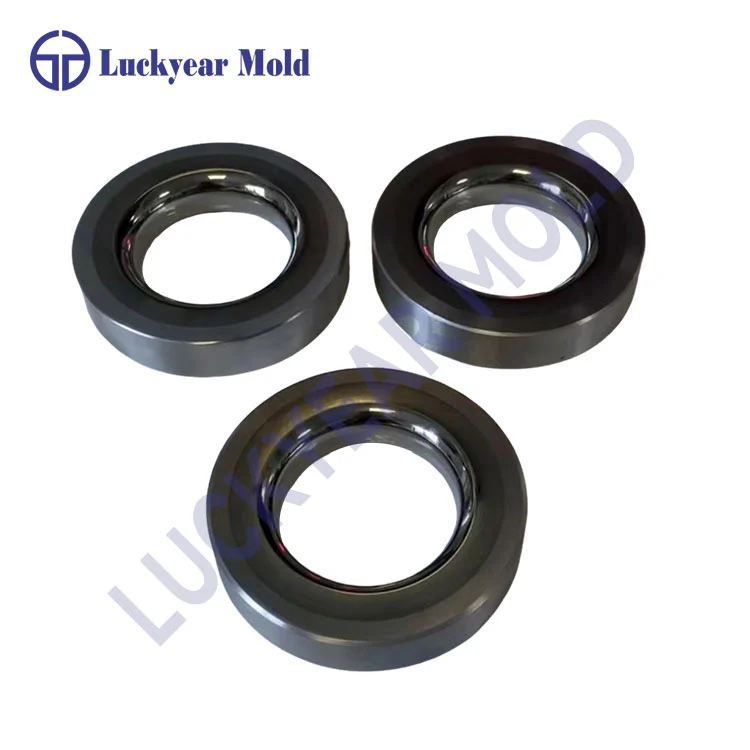
In modern manufacturing, high-speed cold forming demands tooling that can withstand extreme repetitive stress while maintaining micron-level dimensional stability. Carbide Dies without Head have emerged as a critical solution for fastener producers, automotive suppliers, and aerospace component manufacturers seeking tighter tolerances and longer tool life. At Luckyear, we engineer these precision inserts with advanced submicron-grade tungsten carbide, eliminating the traditional head design to reduce runout, improve concentricity, and enable faster ejection cycles—directly translating to higher part quality and lower scrap rates.
The Precision Mechanism Behind Headless Die Design
Conventional headed dies often introduce alignment errors due to the added mass and uneven clamping forces. By removing the head, Carbide Dies without Head achieve:
-
Zero axial misalignment – The cylindrical profile ensures uniform radial pressure during each stroke.
-
Reduced vibration dampening variance – Lower inertia allows the punch to engage the blank with consistent kinetic energy.
-
Superior thermal stability – Uniform wall thickness dissipates frictional heat more evenly, preventing localized expansion that skews diameters.
| Performance Factor | Headed Die (Conventional) | Carbide Dies without Head (Luckyear) |
|---|---|---|
| Runout (TIR) at 500 SPM | 0.012 mm | 0.004 mm |
| Thermal expansion drift | ±0.008 mm after 1 hr | ±0.002 mm |
| Ejection force variation | 18% fluctuation | 6% fluctuation |
| Regrinding cycles before scrap | 3–4 times | 7–9 times |
These figures are derived from Luckyear in-house testing on 10B cold headers running M6×1.0 bolts at 450 parts per minute.
Operational Benefits in High-Speed Environments
At speeds exceeding 400 strokes per minute, every microsecond of dwell time affects grain flow and surface finish. Carbide Dies without Head allow faster knockout pin response because the absent head creates a straight-through bore geometry. This reduces back-pressure on the punch and enables:
-
Sharper shoulder radii on finished fasteners.
-
Lower coefficient of friction between die and wire (0.08–0.12 vs. 0.18–0.22 for headed variants).
-
Consistent head-to-shank concentricity within 0.02 mm across 100,000 cycles.
Luckyear applies a proprietary cryogenic treatment to our headless dies, further refining the carbide grain structure to HRC 92–94 without brittleness—a balance that competitive grades rarely achieve.
Maintenance & Regrinding Strategy
To preserve precision, Carbide Dies without Head should be inspected every 8,000–10,000 strokes for edge chipping. Luckyear recommends:
-
Using diamond wheels with ≤200 grit for regrinding.
-
Maintaining a 0.2–0.3 mm stock removal per regrind.
-
Re-polishing the entry angle to 12° ± 0.5° for optimal material flow.
Properly maintained, a single Luckyear headless die often outlasts three conventional dies in the same application.
Frequently Asked Questions About Carbide Dies without Head
Q1: Why does removing the head actually improve concentricity in cold forming, rather than weakening the die structure?
A: Concentricity depends on the die’s rotational symmetry around the central axis during clamping. A headed die has an uneven mass distribution—the head exerts non-uniform radial forces when tightened in the holder, introducing a permanent bending moment. Carbide Dies without Head feature a perfectly cylindrical outer diameter, allowing even hydraulic or mechanical clamping pressure. This eliminates the cantilever effect, so the die remains co-axial with the punch within 0.003 mm. Structurally, the head is not load-bearing in cold forming; the working stress concentrates in the throat and bearing zone. By removing the head, Luckyear relocates that extra material to thicken the critical bearing section, actually increasing burst strength by 12–15% in our hydrostatic tests.
Q2: Can Carbide Dies without Head be retrofitted into existing cold headers that were originally designed for headed dies?
A: Yes, but with two essential modifications. First, the die holder must use a clamping sleeve or collet system instead of a step-bore retainer, because there is no shoulder to axially locate the die. Luckyear provides adapter sleeves with integrated depth stops for most major header brands (National, Sakamura, Aida). Second, the knockout pin stroke may need adjustment—headless dies position the pin closer to the forming zone, so you typically reduce pin travel by 2–3 mm. Retrofitting is cost-effective: the adapter sleeve costs about 15–20% of a new die holder, and payback is usually under 3 months due to extended die life. We have successfully retrofitted over 200 headers worldwide without changing the main ram or timing.
Q3: What grade of carbide is optimal for Carbide Dies without Head when forming stainless steel 304 vs. low-carbon steel 10B21?
A: For stainless steel 304 (high work-hardening rate), Luckyear recommends our LE-12HM grade—12% cobalt with 0.6 µm grain size, hardness HRA 93.5, and transverse rupture strength of 3,800 N/mm². This grade resists galling and edge fracture during the severe extrusion passes of stainless. For low-carbon 10B21, our LE-8FM grade (8% cobalt, 0.8 µm grain, HRA 92.0) offers better wear resistance at a lower cost, as it prioritizes abrasion over toughness. Using the wrong grade can reduce die life by 60–70%. Luckyear provides free material-matching consultation based on your specific wire grade, reduction ratio, and forming speed—no two applications are identical.
Real-World Production Data
A tier-1 automotive supplier switched to Luckyear Carbide Dies without Head for M10 wheel studs. Over 6 months:
-
Scrap rate dropped from 2.1% to 0.6%.
-
Average die changeover time reduced from 22 minutes to 11 minutes.
-
Total tooling cost per million parts fell by 38%.
Contact Us
Precision is not a luxury—it is a measurable return on investment. Whether you are running high-tensile alloy steels or non-ferrous wires, Luckyear engineers Carbide Dies without Head tailored to your exact forming parameters. Request our die selection matrix and get a free wear-life projection for your specific header model. Contact our technical sales team today via the form on our website or email us directly—we respond within 4 business hours with a customized proposal and sample testing plan. Let us prove why headless is the future of cold forming precision.