
How Can a Screw for YIZUMI Injection Machine Improve Plasticizing Performance?
2026-09-01
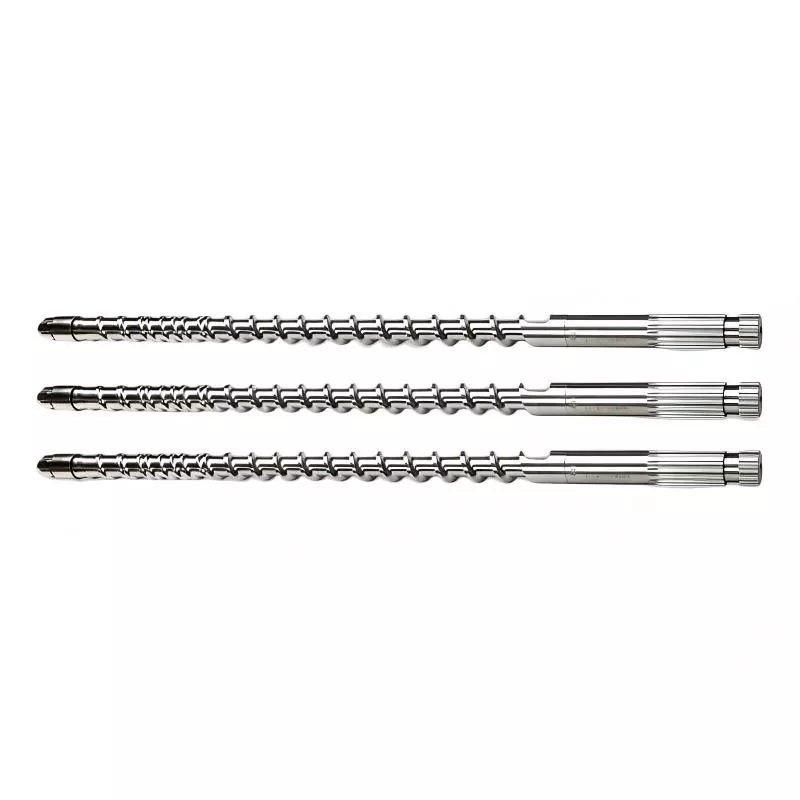
In injection molding, the screw is one of the most important components for achieving stable plasticizing, efficient melting, uniform mixing, and consistent injection. A properly engineered Screw for YIZUMI Injection Machine works together with the barrel to transform plastic pellets into a homogeneous melt and deliver it accurately into the mold. YIZUMI injection molding machines are available with different injection-unit configurations and screw diameters, making correct screw selection particularly important for production efficiency and product quality.
For manufacturers using different polymers, fillers, colors, or processing conditions, a standard screw may not always provide the ideal solution. ZHOUSHAN HAPPY PLASTICS MACHINERY CO., LTD. focuses on supplying injection molding machine screws and related components with engineering-oriented customization. One of its key advantages is support for special-shaped screw customization, allowing the screw geometry to be developed according to the machine model, material characteristics, processing requirements, and customer's application.
Why Is the Screw So Important in Injection Molding?
The injection screw performs several functions during the molding cycle. It conveys plastic material forward, generates frictional and shear heat, promotes melting and mixing, and finally injects the molten polymer into the mold.
A high-quality screw can help improve:
-
Plasticizing efficiency
-
Melt uniformity
-
Color dispersion
-
Injection stability
-
Production consistency
-
Energy utilization
-
Resistance to wear and corrosion
-
Overall service life of the screw and barrel
YIZUMI's own technical information highlights the importance of screw optimization for plasticizing efficiency, mixing, and injection stability. Different machine series can also use different screw diameters and injection-unit configurations, which means screw replacement should be based on actual machine specifications rather than simply selecting a visually similar component.
What Does a Screw for YIZUMI Injection Machine Do?
The screw generally consists of several functional sections, including the feeding, compression, and metering zones. Each section has a specific role in the plasticizing process.
| Screw Section | Main Function | Processing Effect |
|---|---|---|
| Feeding Zone | Conveys solid pellets | Stable material feeding |
| Compression Zone | Compresses and melts polymer | Efficient melting |
| Metering Zone | Homogenizes the melt | Stable melt quality |
| Mixing Section | Enhances dispersion | Better color and additive mixing |
| Screw Tip & Check Ring | Controls melt flow | More consistent injection |
The geometry of these sections can be adjusted according to the characteristics of the processed material. For example, engineering plastics, glass-fiber-reinforced materials, abrasive compounds, and heat-sensitive polymers can require different screw designs.
This is where customized screw engineering becomes particularly valuable.
How Does a Customized Screw Improve Production?
A customized Screw for YIZUMI Injection Machine can be designed around the actual production conditions rather than relying solely on a general-purpose configuration.
For example, screw geometry may be adjusted in areas such as:
-
Screw diameter
-
L/D ratio
-
Compression ratio
-
Flight depth
-
Feeding section design
-
Mixing section structure
-
Screw head configuration
-
Surface treatment
-
Material selection
-
Hardness and wear resistance
The objective is to achieve a better balance between melting capacity, mixing performance, injection stability, and component durability.
YIZUMI documentation shows that injection units can have multiple screw diameter options for the same machine family, while some models also offer different screw configurations. Therefore, confirming the machine model, screw diameter, and processing requirements before manufacturing is essential.
Special-Shaped Screw Customization: A Major Advantage
One of the strongest advantages of ZHOUSHAN HAPPY PLASTICS MACHINERY CO., LTD. is its ability to support special-shaped screw customization.
Instead of limiting customers to conventional screw geometries, customized designs can be developed for specific applications. A special-shaped screw can be considered when conventional screw designs cannot adequately satisfy requirements for mixing, melting, conveying, or material processing.
Customization can be based on:
-
Machine model – Matching the injection unit and installation dimensions.
-
Screw specifications – Including diameter, length, L/D ratio, and geometry.
-
Plastic material – Such as PP, PE, ABS, PA, PC, POM, or reinforced compounds.
-
Production requirements – Including output, cycle time, injection speed, and plasticizing capacity.
-
Material characteristics – Considering viscosity, abrasiveness, thermal sensitivity, and filler content.
-
Application requirements – Developing suitable geometry for demanding molding processes.
This flexibility makes the company a practical option for customers who require replacement screws as well as application-specific solutions.
Standard Screw vs. Customized Screw
| Aspect | Standard Screw | Customized Screw |
|---|---|---|
| Machine Compatibility | Based on standard specifications | Designed for specific machine requirements |
| Material Adaptability | General applications | Targeted material processing |
| Mixing Performance | Standard | Can be optimized |
| Wear Resistance | General selection | Can be matched to material |
| Special Applications | Limited | Stronger adaptability |
| Special-Shaped Design | Usually unavailable | Supported |
| Production Optimization | General-purpose | Application-oriented |
A standard screw can be suitable for common molding applications. However, when production involves demanding materials or specialized processing conditions, customization can provide greater flexibility.
What Materials Can Be Considered?
Material selection is another important part of screw manufacturing. The screw must withstand mechanical loads, heat, friction, and potentially abrasive or corrosive polymers.
Depending on the application, customers may consider solutions featuring:
-
High wear resistance
-
High corrosion resistance
-
Improved surface hardness
-
Suitable toughness
-
Enhanced fatigue resistance
-
Application-specific surface treatment
This approach is consistent with the broader industry practice of developing screw and barrel solutions according to different polymer-processing requirements. YIZUMI, for example, describes specialized screw and barrel solutions for general resins, engineering plastics, high-wear applications, high-corrosion applications, and low-shear applications.
What Production Effects Can Be Expected?
The performance of a screw directly influences the plasticizing stage and therefore affects downstream injection molding.
A properly selected or customized screw can help manufacturers achieve:
More uniform melting: Better screw geometry promotes consistent heat transfer and material mixing.
Improved color dispersion: Optimized mixing can reduce color variation when masterbatch or pigments are used.
More stable plasticizing: Appropriate feeding and compression characteristics help maintain consistent melt preparation.
Reduced material degradation: A screw designed for the material can help avoid unnecessarily aggressive shear.
Better production stability: Consistent plasticizing contributes to more predictable injection cycles.
Longer component life: Suitable materials and surface treatments can improve resistance to wear under demanding conditions.
These benefits are particularly important in high-volume production, where even small improvements in cycle stability can accumulate into significant productivity gains.
How to Choose the Right Screw for YIZUMI Injection Machine?
Before ordering a replacement or customized screw, buyers should provide as much technical information as possible.
Recommended Information Checklist
-
YIZUMI machine series and model
-
Screw diameter
-
Screw overall length
-
L/D ratio
-
Screw stroke
-
Original screw drawing, if available
-
Processed plastic material
-
Material grade and additives
-
Glass-fiber or mineral-filler content
-
Required production output
-
Existing screw problems
-
Desired mixing or plasticizing performance
-
Required surface treatment
-
Special-shaped screw requirements
Providing an original drawing or worn screw sample can further improve dimensional matching and reduce installation risks.
Why Choose ZHOUSHAN HAPPY PLASTICS MACHINERY CO., LTD.?
For buyers searching for a Screw for YIZUMI Injection Machine, the value of a supplier is not limited to producing a replacement component. Engineering communication, dimensional accuracy, material selection, customization capability, and application understanding are equally important.
ZHOUSHAN HAPPY PLASTICS MACHINERY CO., LTD. combines manufacturing experience with customized screw solutions to serve different injection molding requirements. Its ability to support special-shaped screw customization gives customers more freedom when conventional replacement screws cannot meet their specific processing needs.
Whether the requirement involves a standard replacement, improved wear resistance, enhanced mixing, material-specific optimization, or a specially designed screw profile, a customized approach can help create a solution that better matches the actual production environment.
Final Considerations
The screw is much more than a simple rotating metal component. It is a core part of the plasticizing and injection system, directly influencing how efficiently raw materials are melted, mixed, conveyed, and injected.
Choosing the right Screw for YIZUMI Injection Machine requires consideration of the machine model, screw dimensions, polymer characteristics, production requirements, and expected service conditions. For standard applications, a correctly matched replacement screw may be sufficient. For demanding or specialized applications, however, a customized and special-shaped screw can offer greater flexibility and application potential.
With professional customization capabilities, ZHOUSHAN HAPPY PLASTICS MACHINERY CO., LTD. provides an engineering-focused option for customers seeking reliable screw solutions for YIZUMI injection molding equipment.
Looking for a replacement or customized Screw for YIZUMI Injection Machine? Share your machine model, screw specifications, material information, or drawing with ZHOUSHAN HAPPY PLASTICS MACHINERY CO., LTD. The team can help evaluate your requirements and develop a suitable solution. For standard or special-shaped screw requirements, contact us today to discuss your application and customization needs.