
How Aluminum Profiles Shape Solar Module Frames?
2026-11-09
A solar module frame is often described as a simple aluminum picture frame. That description hides the engineering. The frame must hold the laminate against wind uplift, protect the glass edge during transport, provide a clamping surface for the mounting system, allow water to drain, and remain dimensionally stable for 25 years outdoors. These requirements pull the design in different directions, and the Aluminum Profiles cross section is the place where they are reconciled. The geometry of the profile, the alloy and temper, and the surface treatment together determine whether the frame performs. This guide explains how each factor shapes the final frame.
1. Why Must a Solar Frame Satisfy Four Conflicting Requirements at Once?
The four requirements are mechanical strength, edge protection, mounting compatibility, and long-term weather resistance. Mechanical strength requires a deep section and thick walls to resist bending under wind and snow load. Edge protection requires a groove that cradles the laminate without point contact. Mounting compatibility requires a flange that matches the clamp opening and a surface that distributes the clamp force. Weather resistance requires a coating or an anodized layer that does not chalk, crack, or corrode. A profile that is optimized for one requirement will often fail another. A very deep section adds strength but increases weight and cost. A very tight groove protects the edge but makes assembly difficult. The Aluminum Profiles design is therefore a compromise, and the compromise is defined by the cross section. In our factory, we extrude solar frame profiles and supply them with the laminate and clamp dimensions already checked. Ningbo Gangtong Zheli Fasteners Co.,Ltd. has been supplying aluminum profiles for over 12 years.
The compromise is not arbitrary. It is calculated from the module size, the glass thickness, the snow load, and the wind load for the installation site. A frameless module has different requirements, but most utility scale modules still use a framed construction because the frame protects the glass edge during handling and provides a predictable clamping surface.
2. How Does the Cross Section Geometry Distribute Mechanical Load?
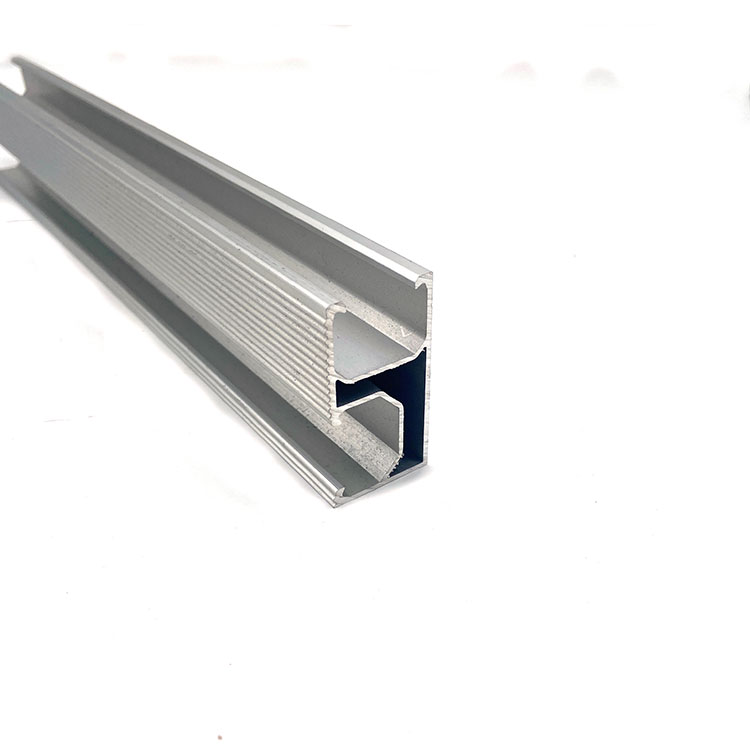
The cross section of a solar frame profile has four functional zones. The first is the main body, which carries the bending load between the mounting clamps. The second is the laminate groove, which holds the glass and the encapsulant. The third is the flange, which provides the clamping surface. The fourth is the drainage channel, which allows water to escape from the groove. The depth of the main body and the thickness of its walls determine the moment of inertia and therefore the bending stiffness. The groove depth and width determine the edge protection. The flange thickness determines the clamp bearing stress. A profile with a 1.2 millimeter wall and a 35 millimeter body depth has a moment of inertia of about 12,000 mm⁴. Increasing the wall to 1.5 millimeters raises the moment of inertia by about 25 percent, which allows a longer clamp span or a higher snow load. The table below shows the relationship between profile geometry and frame performance.
| Profile parameter | Typical range | Effect on frame performance |
| Body depth | 30 – 40 mm | Higher depth increases bending stiffness and wind resistance |
| Wall thickness | 1.0 – 1.8 mm | Thicker walls increase stiffness and screw pull-out strength |
| Groove width | 4.5 – 6.0 mm | Must match laminate thickness plus sealing tape |
| Groove depth | 15 – 25 mm | Deeper groove protects the glass edge and holds the sealant |
| Flange thickness | 1.5 – 2.5 mm | Thicker flange distributes clamp force and resists local deformation |
| Drainage channel | 2 – 4 mm | Allows water to escape and prevents pooling in the groove |
The drainage channel is often overlooked. A frame without a drainage path will collect water in the groove, and the water will freeze in cold climates or promote corrosion in coastal climates. In our factory, we include a drainage channel in every solar frame profile and we verify the channel continuity on the extrusion die. Ningbo Gangtong Zheli Fasteners Co.,Ltd. provides the cross section drawing with the drainage path marked.
3. What Role Does the Alloy and Temper Play in Frame Stiffness and Corrosion?
The most common alloy for solar frames is 6063, with a T5 or T6 temper. The 6063 alloy is chosen because it has good extrudability, which allows complex cross sections with thin walls, and good corrosion resistance, which is important for outdoor service. The T5 temper is cooled by air or mist after extrusion, and the T6 temper is cooled by water quench. The T6 temper has a higher yield strength, typically 170 MPa compared to 110 MPa for T5, which allows a thinner wall or a longer clamp span. But the T6 temper has a higher residual stress and may distort in complex sections. The table below compares the two tempers for solar frame applications.
| Property | 6063-T5 | 6063-T6 |
| Yield strength | 110 MPa | 170 MPa |
| Tensile strength | 150 MPa | 205 MPa |
| Elongation | 12% | 10% |
| Distortion risk in complex sections | Low | Moderate |
| Typical frame application | Residential and commercial modules | Large format and high load modules |
Extrusion engineer's note: The temper is not simply a strength choice. It affects the dimensional stability of the profile and the anodizing appearance. A T6 profile with a complex cross section may have a slight twist after quenching, which must be straightened before anodizing. In our factory, we select the temper based on the section complexity and the load requirement, and we straighten the profile before aging. Ningbo Gangtong Zheli Fasteners Co.,Ltd. provides the temper and the mechanical properties with each shipment.
4. Why Does the Surface Treatment Determine Both Warranty and Recyclability?
The surface treatment protects the Aluminum Profiles from corrosion and provides the appearance that the module manufacturer wants. The two common treatments are anodizing and powder coating. Anodizing creates a hard, transparent oxide layer that is part of the metal, so it does not chip or peel. Powder coating creates a colored polymer layer that is thicker and more uniform, but it can chip at the edges and it must be removed before the aluminum can be recycled as a single stream. Anodizing is therefore preferred for recyclability, and powder coating is preferred for color matching and for coastal environments where a thicker barrier is needed. In our factory, we offer both treatments and we control the anodizing thickness to 10 to 15 microns for solar frames. We also control the powder coating thickness to 60 to 80 microns and we verify the adhesion with a cross cut test. Gangtong Zheli Fasteners provides the coating thickness and adhesion report with each order.
The surface treatment also affects the assembly. A thick powder coating reduces the groove width and the flange thickness, which can cause an interference fit with the laminate or the clamp. We compensate the extrusion die for the coating thickness so that the finished dimensions meet the specification after coating.
5. How Should Module Designers Specify and Verify Aluminum Profiles for Frames?
The specification should include six items. The first is the alloy and temper. The second is the cross section drawing with the critical dimensions and tolerances. The third is the surface treatment type and thickness. The fourth is the mechanical properties, including the yield strength and the elongation. The fifth is the corrosion test requirement, such as the salt spray hours. The sixth is the packaging and the traceability requirement. The verification should include four checks. The first is the cross section measurement on a profile projector. The second is the mechanical property test on a tensile specimen. The third is the coating thickness and adhesion test. The fourth is the salt spray test on a sample. In our factory, we perform these checks on every lot and provide the inspection report with the shipment. Gangtong Zheli Fasteners also offers a pre-production sample for the module designer to verify the fit with the laminate and the clamp.
We recommend that the designer verify the frame stiffness with a bending test on a full size module, not just on the profile. The frame behaves differently when it is assembled with the glass and the laminate, and the bending test reveals the interaction between the frame and the module. A frame that passes the profile test may still deflect too much when assembled.
Frequently Asked Questions About Aluminum Profiles for Solar Module Frames
Summary for Module Designers and Frame Buyers
Aluminum Profiles shape solar module frames through the cross section geometry, the alloy and temper, and the surface treatment. The cross section distributes the mechanical load, protects the laminate edge, provides the clamping surface, and allows drainage. The alloy and temper determine the stiffness and the dimensional stability. The surface treatment determines the corrosion resistance, the appearance, and the recyclability. The specification should include the alloy and temper, the cross section drawing, the surface treatment, the mechanical properties, and the corrosion test. The verification should include the cross section measurement, the mechanical property test, the coating test, and the salt spray test. Ningbo Gangtong Zheli Fasteners Co.,Ltd. has been supplying aluminum profiles for over 12 years and provides full frame design and verification support for our customers.