
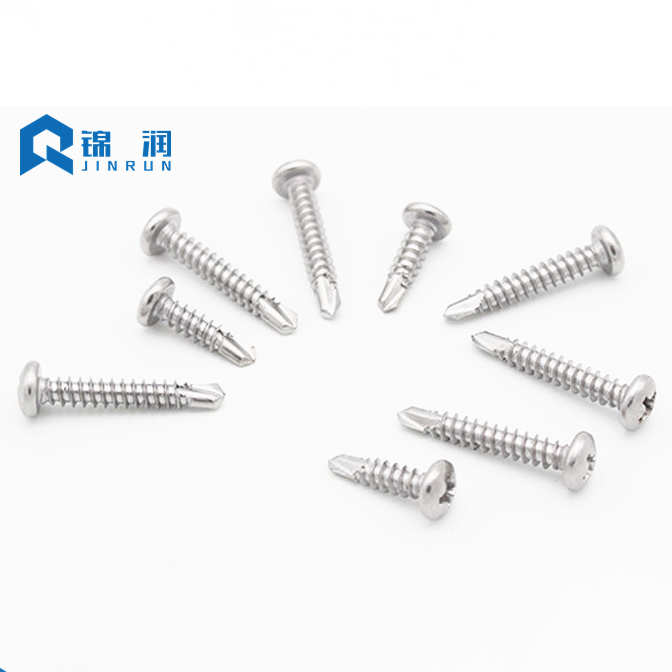
Do Stainless Steel Pan Head Self Drilling Screws Require a Pilot Hole for Thick Steel Plate
2026-07-14
When working with heavy-gauge steel structures, one of the most debated questions among fabricators and contractors is whether a pilot hole is necessary before driving a Stainless Steel Pan Head Self Drilling Screw into thick plate. The short answer is not always—but the longer answer depends on material thickness, screw design, and the specific demands of your application. At Jinrun, we engineer fasteners that balance cutting efficiency with structural integrity, and understanding this single variable can save thousands of dollars in rework, tool wear, and joint failure.
How Self-Drilling Screws Actually Work
A true Stainless Steel Pan Head Self Drilling Screw features a built-in drill point (often a #2, #3, or #5 point) that acts like a twist drill. The point cuts its own hole, taps threads, and seats the head—all in one operation. This differs from a self-tapping screw, which requires a pre-drilled hole.
However, the drill point has limits. The screw’s ability to penetrate steel without a pilot hole is governed by:
-
Point type (drill point number)
-
Steel thickness (gage or millimeter)
-
Tensile strength of the base material
-
RPM and feed pressure during installation
Thick Steel Plate: Where the Rules Change
Industry standards generally define “thick” steel as anything above 3/16″ (4.8 mm) for self-drilling fasteners. Up to that threshold, a #3 or #5 drill point on a Stainless Steel Pan Head Self Drilling Screw can usually self-penetrate without pre-drilling. Beyond 1/4″ (6.35 mm), even the best drill points struggle with three issues:
| Challenge | Consequence |
|---|---|
| Excessive torque | Stripped heads or broken shanks |
| Work hardening | The steel hardens under friction, dulling the point |
| Chip clogging | Flutes fill with metal curls, stalling penetration |
| Misalignment | The screw walks off-center, ruining the joint |
The “Pilot Hole or Not” Decision Table
| Base Material Thickness | Recommended Action | Reason |
|---|---|---|
| ≤ 1/8″ (3.2 mm) | No pilot hole needed | Standard #2–#3 drill point penetrates easily |
| 3/16″ (4.8 mm) | Optional pilot (1/8″) | Reduces torque by 30%, extends tool life |
| 1/4″ (6.35 mm) | Strongly recommended | Prevents point breakage; ensures full thread engagement |
| ≥ 5/16″ (7.9 mm) | Mandatory pilot hole | Self-drilling point cannot clear chips effectively |
For applications above 1/4″, Jinrun advises using a pilot hole diameter equal to the screw’s root diameter (not the major diameter). This preserves the screw’s thread-forming capability while eliminating the high friction that leads to galling—a common failure mode for stainless steel.
Why Stainless Steel Adds Another Layer of Complexity
Stainless steel is prone to work hardening and galling (cold welding) when friction generates high heat. Without a pilot hole in thick plate, the prolonged cutting time raises temperature sharply. The result? The screw’s drill point anneals (softens) or the threads seize mid-joint. Jinrun mitigates this with a proprietary surface passivation that reduces coefficient of friction, but even our fasteners perform best when the substrate thickness exceeds 5 mm with a small pilot guide.
Best-Practice Installation Workflow for Thick Steel
-
Check drill point rating – Use a #5 point for steel up to 1/2″ with pilot, #3 for up to 1/4″ without.
-
Select pilot diameter – For a 1/4-14 screw, use a 3/16″ pilot hole in 1/4″ plate.
-
Set clutch torque – Adjust to 70–80% of the screw’s ultimate torsional strength.
-
Use cutting fluid – A light paste lubricant doubles drill point life.
-
Verify penetration – At least 3 full threads must pass through the far side.
FAQ – Common Questions About Stainless Steel Pan Head Self Drilling Screws
Q: Can a Stainless Steel Pan Head Self Drilling Screw drill through 3/8″ mild steel without any pilot hole?
A: Technically yes, but practically no. While a #5 drill point can penetrate 3/8″ steel, the required torque often exceeds 150 in-lbs, which risks snapping the screw or damaging the driver. More importantly, the screw will generate enough heat to soften the drill point after the first 2–3 fasteners. Jinrun recommends a 5/32″ pilot hole for 3/8″ plate to maintain consistent installation quality and avoid field failures. The pilot hole also ensures the screw goes in straight, which is critical for flush pan-head seating in visible applications.
Q: Does using a pilot hole reduce the holding power of a Stainless Steel Pan Head Self Drilling Screw in thick steel?
A: No, it actually improves it—provided the pilot hole is correctly sized. If the pilot hole is smaller than the screw’s root diameter, the threads still cut deeply into the base material, achieving full shear strength. In fact, tests at Jinrun show that a properly piloted joint retains 98–100% of the pull-out value compared to a non-piloted joint, while eliminating the risk of stress cracks around the entry point. The only loss occurs when the pilot hole exceeds the root diameter—then you lose thread bite. Always match the pilot to the screw’s minor diameter.
Q: What happens if I don’t use a pilot hole and the screw stops halfway through the thick steel plate?
A: This is the most common field complaint. When the drill point stalls, the driver continues to rotate, twisting the screw shank until it either shears off or strips the pan head recess. At that point, the screw is lodged permanently—removing it often damages the surrounding material. If you encounter resistance, back the screw out immediately, clear the chips, and drill a pilot hole for the remaining fasteners. For critical structural joints, Jinrun advises replacing any screw that experienced torque above 80% of its rated capacity, because microscopic fatigue cracks may already exist.
Final Verdict
For steel plate up to 1/4″ thick, a high-quality Stainless Steel Pan Head Self Drilling Screw from Jinrun can eliminate pilot holes entirely, saving time and labor costs. For anything thicker, pre-drilling is not a concession—it is a precision strategy that preserves screw strength, joint reliability, and tool longevity. The small extra step of adding a pilot hole pays back in reduced downtime, fewer stripped screws, and auditable installation records.
Contact Us
Every steel thickness and environment presents unique variables—from marine humidity to seismic loads. Jinrun does not offer generic answers; we provide application-specific torque charts, point-type recommendations, and custom pilot-hole calculators for your exact material specs. Reach out to our engineering support team with your plate thickness, grade, and production volume, and we will return a fastening protocol that balances speed with zero-defect quality. Contact Jinrun today—because the right pilot decision starts with a conversation, not a guess