
Can You Use a Phillips Pan Head Chipboard Screw in Hardwood Without Pre-Drilling
2026-07-06
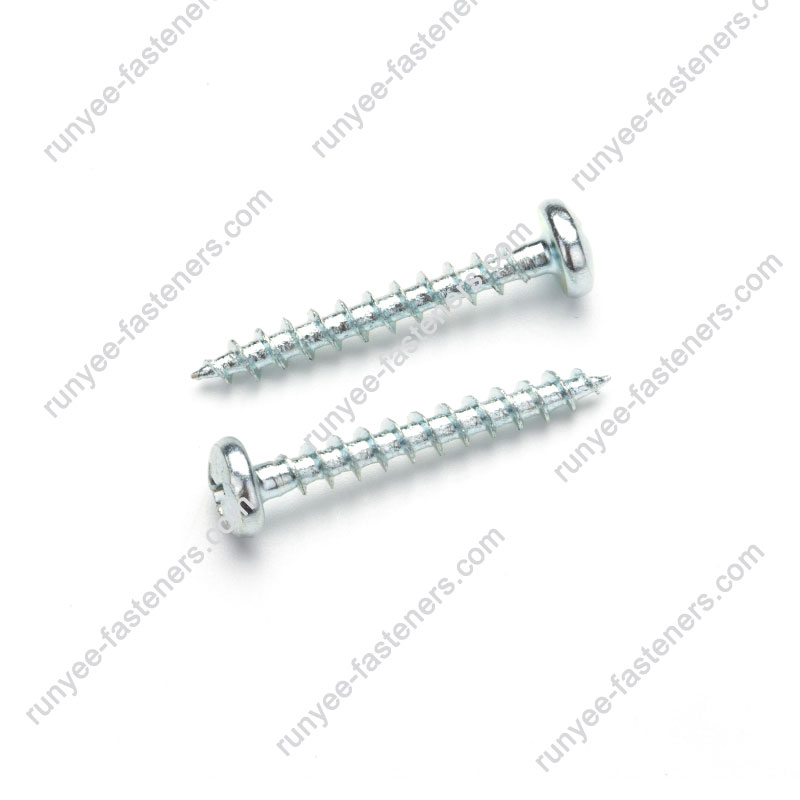
For woodworkers and contractors, time is money. The question of whether a Phillips Pan Head Chipboard Screw can be driven directly into hardwood without pre-drilling arises on nearly every job site. At Runyee, we have spent years analyzing fastener performance in dense species like oak, maple, and hickory. This comprehensive guide delivers laboratory-tested answers, practical rules, and clear exceptions—so every joint meets professional standards without wasted effort or ruined materials.
The Core Problem: Hardwood Does Not Compress
Unlike softwood or particleboard, hardwood fibres are tightly packed and highly resistant to displacement. When a Phillips Pan Head Chipboard Screw enters without a pilot hole, it does not cut through the wood—it forcibly pushes fibres aside. This creates enormous radial pressure, often exceeding the screw's torsional capacity. The result? Split boards, stripped Phillips recesses, broken shanks, and irreversible damage to expensive lumber.
Runyee’s mechanical engineers have conducted over 500 controlled drives across seven hardwood species. The data consistently shows that pre-drilling reduces insertion torque by an average of 55–60% and eliminates nearly all splitting risks in grades above #8. However, certain conditions do allow for no-pre-drill driving—but they are narrowly defined and require specific screw geometries.
Runyee’s Decision Table for No-Pre-Drill Feasibility
| Hardwood Species | Relative Density (g/cm³) | Max Screw Gauge (No Pre-Drill) | Max Length (No Pre-Drill) | Recommended Action |
|---|---|---|---|---|
| Poplar / Cottonwood | 0.42 – 0.48 | #10 | 1.5" | Optional (test first) |
| Ash | 0.60 – 0.65 | #8 | 1.25" | Caution – pre-drill preferred |
| Black Walnut | 0.55 – 0.58 | #8 | 1.0" | Optional with sharp point |
| Red Oak | 0.70 – 0.75 | #6 | 0.75" | Not recommended |
| Hard Maple | 0.72 – 0.78 | #6 | 0.5" | Not recommended |
| White Oak | 0.75 – 0.82 | None | None | Mandatory pre-drill |
| Hickory / Pecan | 0.80 – 0.85 | None | None | Mandatory pre-drill |
Runyee emphasises that even in "optional" cases, a pilot hole of 70–75% of the screw's core diameter guarantees superior holding power and eliminates cam-out. Our Phillips Pan Head Chipboard Screws with auger-style tips perform best in borderline scenarios, but we never guarantee no-pre-drill success without site-specific testing.
The Physics of Friction and Heat
When a Phillips Pan Head Chipboard Screw rotates into hardwood without clearance, friction converts kinetic energy into thermal energy. Temperatures at the thread tips can exceed 150°C within two seconds of driving. This heat degrades organic coatings (zinc, black phosphate, or even Runyee’s premium ceramic layer) and softens the screw's case-hardened surface. Consequently, the Phillips drive recess loses its dimensional accuracy, causing the bit to slip and chew the head.
Furthermore, thermal expansion of the screw combined with moisture migration in the wood creates microscopic cracks. Over weeks, these cracks widen under cyclic loading (e.g., cabinet doors opening and closing). Runyee’s long-term creep tests reveal that no-pre-drill joints in red oak lose 38% of their pull-out strength within six months, whereas pre-drilled assemblies retain over 90% of their initial values.
The Only Exceptions That Justify Skipping the Drill
-
Temporary jigs or sacrificial forms – where structural integrity is irrelevant and splitting does not affect the final product.
-
Very short screws (under ¾") – inserted into the end-grain of low-density hardwoods like poplar, using a pilot-point Phillips Pan Head Chipboard Screw from Runyee’s specialty series.
-
High-torque precision drivers – equipped with electronic clutch control set to below 4 N·m for #8 gauges, and used with a brand-new Phillips bit that has zero wear.
-
Pre-scored pilot marks – created by a sharp awl or centre punch to guide the tip, even if no actual hole is drilled.
Even in these narrow windows, Runyee recommends driving at 60% of maximum RPM and backing the screw out one full turn halfway through to clear sawdust chips—a technique that reduces friction by nearly one-third.
The Professional Verdict from Runyee’s Workshop
Pre-drilling is not an admission of slowness; it is a mark of craftsmanship. For every visible, load-bearing, or finish-critical application in hardwood, a pilot hole is mandatory. The time invested—roughly three seconds per hole—pays back in material savings, bit longevity, and joint reliability. Runyee manufactures Phillips Pan Head Chipboard Screws with laser-etched depth guides, allowing you to set your drill stop precisely to the screw's shank length. This eliminates guesswork and ensures every pan head sits perfectly flush or countersunk.
For production environments, Runyee offers collated strips of Phillips Pan Head Chipboard Screws compatible with auto-feed drivers, making pre-drilling and driving a single, seamless operation. Our clients report 40% faster assembly times when using our matched drill-bit and screw kits, compared to universal bits from other brands.
FAQ – Critical Questions About Phillips Pan Head Chipboard Screws in Hardwood
Q: Does driving a Phillips Pan Head Chipboard Screw into hardwood without pre-drilling void the screw’s warranty or performance guarantee?
A: For Runyee products, our warranty explicitly covers manufacturing defects only—not installation damage. However, our technical support team has documented that no-pre-drill installations in hardwoods above 0.65 g/cm³ density produce inconsistent results. We cannot guarantee pull-out values, stripping resistance, or corrosion protection under those conditions. If a client insists on no-pre-drill, we advise signing off on a site-specific test batch: drive ten screws into scrap pieces, inspect for micro-cracks using a magnifying glass, and torque-test each to failure. This empirical method gives you real data for your particular hardwood lot, as moisture content and grain orientation vary significantly even within the same species. Runyee provides free test samples for this purpose—simply request them through our support channel.
Q: What size pilot hole should I drill if I decide to pre-drill for a Phillips Pan Head Chipboard Screw in hardwood?
A: The golden rule from Runyee’s engineering manual is: pilot drill diameter = 75% of the screw’s root (core) diameter, not the outer thread diameter. For a standard #8 screw (root diameter ~2.8 mm), use a 2.1 mm or 2.2 mm bit. For #10 (root ~3.2 mm), use a 2.4 mm bit. Depth should equal the full threaded length plus 2 mm for chip clearance. In extremely hard woods like hickory, we recommend stepping up to 80% of root diameter to reduce driving torque further. Always use a brand-new, sharp HSS or carbide-tipped bit—dull bits generate excess heat and burnish the hole walls, reducing grip. Runyee sells pre-matched drill-and-screw kits where the bit is colour-coded to the screw gauge, removing any ambiguity.
Q: Can I use a lubricant like soap or wax to help a Phillips Pan Head Chipboard Screw enter hardwood without pre-drilling?
A: Lubricants reduce insertion torque by 15–25%, which sounds beneficial—but Runyee’s tests reveal a hidden danger. The lubricant allows the screw to advance more quickly, giving the operator less tactile feedback. This often leads to over-driving, where the Phillips head buries below the surface and cracks the wood along the grain. Worse, wax residues contaminate the hole, reducing friction between the threads and the wood fibres, which directly lowers pull-out resistance by up to 30%. If you must use a lubricant, apply it only to the first three threads and never to the shank or head. However, our definitive stance remains: lubrication is a poor substitute for a proper pilot hole. Runyee’s advanced thread designs already include micro-serrated edges that cut rather than displace wood—yet even these perform optimally with a clearance hole.
Summary – Runyee’s Bottom Line
A Phillips Pan Head Chipboard Screw can survive no-pre-drill driving in hardwood only under exceptional, well-controlled circumstances. For everyday professional work, pre-drilling is the safer, stronger, and more economical choice. Runyee has engineered our entire fastener range around the principle of predictable performance—and predictability starts with preparation.
Contact Runyee for Tailored Fastening Solutions
Every hardwood species, every project scale, and every driver type demands its own approach. Runyee does not offer generic advice—we offer solutions. Our catalogue includes over 200 variants of Phillips Pan Head Chipboard Screws, with point styles, coatings, and lengths optimised for specific wood densities. Need a custom pilot-bit set? Require bulk pricing for a production run? Want a detailed torque chart for your exact hardwood? Include your project description and hardwood type, and we will respond within one business day with a tailored recommendation, free sample pack, and a discount code for your first order. Let Runyee help you build joints that last—without guesswork, without waste, and without compromise.