
Can You Use a Flat Raised Face Flange with an RTJ Gasket Instead of a Spiral Wound One
2026-06-22
In the world of industrial piping, the selection of gaskets and flange faces is not a matter of preference—it is a matter of engineering integrity. The flat raised face flange (often abbreviated as flat RF flange) is one of the most common connection types in petrochemical, power, and water treatment systems. However, a question that frequently surfaces in both procurement and field engineering is whether a flat raised face flange can accept a Ring-Type Joint (RTJ) gasket in place of a spiral wound gasket. At Longan, we have encountered this query across hundreds of project specifications, and the short answer is technically possible but practically dangerous. This article breaks down the metallurgy, sealing mechanics, and code requirements to give you a definitive, field-tested perspective.
The Core Mechanics: Why Face Design Matters
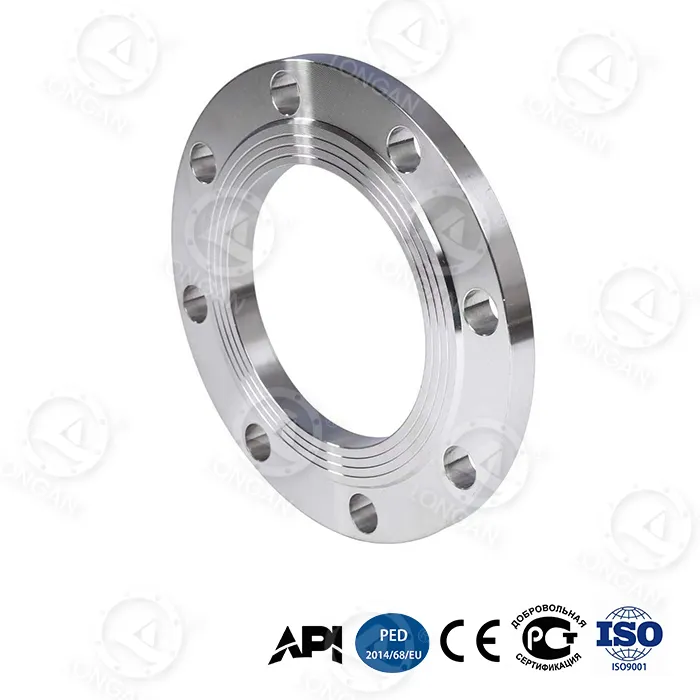
A flat raised face flange has a distinct raised ring (typically 0.06 to 0.25 inches high) that concentrates bolt load onto a narrow sealing area. This design relies on gasket compression to fill microscopic surface irregularities. Spiral wound gaskets are engineered for this exact scenario—they compress evenly, maintain spring-back, and accommodate thermal cycling.
An RTJ gasket, by contrast, is a solid metal ring (oval or octagonal) that seals by plastic deformation into a matching groove. This groove is absent on a standard flat raised face flange. When you place an RTJ gasket onto a flat RF face, the contact area reduces to two narrow lines, creating extreme localized stress. The table below illustrates the critical differences:
| Feature | Spiral Wound Gasket | RTJ Gasket |
|---|---|---|
| Required flange groove | No (flat or raised face works) | Yes (must have a precision-machined groove) |
| Sealing mechanism | Compression + spring-back | Metal-to-metal plastic deformation |
| Reusability | No (single-use) | Limited (can be reused after inspection) |
| Pressure range | Up to Class 2500 (with proper design) | Up to Class 2500+ |
| Tolerance for flange misalignment | Moderate | Very low |
| Cost (per unit) | Lower | Higher |
The Three Hidden Risks of Using an RTJ Gasket on a Flat Raised Face Flange
-
Gasket extrusion and flange damage – Without a groove to contain the RTJ ring, the gasket can shift under bolt torque, causing the ring to bite into the flat raised face flange surface. This permanent indentation ruins the flange for future gasket replacements.
-
Inconsistent bolt load distribution – RTJ gaskets require higher and more precise bolt torque (often 1.5–2× that of spiral wound gaskets). Applying this to a flat raised face flange can over-stress the bolting or warp the raised face, leading to leakage at adjacent bolting holes.
-
Code non-compliance – ASME B16.5 and B16.20 explicitly state that RTJ gaskets must be used only with flanges that have a matching groove. Using an RTJ on a flat raised face flange violates these standards, voiding warranty and insurance coverage.
When Might an Engineer Consider This Hybrid?
Some older plants with mixed inventory may attempt this substitution during emergency shutdowns. However, Longan strongly advises against it unless the flange face is re-machined to accept a groove—a costly and time-consuming modification that often exceeds the cost of simply ordering the correct spiral wound gasket.
Flat Raised Face Flange – FAQ Section
Q1: Can a flat raised face flange be modified to accept an RTJ gasket safely?
A: Yes, but only through professional re-machining. The raised face must be cut down and a concentric groove (either oval or octagonal, per ASME B16.5) must be precision-milled. This process reduces the flange’s pressure rating because material is removed, so you must recalculate the flange’s MAWP (Maximum Allowable Working Pressure). At Longan, we have performed this modification for clients in offshore platforms, but we always require a full FEA (Finite Element Analysis) validation and hydrostatic testing afterward. The total cost typically ranges from 40–60% of a new flange, so it is rarely economical for sizes under 10 inches.
Q2: What happens if I temporarily use an RTJ gasket on a flat raised face flange for a low-pressure water line?
A: Even at low pressure (e.g., 150 psi), the risk is not pressure—it is thermal movement and vibration. Water lines experience expansion/contraction and pump-induced harmonics. An RTJ gasket on a flat raised face flange lacks a groove to anchor it, so it can “walk” radially, causing uneven compression. Over 3–6 months, this leads to fretting corrosion on the raised face and gradual weeping leaks. We have seen this in cooling water loops where operators assumed “low pressure = safe.” The gasket may seal initially, but reliability drops exponentially after the first thermal cycle. Longan always recommends a spiral wound gasket with an inner ring for such services—it is cheaper and far more forgiving.
Q3: Are there any standards that explicitly prohibit RTJ gaskets on a flat raised face flange?
A: Absolutely. ASME B16.20 (Gaskets for Pipe Flanges) Table 1 clearly mandates that RTJ gaskets shall be used only with flanges having a ring groove conforming to ASME B16.5. Additionally, EN 1514 and ISO 7483 have similar restrictions. Beyond written codes, the practical prohibition comes from the gasket manufacturer’s own installation instructions—every major gasket vendor, including Flexitallic and Garlock, explicitly states that RTJ rings require a grooved flange. If you proceed against these guidelines, you assume full liability for any leak, fire, or environmental release. Longan’s quality assurance team rejects any non-conforming gasket-flange combinations during pre-commissioning inspections, as they are a red flag for overall project quality.
Conclusion and Practical Recommendation
After analyzing the geometry, metallurgy, and code requirements, the professional verdict is clear: do not use an RTJ gasket on a flat raised face flange unless the flange is physically re-grooved and re-rated. The spiral wound gasket remains the correct, safe, and most cost-effective choice for RF flanges up to Class 900. For higher classes or critical services (hydrogen, high-temp steam, or sour gas), consider switching to a grooved flange design from the outset, or use a specialty gasket like a camprofile or kammprofile with a flat RF face.
Do you have a specific flange-gasket combination that needs expert review? Longan provides free gasket selection audits, bolt torque calculations, and on-site flange inspection services across North America and the Middle East. Our engineering team can help you avoid costly shutdowns and safety incidents with customized sealing solutions. Reach out to us today – visit our website or email our technical support desk for a rapid, no-obligation consultation. Your project’s integrity is our priority.