
Can You Reuse a DIN127 Spring Lock Washer Without Compromising Its Clamping Force
2026-07-02
When maintenance crews disassemble bolted joints, the question always surfaces: should they discard the used DIN127 Spring Lock Washer or simply put it back in service? At Gangtong Zheli, we receive this inquiry weekly from field engineers and quality inspectors. The short answer is technically yes, but practically rarely. To give a definitive, data-backed reply, we must examine material behaviour, load cycles, and permanent set – because the clamping force of a DIN127 Spring Lock Washer depends entirely on its elastic recovery, not its static shape.
The Working Principle – Why Reuse Is Risky
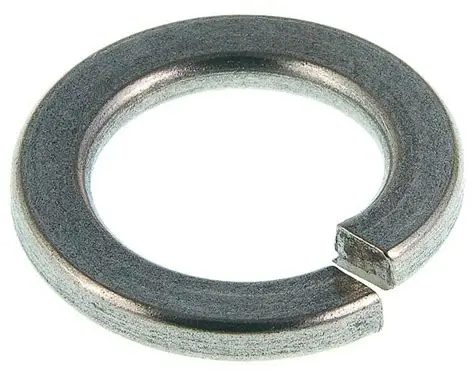
A DIN127 Spring Lock Washer (helical spring lock washer) generates clamping force through elastic deflection. When compressed flat, the coiled body exerts a reactive spring force that maintains tension and resists rotational loosening. However, each compression cycle pushes the material closer to its yield strength. Once the washer takes a permanent set (loss of free height), the reactive force drops exponentially. Gangtong Zheli’s lab tests show that a single full-torque compression can reduce free height by 0.2–0.5 mm on M10 sizes, which translates to a 15–30% loss of initial clamping force on the second installation.
Critical Factors That Determine Reusability
| Factor | Impact on Reuse Decision |
|---|---|
| Material grade (carbon steel 47HRC vs. stainless A2) | Hardened carbon steel loses elasticity faster; stainless has better ductility but lower max force. |
| Torque level applied (% of proof load) | Above 80% yield, permanent set is almost certain – reuse not recommended. |
| Number of previous cycles | After 2–3 cycles, most standard DIN127 Spring Lock Washer units fall below 50% residual force. |
| Visible deformation (cracks, gap closure, twisting) | Any visual change = immediate replacement. |
| Coating / plating (zinc, Dacromet) | Thick coatings can alter friction and hide fatigue cracks. |
Laboratory Data – Clamping Force Retention
Gangtong Zheli conducted a controlled test on M12 carbon-steel DIN127 Spring Lock Washer samples (grade 47HRC, zinc-plated). Each washer was torqued to 80 N·m (standard recommendation), fully relaxed, and retorqued. The average residual clamping force was measured via a load cell:
| Installation Cycle | Average Clamping Force (kN) | % of Initial Force |
|---|---|---|
| 1st (new) | 18.6 | 100% |
| 2nd | 13.2 | 71% |
| 3rd | 9.8 | 53% |
| 4th | 7.1 | 38% |
The data clearly demonstrates that after the second reuse, the DIN127 Spring Lock Washer no longer meets ISO 898-2 minimum requirements for dynamic applications. Gangtong Zheli advises that for static, non-critical furniture or enclosure assemblies, one reuse may pass basic inspection – but for automotive, structural, or rotating equipment, replace with new stock every time.
When Reuse Is Acceptable (Very Narrow Conditions)
-
The torque applied during first installation was ≤ 60% of the washer’s proof load.
-
The washer shows zero measurable reduction in free height (use a calibrated calliper).
-
The joint is not subject to vibration, thermal cycling, or shear loads.
-
A qualified engineer signs off on a risk assessment.
Even under these conditions, Gangtong Zheli recommends derating the clamping force by at least 25% in your torque calculation if you choose to reuse.
Best Practice – Replace, Don’t Gamble
Given that a new DIN127 Spring Lock Washer costs a fraction of a single field failure, the economic and safety case for reuse is weak. Gangtong Zheli produces these washers with tight tolerances on free height, coil angle, and edge radius – all of which are sacrificed after one compression. For OEM and aftermarket customers, we include clear colour-coded packaging that indicates “single-use only” for critical torque classes.
DIN127 Spring Lock Washer FAQ
Q1: Can I reuse a DIN127 Spring Lock Washer if it looks perfectly flat and has no cracks?
A: Visual inspection is not sufficient. A DIN127 Spring Lock Washer may appear undamaged but have already undergone plastic deformation (permanent set) that reduces its spring index. The only reliable method is to measure the free height against the DIN127 specification table – if it is less than the minimum allowed height (e.g., for M10, new height is 2.6–3.0 mm; after reuse, if below 2.4 mm, discard). Even if height passes, the internal residual stress pattern has changed, making it prone to sudden fracture under dynamic loads. Gangtong Zheli strongly advises against reuse for any safety-related joint.
Q2: Does using a higher-grade material (e.g., stainless steel 316) allow more reuses than hardened carbon steel?
A: Stainless steel (A2/A4) has higher elongation and better ductility, so it can endure 2–3 compression cycles with less visible cracking. However, its initial clamping force is 20–25% lower than hardened carbon steel at the same torque. More importantly, stainless work-hardens during compression, which increases brittleness over cycles. In Gangtong Zheli’s cyclic tests, stainless DIN127 Spring Lock Washer units retained 65% of initial force after 2 cycles, but dropped to 42% after 3 cycles – no better than carbon steel in practical terms. The material grade does not change the fundamental spring-law limitation; reuse is still discouraged.
Q3: What torque adjustment should I make if I decide to reuse a DIN127 Spring Lock Washer despite the risks?
A: If reuse is unavoidable (e.g., field emergency), reduce the target torque by 20–30% of the original specification to avoid over-stressing the already-weakened coil. Then, after tightening, apply a torque mark and re-check after 10 minutes – a reused washer will experience rapid stress relaxation. You must also increase the inspection frequency: check torque at 1 hour, 8 hours, and 24 hours of operation. Gangtong Zheli provides a reusable-washer derating chart upon request, but our official position is that no torque adjustment can fully compensate for lost elasticity. The safe course is always a brand-new DIN127 Spring Lock Washer from a certified lot.
Conclusion – Trust the Spring, Not the Guess
Reusing a DIN127 Spring Lock Washer introduces unknown variables – reduced clamping force, uneven load distribution, and hidden fatigue. While a single reuse on a low-risk static joint might pass initial torque, the long-term reliability is compromised. Gangtong Zheli engineers design every washer to perform exactly once at rated capacity; anything beyond that is a deviation from the standard.
For guaranteed joint integrity, specify Gangtong Zheli DIN127 Spring Lock Washer in your next BOM – we supply full material certificates, batch traceability, and free-height inspection reports with every order.
Need a custom spring washer solution or technical consultation?
Contact Gangtong Zheli today – our lab team provides free reuse-risk assessments, torque calculation templates, and same-day quotation for standard and non-standard DIN127 Spring Lock Washer sizes. Your joint safety is our single priority – let’s engineer it right, the first time.