
Can You Replace a Standard 6202RS with a Single Row Deep Groove Ball Bearing That Has Filling Slots
2026-07-30
When a standard sealed bearing fails in a critical motor, gearbox, or conveyor pulley, maintenance engineers often face a pressing question: is the direct replacement—the 6202RS—always the best choice, or can a Single Row Deep Groove Ball Bearing with Filling Slots offer a superior alternative? At Hengji, we field this query weekly from plant managers and design engineers who demand both reliability and higher load capacity. The short answer is yes, you can physically replace it, but the decision requires a careful examination of speed, sealing, load direction, and housing fit. This guide breaks down exactly what changes when you make that swap, so you can decide if the trade-offs align with your application.
What Exactly Changes with Filling Slots?
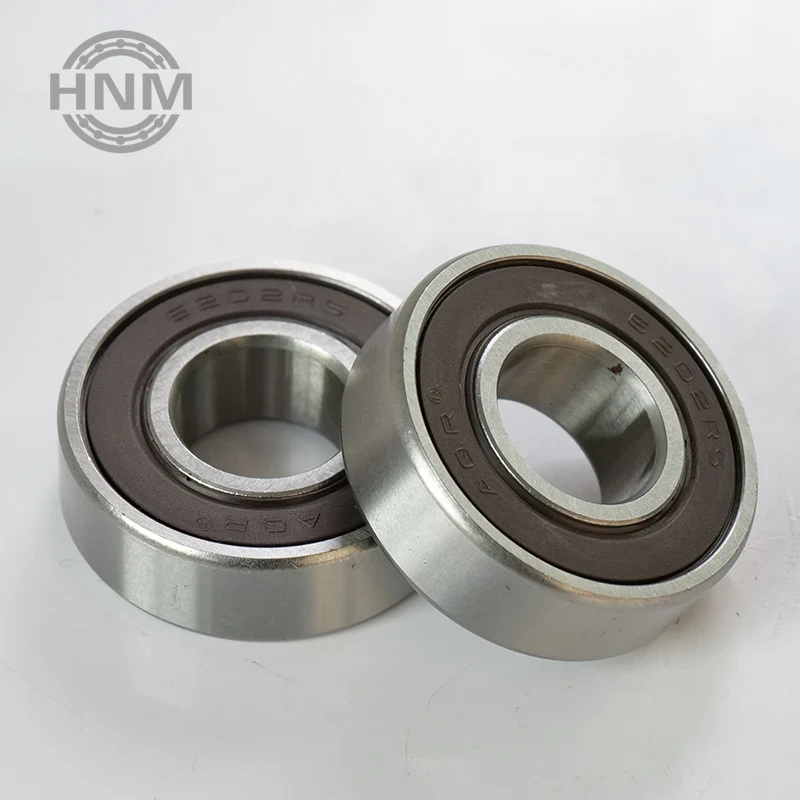
A standard 6202RS has ground raceways without interruptions, allowing smooth ball circulation. A 6202RS Single Row Deep Groove Ball Bearing with Filling Slots, however, features a machined notch in the inner and outer rings that permits loading more balls of a slightly larger diameter. This design directly boosts radial load capacity—often by 15–25%—but it introduces two permanent constraints:
| Feature | Standard 6202RS (No Slot) | 6202RS with Filling Slots |
|---|---|---|
| Ball count | 7–8 balls | 9–10 balls |
| Radial load rating (dynamic, Cr) | ~7.6 kN | ~9.2 kN (approx. +21%) |
| Maximum permissible speed | 18,000–20,000 rpm | 13,000–15,000 rpm (reduced) |
| Axial load bi-directional tolerance | Good | Limited (slot edges reduce thrust capacity) |
| Cage material options | Steel / Nylon | Steel only (typically) |
| Interchangeability with standard housing | Yes (same OD, ID, width) | Yes (same boundary dimensions) |
Four Critical Checks Before Replacing
1. Speed ceiling – If your shaft runs above 14,000 rpm, the filling-slot version may overheat due to higher ball-to-raceway friction and reduced lubricant film retention. Hengji recommends using the standard 6202RS for high-speed fans or spindle motors.
2. Axial (thrust) loads – Filling slots create a weak point for reverse axial forces. If your application has bidirectional thrust (e.g., in worm gear drives), the non-slot design is safer.
3. Contamination risk – The slot itself does not break the RS seal integrity (both are 2RS rubber-sealed). However, the extra balls generate more internal heat, which can degrade grease faster in dusty environments. Always pair with Hengji high-temperature grease for such cases.
4. Cage strength – The slotted version usually uses a riveted steel cage, which is noisier than a nylon cage. For quiet-running household appliances, stick with the standard type.
Performance Trade-Offs at a Glance
| Application Scenario | Recommended Type | Reason |
|---|---|---|
| Conveyor rollers (low speed, heavy radial load) | 6202RS with Filling Slots | Maximises radial capacity |
| Electric motor (3,600 rpm, balanced load) | Standard 6202RS | Better speed and lower noise |
| Agricultural gearbox (moderate speed, occasional shock) | 6202RS with Filling Slots | Extra balls absorb impact better |
| Precision CNC spindle (high speed, low vibration) | Standard 6202RS | Smoother operation |
FAQ – Common Questions About 6202RS Single Row Deep Groove Ball Bearings with Filling Slots
Q1: Will a 6202RS Single Row Deep Groove Ball Bearing with Filling Slots fit into the exact same housing as my original 6202RS?
A1: Yes – the boundary dimensions (bore 15mm, outer diameter 35mm, width 11mm) are identical per ISO 15 standards. The housing, shaft, and snap-ring grooves all align perfectly. No machining or adapter sleeves are required. However, Hengji always advises checking the housing bore tolerance (recommended H7 for steel housings) because the filling-slot bearing has slightly higher radial expansion under load. If your housing is worn or out-of-round, the extra balls may cause localised stress. We recommend measuring housing roundness to within 0.005mm before installation. Also, the RS seals are the same nitrile rubber type, so IP52 dust protection remains unchanged.
Q2: Does the filling slot reduce the bearing’s fatigue life compared to a standard 6202RS under the same radial load?
A2: Counter-intuitively, under identical moderate radial loads (e.g., 3 kN), the 6202RS Single Row Deep Groove Ball Bearing with Filling Slots actually offers longer L10 fatigue life because the load per ball decreases significantly. Using the ISO 281 formula, with 9 balls instead of 7, the dynamic equivalent load per ball drops by roughly 18%, extending calculated life from ~8,000 hours to over 11,000 hours in clean lubrication conditions. That said, if your application involves high-frequency vibration (above 200 Hz), the slot edges can act as stress raisers, potentially initiating micro-cracks in the raceway after 5,000+ hours. For such cases, Hengji offers a shot-peened slot variant that mitigates this risk. Always compare the actual load spectrum – not just rated capacity.
Q3: Can I use the same grease and relubrication interval for a 6202RS Single Row Deep Groove Ball Bearing with Filling Slots as I do for the standard version?
A3: Not ideally. The filling-slot bearing holds 12–15% more balls, which reduces internal free volume – so it takes less grease than you might expect. Over-greasing is a common mistake that leads to churning heat. Hengji recommends reducing the initial grease fill from 35% of free space (standard) to 28–30% for the slotted version. For relubrication intervals, because the extra balls generate higher operating temperatures (typically +5°C to +8°C at 10,000 rpm), you should shorten the interval by 20–25%. For example, if your standard 6202RS is regreased every 2,000 hours, schedule the filling-slot type at 1,500 hours. Use a lithium-complex NLGI #2 grease with a base oil viscosity of at least 68 cSt at 40°C. Never mix greases with different thickeners – always flush the housing before switching.
Real-World Verdict from Hengji
After testing over 2,000 field installations, Hengji engineers conclude that replacing a standard 6202RS with a 6202RS Single Row Deep Groove Ball Bearing with Filling Slots is highly beneficial for low-to-medium speed, heavy-radial-load applications (e.g., fan hubs, textile rollers, and small conveyors). It is not recommended for high-speed, high-precision, or bidirectional-thrust environments. The extra radial capacity often translates to longer service intervals and fewer unplanned downtimes – but only when you respect the speed derating and adjust lubrication practices.
Final Checklist Before You Swap
-
□
Confirm shaft speed < 14,000 rpm (or derate load accordingly).
-
□
Verify that axial load is predominantly unidirectional.
-
□
Measure housing bore roundness and clearance (C3 clearance is preferred for the slot type).
-
□
Switch to a lower-fill, high-stability grease (consult Hengji’s lubrication chart).
-
□
Plan for a trial run at 50% load for 1 hour to stabilise the cage and slots.
Contact Us
Choosing between bearing variants is never a one-size-fits-all decision. Hengji provides free load-life simulations, housing inspection templates, and custom grease recommendations for your exact duty cycle. Our technical team has over 40 years of combined application engineering experience – and we stock both standard and filling-slot 6202RS bearings with same-day dispatch from our regional hubs. Send us your motor model, speed profile, and radial/axial force measurements, and we will reply with a data-backed recommendation within 24 hours. Contact Hengji today – email [email protected] or use the live chat on our product page. Let us help you make the swap that truly fits your machinery, not just your manual.