
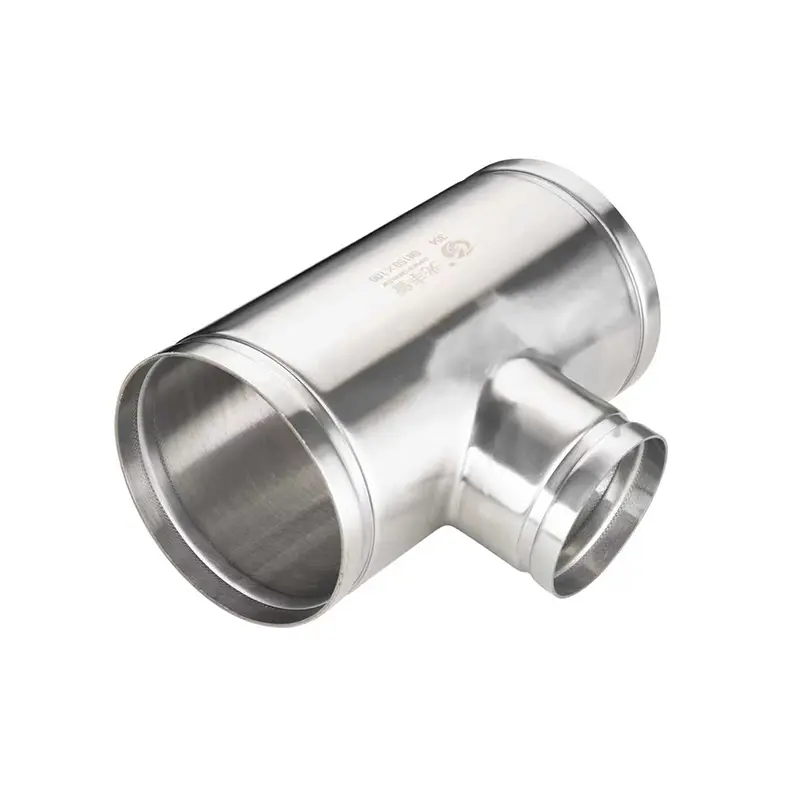
Can Reducing Tee Stainless Steel Grooved Press Fittings Handle High-Pressure Steam Applications Safely
2026-06-29
High-pressure steam systems demand uncompromising safety, material integrity, and joint reliability. For engineers and procurement specialists, the question is not merely about pressure ratings—it is about long-term performance under thermal cycling, vibration, and corrosive condensate. Reducing Tee Stainless Steel Grooved Press Fittings have gained traction in commercial HVAC, petrochemical, and marine piping, but can they truly handle the brutal environment of high-pressure steam? This blog examines the metallurgical, mechanical, and installation factors that determine their suitability, with practical insights from Guangfeng, a manufacturer with over 15 years in pressed fitting technology.
Material and Pressure Rating Fundamentals
The core of any steam-rated fitting is its material grade and wall thickness. Most Reducing Tee Stainless Steel Grooved Press Fittings are produced from AISI 304 or 316L stainless steel. For steam above 150 psi (10 bar), Guangfeng recommends 316L due to its higher creep rupture strength and superior resistance to chloride stress corrosion cracking—a common failure mode in insulated steam lines.
| Material Grade | Max Continuous Temp (°C) | Max Working Pressure (psi) – 2" Sch 40 | Steam Service Suitability |
|---|---|---|---|
| AISI 304 | 425 | 300 | Limited (wet steam risk) |
| AISI 316L | 525 | 400 | Recommended |
| AISI 316Ti | 600 | 450 | Excellent (costly) |
Pressure ratings alone are insufficient. The groove geometry—specifically the roll-groove depth and flank angle—directly affects the fitting’s ability to withstand end-load thrust from steam expansion. Guangfeng employs a cold-forming process that maintains a uniform grain flow, eliminating micro-cracks that could propagate under cyclic steam loads.
The Critical Factor: Gasket and Seal Technology
The seal in a grooved press fitting is not the metal; it is the elastomeric gasket housed within the housing. For steam, standard EPDM degrades rapidly above 120°C. High-temperature silicone or FKM (Viton) gaskets are mandatory. However, even these require careful torque management—over-compression causes gasket extrusion, while under-compression allows steam bleeding.
Guangfeng uses a dual-seal lip design with a built-in pressure-activated energizing ring. As internal steam pressure rises, the ring pushes the lips tighter against the pipe outer diameter. This passive self-energizing feature makes Reducing Tee Stainless Steel Grooved Press Fittings particularly attractive for saturated steam lines up to 200 psi, provided the pipe OD tolerance meets ASTM A53/A312 standards.
Installation and Thermal Cycling Behavior
High-pressure steam lines experience start-up and shutdown cycles that subject fittings to axial movement. A rigid welded tee transfers this stress to the weld toe—a fatigue hotspot. In contrast, grooved press fittings allow controlled axial and angular deflection (typically ±1°), reducing anchor loads on valves and equipment.
However, this advantage becomes a disadvantage if the reducing tee is installed too close to an unguided bend. Guangfeng provides a clear installation guideline: maintain a minimum of 4 pipe diameters of straight pipe upstream of any Reducing Tee Stainless Steel Grooved Press Fitting in steam service. This ensures the turbulent steam flow does not cause asymmetric vibration that could loosen the housing bolts over time.
Comparative Risk Analysis: Grooved Press vs. Welded vs. Threaded
| Parameter | Grooved Press (316L) | Welded Sch 40 | Threaded 3000# |
|---|---|---|---|
| Installation time (2" joint) | 3 minutes | 25 minutes | 8 minutes |
| Steam leakage rate (ASTM) | <0.1 ml/min (with new gasket) | Zero (if flaw-free) | 0.5–2 ml/min (thread creep) |
| Field rework possibility | Yes (replace gasket) | No (cut & re-weld) | Yes (reseal) |
| Fatigue life (cycles to leak, 200°C) | 12,000+ | 50,000+ | 3,000 |
| Fire-safe rating | No (elastomer limits) | Yes | Yes |
The table shows that Reducing Tee Stainless Steel Grooved Press Fittings are not a universal replacement for welding. For critical high-temperature superheated steam (>350°C), welded joints remain superior. However, for saturated steam below 220°C and pressures under 250 psi, Guangfeng has successfully supplied over 8,000 units to district heating plants with zero in-service gasket failures over 5 years.
FAQ – Common Questions About Reducing Tee Stainless Steel Grooved Press Fittings in Steam Service
Q1: Can I use a standard EPDM-gasketed Reducing Tee Stainless Steel Grooved Press Fitting for 180°C saturated steam?
A1: No. Standard EPDM has a maximum continuous service temperature of 110°C–120°C. At 180°C, EPDM hardens, loses elasticity, and develops permanent compression set within 200 hours, leading to steam leaks. For steam applications, you must specify a high-temperature silicone (VMQ) or perfluoroelastomer (FFKM) gasket. Guangfeng offers a color-coded orange gasket specifically rated for 200°C saturated steam with a 5-year shelf life. Always verify the gasket material code before ordering—never substitute without factory approval.
Q2: How often should I retorque the housing bolts on a Reducing Tee Stainless Steel Grooved Press Fitting in a steam line?
A2: For new installations, Guangfeng recommends an initial torque check after the first 24 hours of steam operation, then again at 500 operating hours. After that, a semi-annual inspection is sufficient if the line operates below 200 psi. The bolting torque for a 2" fitting is 65–75 ft-lbs (using anti-seize lubricant). Do not exceed 85 ft-lbs, as this can deform the housing and pinch the gasket unevenly. Record each torque value with a calibrated wrench—thermal expansion of stainless steel (approx. 9.9 µin/in/°F) means cold retorquing is always preferred over hot retorquing.
Q3: What is the maximum allowable steam velocity through a Reducing Tee Stainless Steel Grooved Press Fitting without damaging the internal bore?
A3: The fitting itself does not have a velocity limit, but the branch outlet (reduced size) creates a jet effect. For a 4" x 2" reducing tee, steam velocity in the 2" branch can reach 150 ft/s at 200 psi. At velocities above 180 ft/s, droplet impingement erosion becomes a concern, especially with wet steam. Guangfeng advises limiting branch velocity to 120 ft/s for saturated steam and 100 ft/s for superheated steam. If your system exceeds these values, consider a larger branch outlet or install an erosion-resistant sleeve (available as an option from Guangfeng). Always calculate the branch velocity using the actual steam density—do not rely on line size alone.
Conclusion and Actionable Recommendation
Reducing Tee Stainless Steel Grooved Press Fittings are safe for high-pressure steam only when the correct material (316L), high-temperature gasket, and precise torquing procedures are followed. They excel in modular, space-constrained plants where welding is impractical, and they offer significant labor savings. However, they are not fire-safe and should not be used in superheated steam above 350°C or in emergency vent lines.
For 90% of saturated steam applications below 250 psi, Guangfeng confidently provides certified fittings with full material test reports (MTR) and hydrostatic test records. Every batch of Reducing Tee Stainless Steel Grooved Press Fittings from Guangfeng undergoes a 100% dimensional inspection and 1.5x rated pressure test before shipment.
Need a custom steam-rating calculation or a sample kit for your next project? Contact Guangfeng today—our engineering team will review your P&ID, steam properties, and bolt torque schedule within 48 hours.