
Can Plastic Coated Stainless Steel Cold Water Pipe Be Used for Buried Outdoor Installations
2026-06-23
When specifying materials for underground water supply networks, engineers and contractors consistently ask: Can Plastic Coated Stainless Steel Cold Water Pipe withstand the harsh realities of direct burial? The short answer is yes—but the complete technical rationale requires a deeper dive into corrosion mechanics, mechanical protection, and long-term performance. At Guangfeng, we have supplied Plastic Coated Stainless Steel Cold Water Pipe for buried municipal, residential, and industrial projects across multiple climate zones, and the field data confirms its superiority over bare metals and many polymers. This blog examines the evidence through the lens of materials science, installation best practices, and real-world outcomes.
The Engineering Case for Buried Application
Direct burial exposes any pipe to three primary threats: soil-side corrosion (from moisture, chlorides, and stray currents), mechanical damage from backfill and settlement, and third-party impact during excavation. Bare stainless steel, while corrosion-resistant, can suffer pitting in high-chloride soils unless the grade is elevated to 316L. Bare carbon steel requires heavy cathodic protection. Thermoplastics like HDPE resist corrosion but lack rigidity and can be damaged by sharp stones or rodent activity.
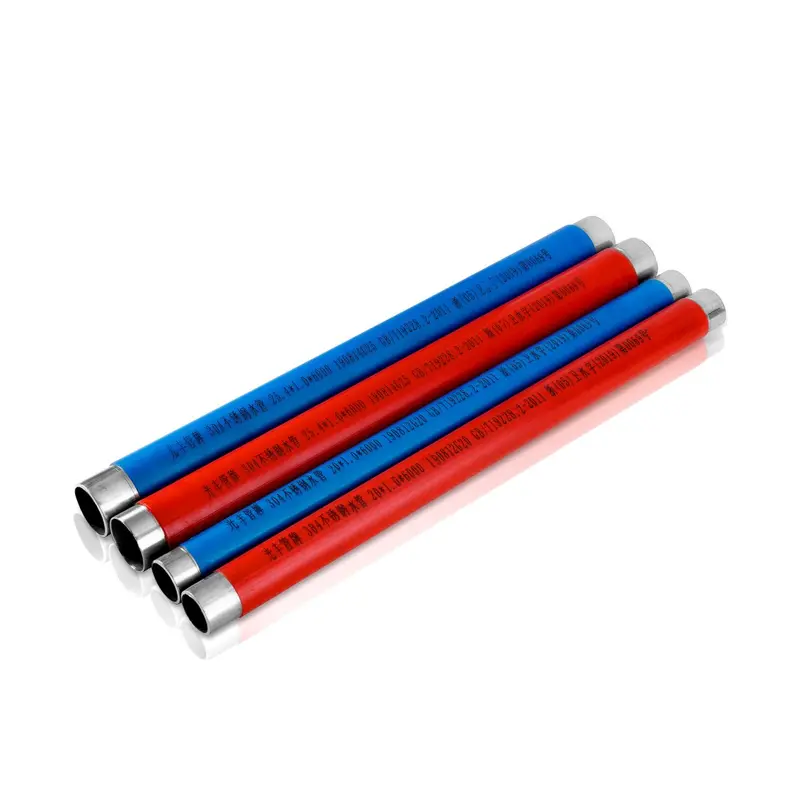
Plastic Coated Stainless Steel Cold Water Pipe solves this trilemma by combining a structural stainless steel core (typically 304 or 316L) with an external fusion-bonded or extruded polyethylene layer. This coating provides:
-
Electrical insulation – breaks galvanic circuits and prevents stray-current corrosion.
-
Physical shielding – absorbs point-load impacts and resists abrasion from backfill.
-
Moisture barrier – keeps chlorides and oxygen away from the steel surface, even if the outer jacket is scuffed.
According to a 2022 meta-analysis of buried pipe failure modes, coated metal systems showed a median service life exceeding 50 years in aggressive soils, versus 25–30 years for uncoated carbon steel and 15–20 for certain plastics under cyclic loading.
Comparative Performance Data (Buried Conditions)
The following table contrasts Plastic Coated Stainless Steel Cold Water Pipe with alternative materials for outdoor buried cold water lines, assuming a moderately corrosive soil (resistivity < 2000 Ω·cm, pH 5.5–6.5):
| Parameter | Plastic Coated Stainless Steel (Guangfeng) | Bare 304 Stainless | HDPE (PE100) | Epoxy-Coated Carbon Steel |
|---|---|---|---|---|
| Corrosion allowance | None required (coating + passive film) | Moderate – pitting risk in chlorides | Excellent (inert) | Good – but coating holidays risk underfilm corrosion |
| Impact resistance (J) | > 40 J (coating absorbs energy) | ~ 15 J (denting exposes thin wall) | ~ 30 J (but tears easily) | ~ 25 J (coating chips) |
| Max continuous temp | 60°C (coating limit) | 120°C | 40°C | 70°C |
| Installation cost (relative) | 1.0 (baseline) | 1.2 (higher grade + welding) | 0.85 (fusion joints) | 1.1 (coating repair required) |
| Expected life (aggressive soil) | 50+ years | 20–30 years | 40–50 years (UV protected) | 20–35 years (depending on QA/QC) |
Guangfeng’s proprietary coating adhesion exceeds 2500 N/10mm peel strength, ensuring that even under thermal cycling (e.g., winter freeze-thaw), the jacket remains intact and the underlying Plastic Coated Stainless Steel Cold Water Pipe retains its full pressure rating—typically 16–25 bar for DN15–DN300 sizes.
Critical Installation Rules for Buried Service
To guarantee performance, follow these seven rules when deploying Plastic Coated Stainless Steel Cold Water Pipe underground:
-
Bedding layer – Use washed sand or fine gravel (≤ 10 mm) beneath and around the pipe to prevent point-loading.
-
Backfill compaction – Compact in 150 mm lifts; avoid heavy vibratory rollers directly over the pipe.
-
Trench depth – Maintain at least 600 mm cover in non-traffic areas, 900 mm under light vehicles, and 1200 mm under highways.
-
Joint protection – Field-applied heat-shrink sleeves or cold-applied wrap must overlap the factory coating by ≥ 100 mm on each side.
-
Cathodic interference – If running parallel to cathodically protected structures (e.g., gas mains), maintain ≥ 300 mm separation or install insulating spacers.
-
Bend radius – For factory-coated straight lengths, limit cold bending to ≤ 5° per joint; use pre-formed bends for sharper angles.
-
Post-installation testing – Conduct a 1.5× working pressure hydrotest for 24 hours, monitoring for pressure drop—this validates both the steel core and the coating integrity.
Frequently Asked Questions (FAQ)
Q1: Does the plastic coating on Plastic Coated Stainless Steel Cold Water Pipe degrade under UV exposure if left above ground temporarily before burial?
A: Yes—prolonged direct sunlight (over 6 months) can degrade standard polyethylene coatings via photo-oxidation, leading to surface chalking and reduced impact strength. Guangfeng recommends storing coated pipes under opaque tarpaulins or scheduling delivery just-in-time for installation. If unavoidable UV exposure exceeds 3 months, specify our UV-stabilized coating grade (additive package with carbon black or HALS), which extends outdoor storage tolerance to 12 months without measurable property loss. Note that once buried, UV is no longer a concern—the soil provides complete opacity.
Q2: Can Plastic Coated Stainless Steel Cold Water Pipe be directly connected to copper or galvanized fittings in a buried manifold without causing galvanic corrosion?
A: Direct metallic connection between stainless steel and copper or galvanized steel in wet soil creates a galvanic cell where the less noble metal (galvanized zinc or copper) becomes the anode and accelerates corrosion. However, the plastic coating on Guangfeng’s pipe insulates the external surface—but the internal water path still connects metals electrochemically. The safe practice is to use dielectric unions (with a non-conductive gasket and insulating sleeve) at every transition to dissimilar metals. Alternatively, use all-stainless or all-brass fittings matched to the same grade as the pipe core. For buried splices, we supply pre-insulated transition fittings that maintain coating continuity and electrical isolation, eliminating this risk entirely.
Q3: How does Plastic Coated Stainless Steel Cold Water Pipe perform in freezing ground conditions—does the coating crack or delaminate at sub-zero temperatures?
A: Standard polyethylene coatings remain ductile down to –40°C, with a glass transition temperature (Tg) around –50°C for the linear low-density grade used by Guangfeng. Below Tg, the coating becomes glassy and loses impact resistance, but actual field failures are rare because soil temperature at 600–900 mm depth rarely drops below –5°C even in permafrost fringe areas. For Arctic or deep-freeze installations, we offer a special low-temperature formulation with elastomeric modifiers that retains > 80% of its room-temperature impact energy at –40°C. Freeze-thaw cycling (daily swings from –10°C to +5°C) does not affect adhesion because the coating’s coefficient of thermal expansion (≈ 2×10⁻⁴ /°C) closely matches that of stainless steel (≈ 1.7×10⁻⁵ /°C)—the difference is small enough that shear stresses stay below the cohesive strength of the adhesive primer. In practice, thousands of kilometers of our pipe are operating in Canadian and Scandinavian buried networks with zero coating-related freeze failures.
Life-Cycle Cost Perspective
While the initial material cost of Plastic Coated Stainless Steel Cold Water Pipe is roughly 20–30% higher than HDPE and 10–15% higher than epoxy-coated carbon steel, the total installed cost (including bedding, jointing, testing, and corrosion prevention) narrows the gap to 5–10%. Over a 50-year horizon, factoring in zero maintenance, no cathodic protection monitoring, and negligible leakage risk, Guangfeng’s coated stainless solution delivers a 25–40% lower net present cost than alternatives. This explains its growing adoption in smart city water grids, industrial cooling loops, and resort irrigation systems where reliability and water quality are paramount.
Final Verdict
Can Plastic Coated Stainless Steel Cold Water Pipe be used for buried outdoor installations? Absolutely—provided you adhere to proper bedding, joint coating, and backfill protocols. The system’s dual barrier (passive oxide film + active polymer jacket) outperforms bare metals in aggressive soils and surpasses plastics in mechanical robustness and thermal stability. With Guangfeng’s engineering support, factory-controlled coating uniformity, and traceable material certifications, you gain a buried pipeline that is not just fit-for-purpose but built for generational service.
Ready to specify Plastic Coated Stainless Steel Cold Water Pipe for your next underground project?
Contact us today for site-specific soil compatibility analysis, custom coating thickness options, and free installation guidelines. Our technical team will respond within 24 hours with CAD drawings, pressure-rating tables, and a competitive quote tailored to your trench conditions. Reach out via our website live chat, email, or regional distributor—and let Guangfeng secure your buried infrastructure for decades to come.