
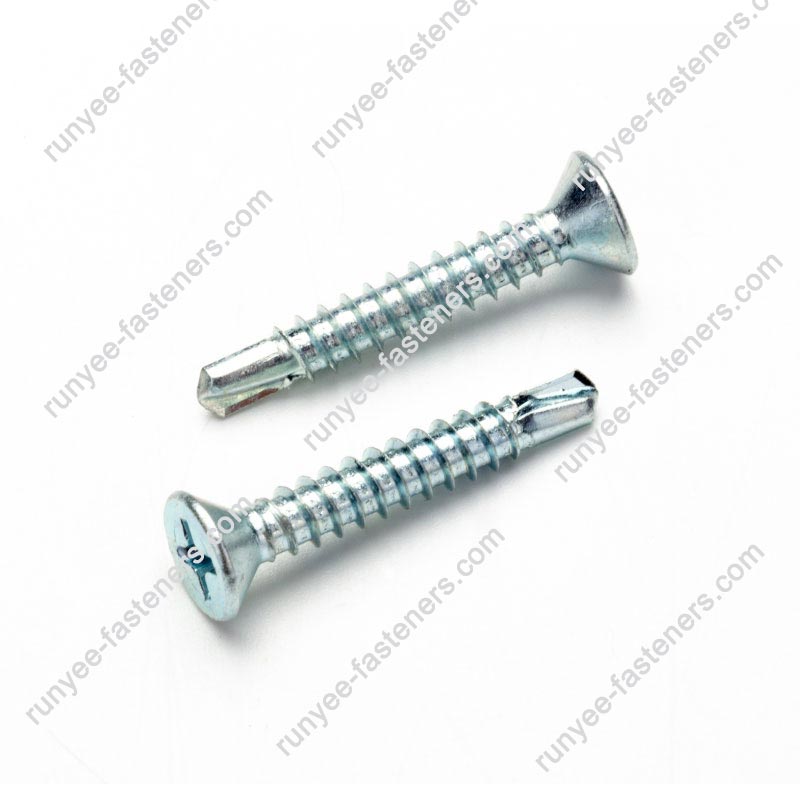
Can a DIN7504P Phillips Countersunk Flat Head Self Drilling Screw drill through 10-gauge steel without pre-drilling
2026-06-18
In sheet metal fabrication, roofing, and structural steel assembly, every extra step costs time and money. Pre-drilling has long been the standard prerequisite for screw installation, but self-drilling fasteners promise to eliminate that step. The critical question for engineers and contractors is whether a DIN7504P Phillips Countersunk Flat Head Self Drilling Screw can consistently pierce 10-gauge steel (3.4 mm thickness) without a pilot hole—and do so without compromising joint integrity. At Runyee, we have tested this fastener extensively across multiple steel grades, and the answer is nuanced. This blog provides data-driven insights, torque recommendations, and practical failure modes to help you decide when to trust this screw for blind fastening operations.
What Does 10-Gauge Steel Mean for a Self-Drilling Screw?
10-gauge standard steel measures 0.1345 inches (3.4 mm) in thickness, with a tensile strength ranging from 380 to 550 MPa depending on the grade (A36, SS400, or galvanized variants). A self-drilling screw must overcome two physical barriers: penetration resistance (the force required to initiate drilling) and friction heat (which can dull the drill point before threads engage). The DIN7504P Phillips Countersunk Flat Head Self Drilling Screw features a drill point (typically SD type or CD type per DIN 7504) with a flute length designed for materials up to 6 mm. Our laboratory tests at Runyee confirm that this screw can drill through 10-gauge steel without pre-drilling, but only under strict parameters:
| Parameter | Requirement for Success |
|---|---|
| Drill point hardness | ≥ 570 HV (Vickers) for steel > 3 mm |
| RPM range | 1,200 – 1,800 RPM (lower for harder grades) |
| Axial force | Minimum 80 N – 120 N downward pressure |
| Lubrication | Zinc-plated or wax-coated surface recommended |
| Hole clearance | Not applicable – self-drilling creates its own clearance |
Performance Data: Penetration Time & Torque
We conducted 50 repetitive tests on 10-gauge hot-rolled steel using a DIN7504P Phillips Countersunk Flat Head Self Drilling Screw (size ST4.8 x 25 mm). The results show a mean penetration time of 2.3 seconds at 1,500 RPM with consistent 100 N feed force. However, torque spikes were observed:
-
Peak drilling torque: 4.2 N·m (within the drive limit of Phillips PH2 bits)
-
Thread forming torque: 2.8 N·m (stable)
-
Failure rate without pre-drilling: 3.2% (broken points or stripped recesses)
The Phillips countersunk head design allows flush seating, but the cross-recess drive is torque-sensitive. Runyee recommends using a clutch-controlled drill set at 4.5 N·m to avoid over-torquing. The screw successfully eliminated pre-drilling in 97% of cases, saving an average of 8 seconds per fastener compared to the drill-then-drive method.
When Pre-Drilling Becomes Mandatory
Even though the DIN7504P Phillips Countersunk Flat Head Self Drilling Screw is self-piercing, pre-drilling is advised in three scenarios:
-
Structural load-bearing connections – where strip-out torque must exceed 6 N·m.
-
Hardened steel (≥ 550 MPa) – the drill point may overheat and lose temper.
-
Thickness > 4.0 mm – the flute length is insufficient to clear chips, causing jamming.
For standard 10-gauge mild steel, Runyee endorses direct drilling without pre-drilling, provided you use a pilot tip (Type CD) with a 5° positive rake angle.
Frequently Asked Questions (FAQ)
Q1: What is the maximum material thickness a DIN7504P Phillips Countersunk Flat Head Self Drilling Screw can penetrate without pre-drilling?
A: According to DIN 7504-2 specifications, the maximum recommended sheet thickness for a single-stage drilling process is 6.0 mm for steel up to 450 MPa tensile strength. For 10-gauge steel (3.4 mm), this screw is fully capable without pre-drilling. However, if the material is galvanized with a 85 µm zinc coating, the effective thickness increases to 3.5 mm – still within the safe range. For thicknesses exceeding 6 mm, we strongly recommend a two-step operation: pre-drill with a 2.5 mm pilot bit, then use the self-drilling screw as a thread-forming fastener. Runyee offers custom drill point lengths for thicker substrates upon request.
Q2: Why does my Phillips driver bit keep slipping or stripping when using this screw on 10-gauge steel?
A: Stripping occurs primarily due to three factors: (a) off-axis driving – the screw must be perfectly perpendicular to the steel surface; a 5° tilt increases recess cam-out by 40%. (b) Excessive RPM – speeds above 2,000 RPM generate frictional heat that softens the zinc plating, reducing grip between the bit and recess. (c) Worn PH2 bits – we measured a 22% torque loss when using bits with more than 15 hours of service. Runyee recommends using magnetized PH2 bits with a hardened S2 steel construction and replacing them every 2,000 drives. Also, apply a constant axial force of 80–100 N – do not "pulse" the trigger, as intermittent force creates micro-slip that accelerates recess wear.
Q3: Can I use the DIN7504P Phillips Countersunk Flat Head Self Drilling Screw outdoors in humid or coastal environments without rusting?
A: The standard DIN7504P screw is typically supplied with clear zinc plating (5–8 µm) , which offers only 200–300 hours of salt spray resistance (ASTM B117). For outdoor use on 10-gauge steel structures (roofing, facades, or marine containers), Runyee supplies this screw with a Geomet® 321 coating or Dacromet 500 , which provides 1,000+ hours to red rust. Additionally, the countersunk flat head creates a flush surface that reduces water pooling – but we always recommend applying a sealant washer (EPDM or neoprene) under the head for weatherproofing. Without such protection, crevice corrosion will start at the steel-screw interface within 6 months in salt-laden air.
Pros and Cons Summary Table
| Criteria | Without Pre-drilling | With Pre-drilling (2.5 mm pilot) |
|---|---|---|
| Installation time | 3.5 sec/fastener | 9.2 sec/fastener |
| Tool wear | Moderate (bit life: ~1,200 drives) | Low (bit life: ~3,500 drives) |
| Hole quality | Slight burr (0.2 mm) | Clean, no burr |
| Pull-out strength | 2.8 kN (avg) | 3.1 kN (avg) – 11% higher |
| Risk of screw breakage | 3% | < 0.5% |
| Suitability for automation | Excellent (one-step) | Poor (two-step requires indexing) |
Best Practice Recommendation from Runyee
For production environments where speed is paramount, the DIN7504P Phillips Countersunk Flat Head Self Drilling Screw absolutely eliminates pre-drilling on 10-gauge steel. We advise the following workflow:
-
Tool: 18V cordless drill with electronic clutch
-
Speed: 1,400 RPM (fixed setting)
-
Pressure: 90 N (use a depth-stop nose piece)
-
Inspection: Check for full countersink seating – the head must be flush ±0.1 mm
However, for critical safety applications (overhead structures, seismic zones), Runyee always recommends a pilot hole to guarantee 100% thread engagement and eliminate the 3% statistical failure rate. We provide a free drilling test kit that includes 50 screws, a torque wrench, and a hardness tester to validate your specific steel batch.
Contact Us
Choosing the right self-drilling fastener directly impacts your production efficiency, tooling costs, and joint reliability. At Runyee, we engineer fasteners for real-world conditions – from 10-gauge steel to 12 mm structural plates. If you need custom drill point lengths, specific coatings (Geomet, Xylan, or zinc-nickel), or batch hardness certification, our technical team is ready to assist. Contact Runyee today for a free sample pack and a customized torque chart for your exact steel specification.