
Can 90 Degree Male Elbow Stainless Steel Double Press Fittings Be Used for Potable Water and Gas Lines
2026-06-11
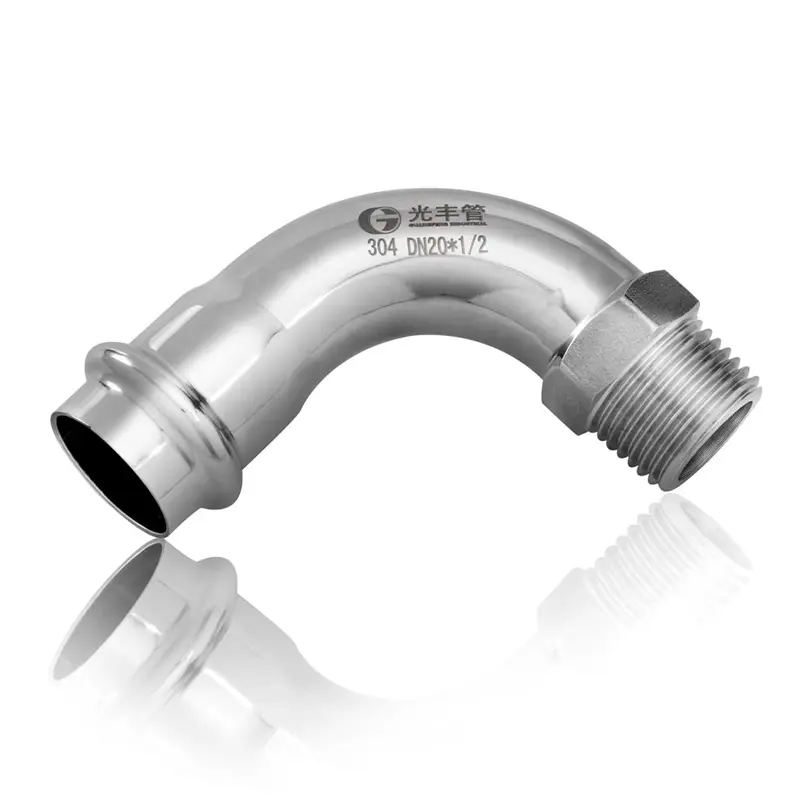
When selecting piping components for residential or commercial systems, one question arises frequently: Can 90 Degree Male Elbow Stainless Steel Double Press Fittings be safely used for both potable water and gas lines? The short answer is yes, but the full explanation requires a closer look at material standards, sealing mechanisms, and application-specific regulations. At Guangfeng, we engineer these components to meet dual-service expectations, provided that installers follow correct procedures and local codes.
Material Compatibility and Safety
The base material is stainless steel, typically SS304 or SS316. For potable water, stainless steel offers excellent corrosion resistance and does not leach harmful chemicals, making it superior to some cheaper alternatives. For natural gas or LPG, stainless steel is non-reactive and impermeable, preventing gas permeation that can occur with rubber or certain polymers. The double press design uses a cold-forming process that creates a permanent, leak-tight mechanical seal. The male elbow configuration allows a threaded connection on one end and a press connection on the other, providing flexibility in hybrid systems.
Performance Comparison: Water vs. Gas
| Feature | Potable Water Systems | Gas Lines (Natural Gas / LPG) |
|---|---|---|
| Pressure rating (typical) | Up to 16 bar (232 psi) | Up to 5 bar (72.5 psi) – gas is lower |
| Temperature range | -20°C to +120°C | -20°C to +60°C (limited by sealing O-ring) |
| Sealing element requirement | WRAS / NSF-61 approved EPDM | Gas-approved HNBR or FKM (yellow or black) |
| Corrosion risk | Low (stainless steel) | Very low |
| Leakage test method | Hydrostatic test | Bubble test or electronic gas detector |
| Code compliance | NSF/ANSI 61, DVGW W270 | EN 1775, CSA B149.1, AS 5601 |
Why the O-Ring Matters More Than the Steel
The 90 Degree Male Elbow Stainless Steel Double Press Fittings rely on an elastomeric O-ring inside the press socket. For water, EPDM is the standard choice. For gas, the O-ring must be different – typically HNBR (Hydrogenated Nitrile Butadiene Rubber) or FKM (Viton), both certified for gas applications. Never use an EPDM-sealed press fitting on a gas line. Guangfeng color-codes its gas fittings (yellow ring for gas, black for water) to prevent cross-application mistakes.
FAQ – Common Questions About 90 Degree Male Elbow Stainless Steel Double Press Fittings
Q1: Can I use the same 90 Degree Male Elbow Stainless Steel Double Press Fittings for both water and gas in the same building?
A1: Physically, the stainless steel body can withstand both fluids. However, legally and safely, the same fitting should not be used for both services unless you replace the O-ring each time, which is not practical. Once a fitting has been pressed onto a water line, the O-ring is compressed and may absorb water or become contaminated. Installing that same fitting on a gas line later risks O-ring degradation and gas leakage. The correct practice is to dedicate fittings per fluid type. Guangfeng recommends separate inventory for water and gas applications to maintain compliance with codes such as the International Fuel Gas Code (IFGC) or local plumbing standards.
Q2: What certifications should I look for on 90 Degree Male Elbow Stainless Steel Double Press Fittings for potable water?
A2: For potable water in North America, look for NSF/ANSI 61 (health effects) and NSF/ANSI 372 (lead-free compliance). In Europe, the key certifications are DVGW W270 (microbiological growth test) and ACS (French sanitation). For the UK, WRAS (Water Regulations Advisory Scheme) approval is mandatory. These certifications confirm that both the stainless steel and the EPDM O-ring do not release heavy metals, endocrine disruptors, or support bacterial growth. Guangfeng provides fittings with NSF-61 and DVGW certification upon request. Always verify the O-ring material data sheet – it must state “Drinking Water Approved” or equivalent.
Q3: How do I test the gas line after installing 90 Degree Male Elbow Stainless Steel Double Press Fittings to ensure no leakage?
A3: After pressing, never use compressed air alone for final gas testing because air is compressible and may give false pressure stability readings. The standard method per NFPA 54 (National Fuel Gas Code) is a tightness test using inert gas (nitrogen) or air with a calibrated manometer at 1.5 times the maximum operating pressure but not less than 3 psi (21 kPa) for 10 minutes, with no pressure drop. For leak location, apply a gas leak detection spray (bubble solution) to every press joint, including the male thread connection. Electronic combustible gas detectors set to the LEL (Lower Explosive Limit) scale are also acceptable. Never use a flame or open fire. Guangfeng recommends a second visual inspection of all press marks – each fitting must show the full hexagonal or circular press indent to confirm complete crimping.
Best Practices for Hybrid Installations
-
Use a dedicated press tool with certified jaws calibrated for double press dimensions.
-
For gas lines, apply thread sealant (gas-rated PTFE tape or paste) on the male NPT or BSPT thread.
-
For potable water, flush the line after installation to remove any manufacturing residues.
Contact Us
Choosing the right fitting for water or gas is critical for safety and longevity. Guangfeng supplies certified 90 Degree Male Elbow Stainless Steel Double Press Fittings with application-specific O-rings and full traceability. Have a project requirement or need technical datasheets? Contact us today for a quote or engineering consultation – our team responds within 24 hours.