
Aluminum Profiles vs Steel: Which Wins for Solar Accessories?
2026-10-10
A solar project engineer is reviewing two bids for a 5 MW rooftop installation. One bid specifies Aluminum Profiles for all mounting rails and clamps. The other specifies hot-dip galvanized steel. The aluminum bid is 18 percent more expensive on material cost. But the steel bid requires additional painting every 5 years and is 2.3 times heavier, which increases the roof load and the installation labor. The engineer must decide which material wins on a total cost of ownership basis. This guide compares aluminum profiles and steel across the criteria that matter most for solar accessories: corrosion resistance, weight, cost, installation, and lifecycle performance.
1. How Does Corrosion Resistance Compare Between Aluminum and Steel?
Corrosion is the primary failure mode for solar mounting accessories. A mounting system that corrodes will lose strength, create electrical grounding issues, and eventually fail. Aluminum Profiles form a natural oxide layer that protects the surface from further oxidation. This oxide layer is stable in most outdoor environments, including coastal areas with high salt spray. Steel, by contrast, requires a protective coating. Hot-dip galvanizing provides a zinc layer that sacrifices itself to protect the steel. The zinc layer corrodes at a rate of 1 to 2 microns per year in moderate environments and 3 to 5 microns per year in coastal environments. The table below shows the corrosion performance of aluminum and galvanized steel in different environments.
| Environment | Aluminum 6063-T6 corrosion rate | Hot-dip galvanized steel corrosion rate | Expected life (aluminum) | Expected life (galvanized steel) |
| Rural inland | Negligible | 1 µm/year | > 30 years | 25 – 30 years |
| Urban industrial | Negligible | 1.5 µm/year | > 30 years | 20 – 25 years |
| Coastal (1 km from sea) | Slight pitting | 3 – 5 µm/year | 20 – 25 years | 10 – 15 years |
| Coastal (100 m from sea) | Moderate pitting | 5 – 8 µm/year | 15 – 20 years | 5 – 8 years |
In coastal environments, aluminum profiles outperform galvanized steel by a factor of 2 to 3 in service life. The aluminum oxide layer is self-healing, while the zinc coating on steel is consumed over time. In our factory, we supply Aluminum Profiles with a 15-micron anodized coating for additional corrosion protection. Ningbo Gangtong Zheli Fasteners Co.,Ltd. has been supplying solar mounting accessories for over 10 years.
2. How Does Weight Affect Installation and Structural Load?
The density of aluminum is 2.70 g/cm³, while the density of steel is 7.85 g/cm³. For the same cross-sectional strength, an aluminum profile weighs 40 to 50 percent less than a steel profile. This weight difference has three practical consequences. First, the roof load is lower, which is critical for retrofitting existing buildings. Second, the installation labor is lower because the profiles are easier to lift and position. Third, the shipping cost is lower because more profiles can be loaded per truck. The table below compares the weight and load for a typical 4-meter mounting rail.
| Parameter | Aluminum profile (6063-T6) | Steel profile (Q235, galvanized) |
| Cross-section (mm) | 40 x 40 x 2.0 | 40 x 40 x 1.5 |
| Weight per meter (kg) | 0.85 | 1.78 |
| Weight per 4-meter rail (kg) | 3.4 | 7.1 |
| Moment of inertia (cm⁴) | 7.2 | 6.8 |
| Roof load for 100 rails (kg) | 340 | 710 |
| Installation labor per rail (minutes) | 4 | 7 |
The aluminum profile weighs 52 percent less than the steel profile with comparable stiffness. For a 5 MW rooftop project with 2,000 rails, the weight saving is 7,400 kg. This reduces the structural load on the building and allows the use of lighter support brackets. The installation labor saving is 6,000 minutes, or 100 hours, which translates to $3,000 to $5,000 in labor cost. In our factory, we extrude Aluminum Profiles to the exact cross-section required for each project, which eliminates unnecessary material and further reduces weight.
3. What Is the Total Cost of Ownership Comparison?
The material cost of aluminum is higher than steel on a per-kilogram basis. Aluminum costs $2.80 to $3.50 per kg, while galvanized steel costs $1.20 to $1.80 per kg. However, the total cost of ownership includes material, installation, maintenance, and replacement. Aluminum requires no painting or maintenance. Galvanized steel requires inspection and touch-up painting every 5 years, and full replacement after 10 to 15 years in coastal environments. The table below shows the 25-year total cost of ownership for a 5 MW project.
| Cost component | Aluminum profiles | Galvanized steel |
| Material cost | $85,000 | $62,000 |
| Installation labor | $12,000 | $18,000 |
| Maintenance (painting every 5 years) | $0 | $15,000 |
| Replacement after 15 years (coastal) | $0 | $62,000 |
| Total 25-year cost | $97,000 | $157,000 |
Project engineer's note: In coastal environments, aluminum profiles have a 25-year total cost of ownership that is 38 percent lower than galvanized steel. The higher upfront material cost is more than offset by the elimination of maintenance and replacement. For inland projects with a 25-year design life, the cost difference is smaller, but aluminum still wins on maintenance and weight.
4. What Are the Design and Installation Differences?
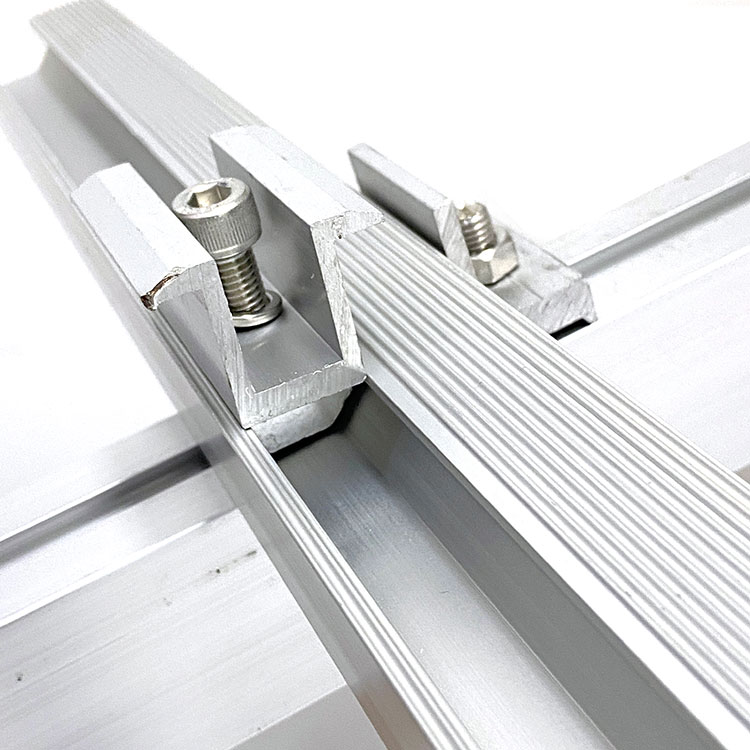
Aluminum profiles are typically extruded with integrated slots and channels that accept solar mounting clamps and bolts directly. This eliminates the need for drilling and welding on site. Steel profiles usually require drilling or welding to attach the clamps, which adds labor and introduces corrosion points at the cut edges. The table below shows the design and installation differences.
| Feature | Aluminum profiles | Steel profiles |
| Attachment method | T-slot with sliding nuts | Drilling or welding |
| On-site cutting | Chop saw with carbide blade | Angle grinder or plasma cutter |
| Corrosion protection after cutting | Not required (oxide layer self-heals) | Required (zinc-rich paint) |
| Grounding path | Integrated (aluminum conducts) | Requires separate grounding conductor |
| Compatibility with roof materials | Excellent (no galvanic corrosion with most roofing) | Requires isolation pads to prevent galvanic corrosion |
In our factory, we supply Aluminum Profiles with T-slots that are compatible with all standard solar mounting clamps. We also supply the sliding nuts and bolts as a complete kit. This reduces the installation time by 30 to 40 percent compared to steel. Ningbo Gangtong Zheli Fasteners Co.,Ltd. provides design support to help project engineers select the correct profile and accessory combination for each project.
Frequently Asked Questions About Aluminum Profiles vs Steel for Solar Accessories
Summary for Solar Project Engineers
Aluminum Profiles and steel both have a place in solar mounting systems. Aluminum wins on corrosion resistance, weight, installation speed, and total cost of ownership in coastal and rooftop applications. Steel wins on upfront material cost for large inland ground-mount projects. The decision should be based on the project location, the design life, and the maintenance strategy. For most rooftop and coastal projects, aluminum profiles are the better choice. For large inland projects with low corrosion risk, steel may be more economical. Ningbo Gangtong Zheli Fasteners Co.,Ltd. has been supplying solar mounting accessories for over 10 years and provides full engineering support for material selection.
Ningbo Gangtong Zheli Fasteners Co.,Ltd. supplies Aluminum Profiles with T-slots, anodized coatings, and complete accessory kits for solar mounting systems. We provide structural calculations, thermal expansion analysis, and lifecycle cost comparisons for our customers.